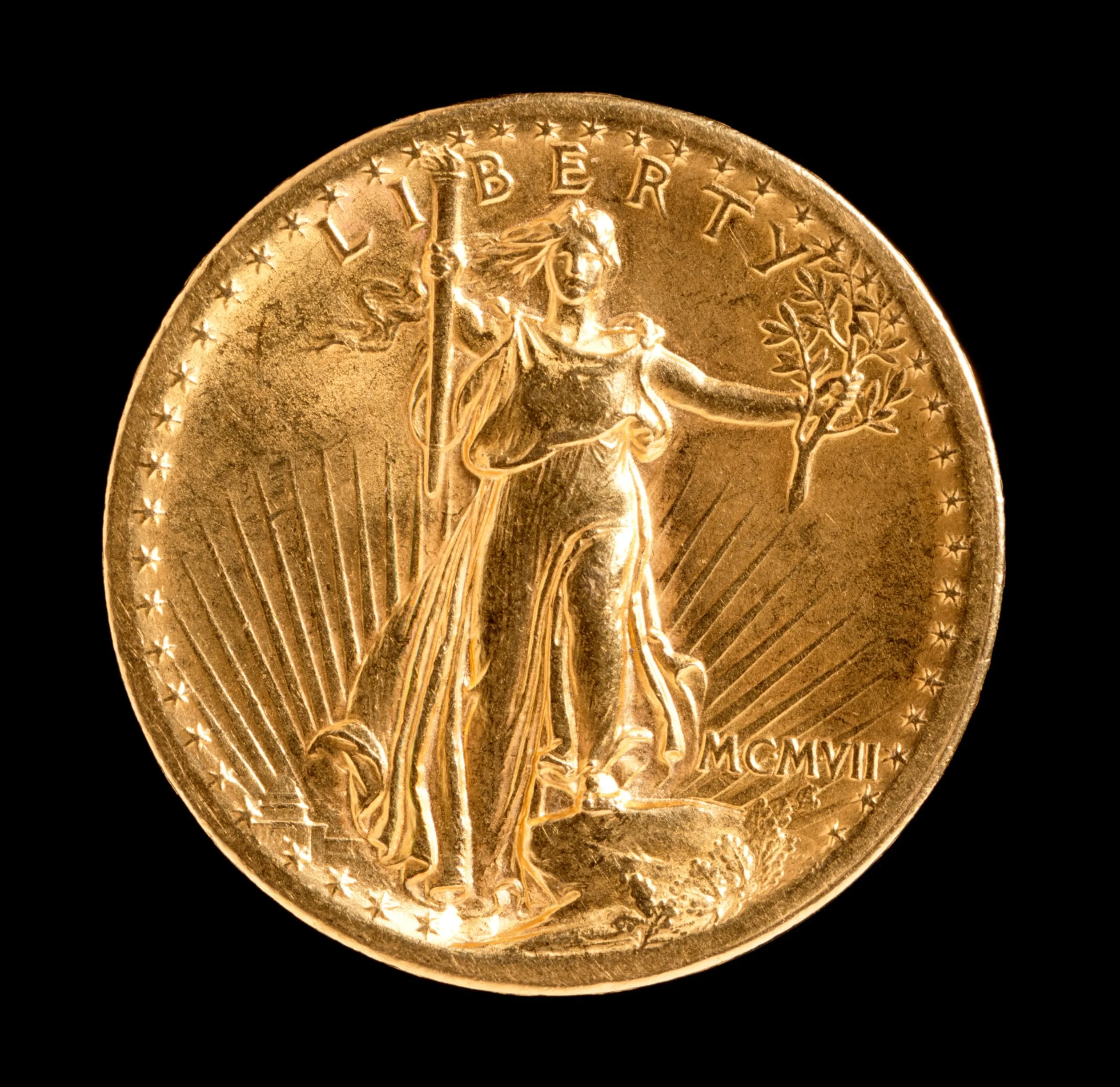
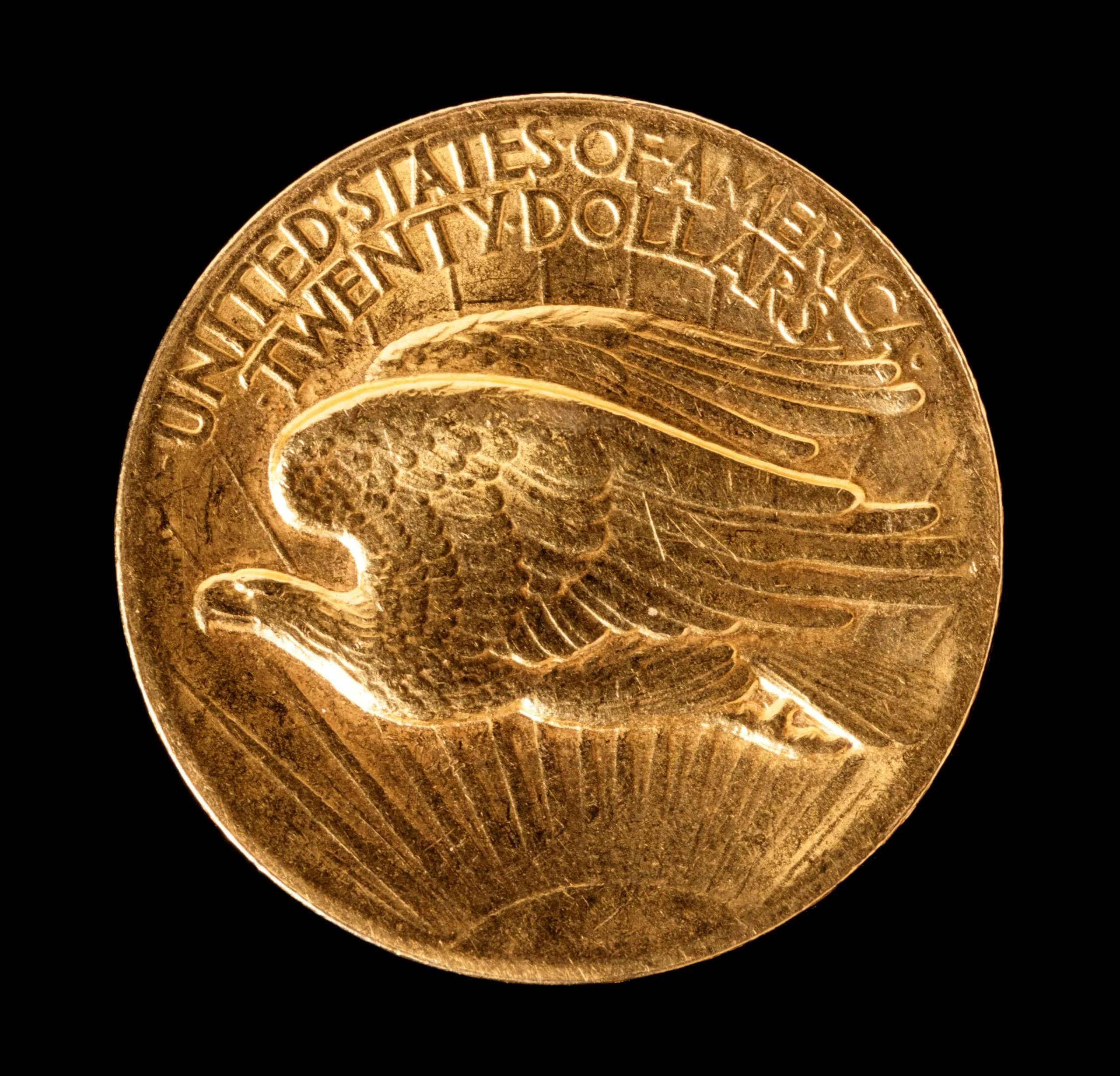
In 1905, soon after they met, President Theodore Roosevelt commissioned Saint-Gaudens to redesign the ten-dollar, twenty-dollar, and one-cent coins. They agreed that ancient Greek coins, as the most artistic ever made, should serve as the standard for the new American ones. It was the president’s suggestion that Saint-Gaudens should adopt in his designs the exceptionally high relief and raised rims of the ancient models. He corresponded with the sculptor frequently during the fall of that year to review design details. The design for the twenty-dollar gold piece was revised three times. Although the position of the eagle on the reverse changed from standing to flying, the obverse remained close to Saint-Gaudens’s original concept of a figure "striding forward as if on a mountaintop," a "living thing and typical of progress."
Differences of opinion with the mint officials regarding the practicality of the high relief delayed the minting until after the sculptor’s death. At the president’s insistence a small number of experimental, extra-high-relief versions of the twenty-dollar coin were struck, and then an edition of high-relief coins was minted. Because these high-relief coins had to be struck on a medal press, rather than a regular coin press, and because they would not stack, Charles E. Barber (1842-1917), the mint engraver, then modeled a coin in flat relief and changed the date from Roman numerals to the Arabic 1907. The museum’s coin is part of the regular issue in high relief, put into circulation in December 1907, before the Barber-modified final issue.
Saint-Gaudens’s ten- and twenty-dollar coins generally have been considered the most artistic ever produced in the United States. President Roosevelt felt the issuance of these coins to have been one of the important accomplishments of his term in office.