- Title
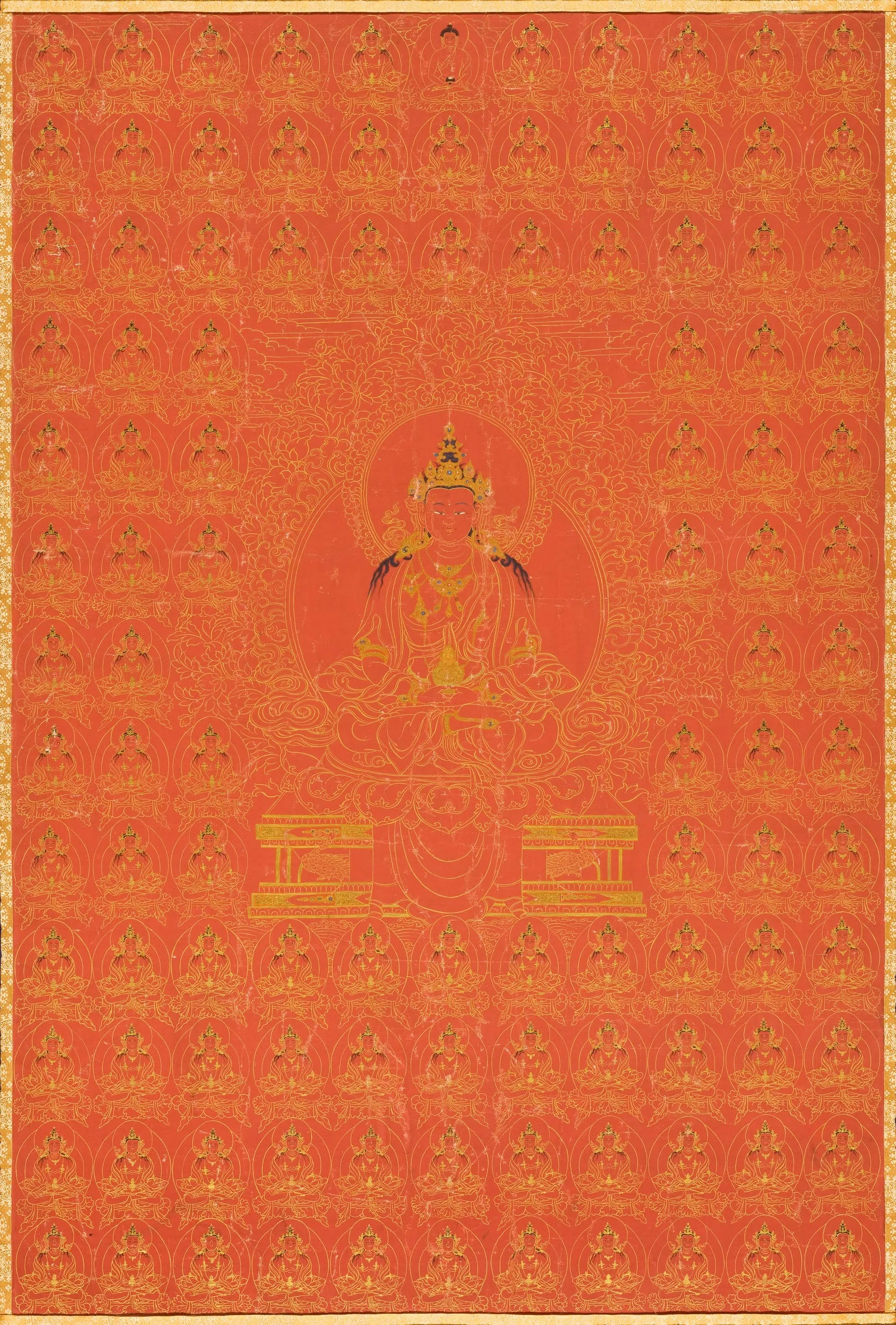
- Myriad Amitayus, the Buddha of Eternal Life
- Date Made
- circa 1800
- Medium
- Mineral pigments and gold on cotton cloth
- Dimensions
- 32 1/4 x 22 in. (81.9 x 55.88 cm)
- Accession Number
- M.83.253
- Curatorial Notes
The subject of this red-field painting is Amitayus, the Buddha of Eternal Life, whose symbolic color is red. Amitayus is a form of Amitabha, the Buddha of Infinite Light, who is the transcendental Buddha of discriminating wisdom. Amitayus is also widely worshipped throughout Asia as the Buddha presiding over the Sukhavati (Pure Land of Bliss) Paradise in the West, where Buddhists can be reborn endlessly while they wait to attain enlightenment. Emblematic of his role in this regard, Amitayus is seated on a lotus throne with his hands in the gesture of meditation (dhyana mudra) and holding a golden vase (tshe-bum) containing the elixir of immortality. Amitayus’ mounts, two peacocks, are represented on the base of the throne. The subsidiary figures symbolizing infinity all depict Amitayus, except for the top central image of the historical Buddha Shakyamuni. It was believed that the more images donated, the greater the accumulated merit.
This type of Tibetan painting (thangka) in which the figures are rendered in a linear technique drawn in gold against a red or black background is known in Tibetan as gser thang (a thangka in which the color gold predominates). See also M.84.224.1 and AC1993.190.1.
- Selected Bibliography
- Pal, Pratapaditya. Art of Tibet. Expanded edition. Los Angeles: Los Angeles County Museum of Art, 1990.
- Little, Stephen, Tushara Bindu Gude, Karina Romero Blanco, Silvia Seligson, Marco Antonio Karam. Las Huellas de Buda. Ciudad de México : Instituto Nacional de Antropología e Historia, 2018.
- Little, Stephen, and Tushara Bindu Gude. Realms of the Dharma: Buddhist Art across Asia. Los Angeles: Los Angeles County Museum of Art, 2025.