LACMA

ShopMembershipMyLACMATickets
LACMA
Los Angeles County Museum of Art
5905 Wilshire Blvd.
Los Angeles, CA 90036
info@lacma.org
(323) 857-6000
Sign up to receive emails
Subscribe
© Museum Associates 2025

Museum Hours

Monday

11 am–6 pm

Tuesday

11 am–6 pm

Wednesday

Closed

Thursday

11 am–6 pm

Friday

11 am–8 pm

Saturday

10 am–7 pm

Sunday

10 am–7 pm


  • About LACMA
  • Jobs
  • Building LACMA
  • Host An Event
  • Unframed
  • Press
  • FAQs
  • Log in to MyLACMA
  • Privacy Policy
© Museum Associates 2025
Collections

Unknown
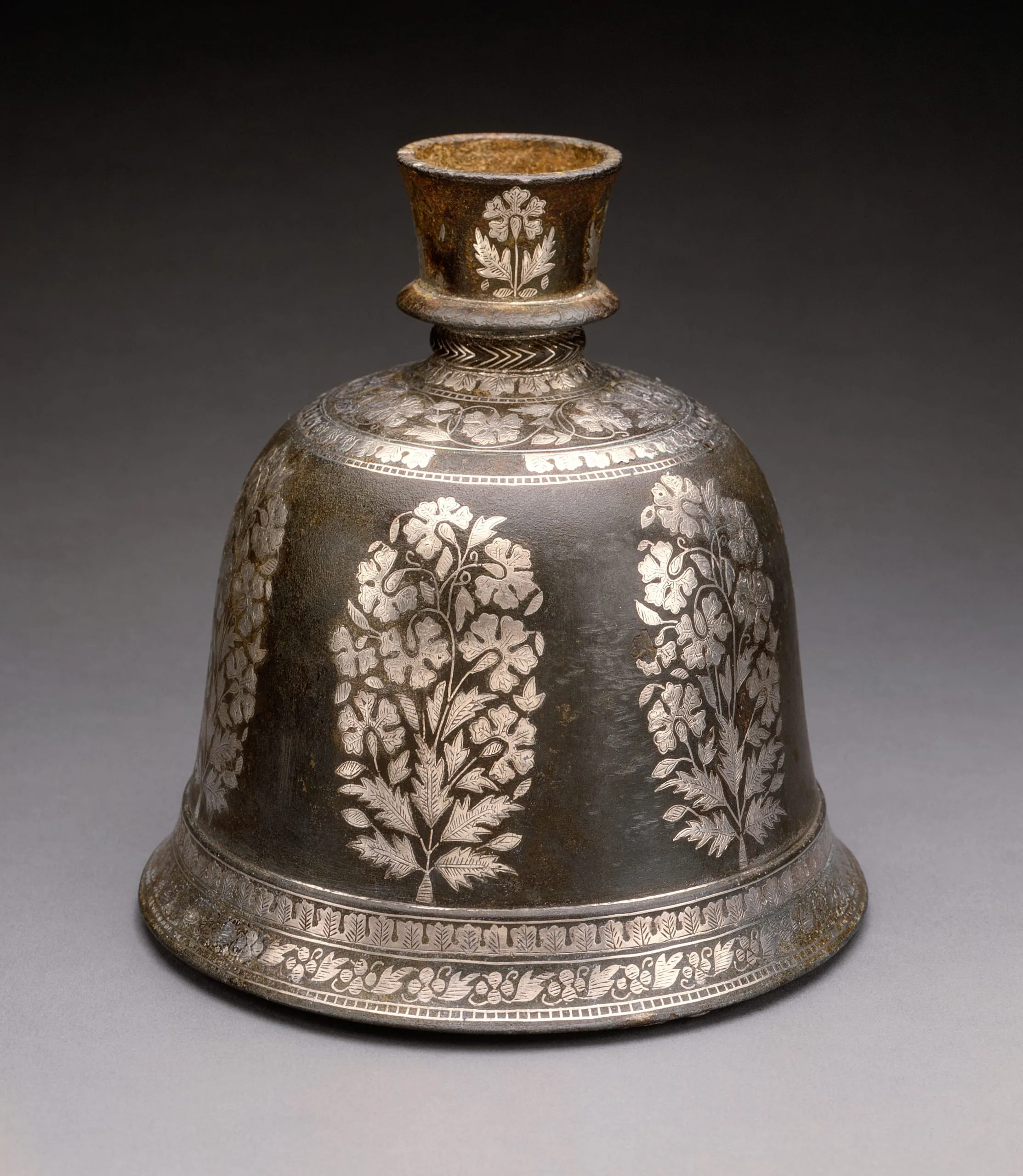
Hookah Basecirca 1750-1800

Not on view
Dark steel or iron bell-shaped vessel with a small flared neck, densely covered in bright silver-inlaid flowering plant motifs and geometric border bands
Artist or Maker
Unknown
Title
Hookah Base
Place Made
India, Telangana, Hyderabad or Karnataka, Bidar
Date Made
circa 1750-1800
Medium
Bidri ware (tarkashi and tehnishan techniques)
Dimensions
6 1/2 x 6 1/4 in. (16.5 x 15.88 cm)
Credit Line
Gift of Dr. and Mrs. Pratapaditya Pal
Accession Number
M.89.131.4
Classification
Tools and Equipment
Collecting Area
South and Southeast Asian Art
Curatorial Notes

This flat-bottomed hookah base is embellished with inlaid silver sheet and silver wire (tehnishan and tarkashi techniques, respectively). The primary decoration on the vessel sides and in an arcade on the neck is the Mughal dynastic leitmotif of stylized poppy plants (Papaver somniferum), which may suggest that the vessel was commissioned or intended for the Mughal market. The supplementary decoration consists of alternating bands of vegetal and geometric motifs. Chevrons encircle the neck on a ring molding below the larger projecting molding used for grasping or carrying the vessel. There are three bands of crenulation-like foliage, an elegant scrolling poppy vine on the shoulder, and a simplified scroll of stylized flowers and leaves on the base.

Flat-bottomed hookah bases presumably made of the zinc-based alloy known as bidri ware, or alternatively perhaps made of brass with a lac ground, are documented in Indian painting by the late 17th century. Prior to their development, hookah bases were generally spherical and needed support rings to keep them upright. By the middle of the 18th century, they had become exceedingly common in painting and extant examples.
Selected Bibliography
  • Sanfrani, Shehbaz H., ed. Golconda and Hyderabad. Bombay: Marg Publications, 1992.