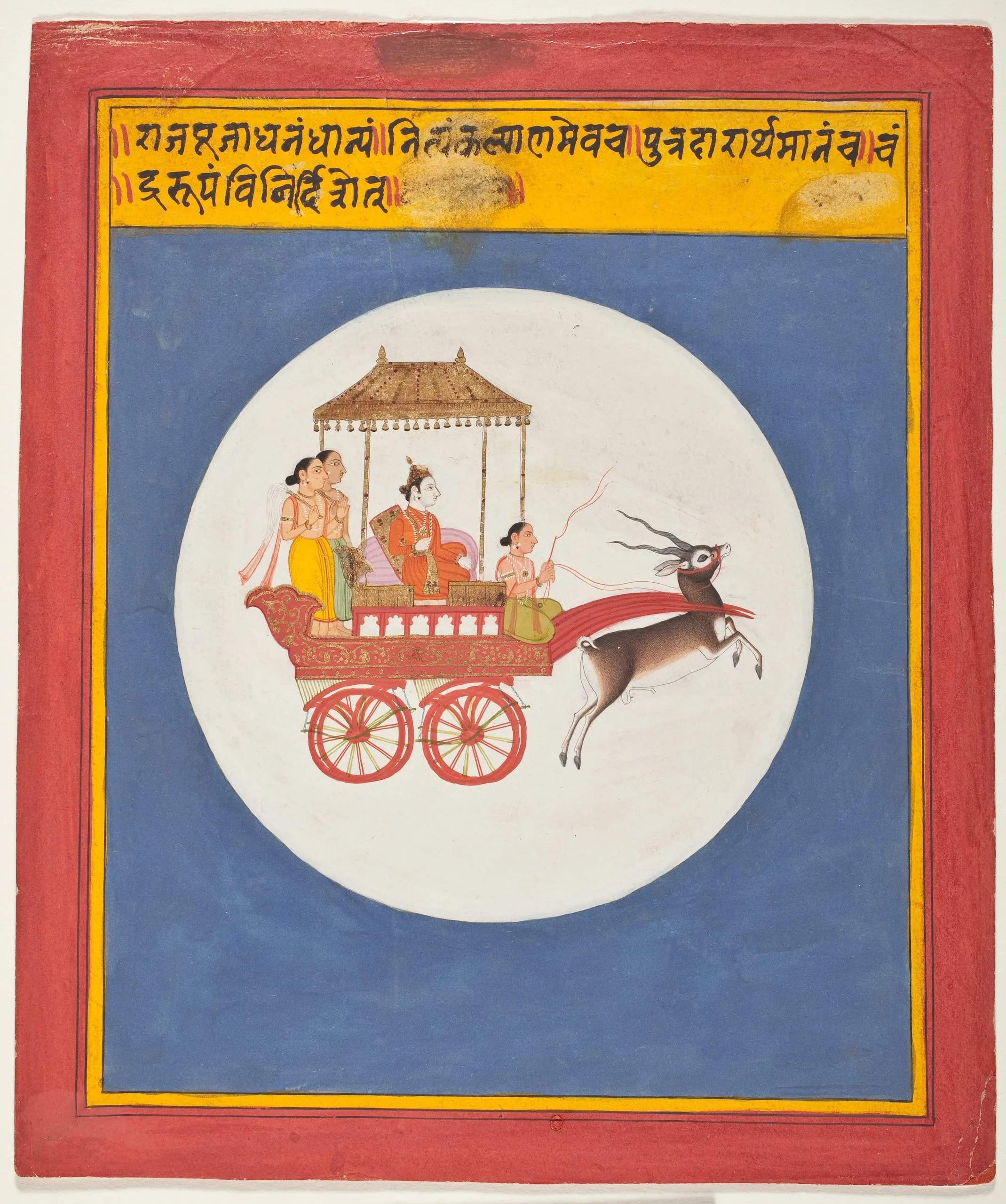
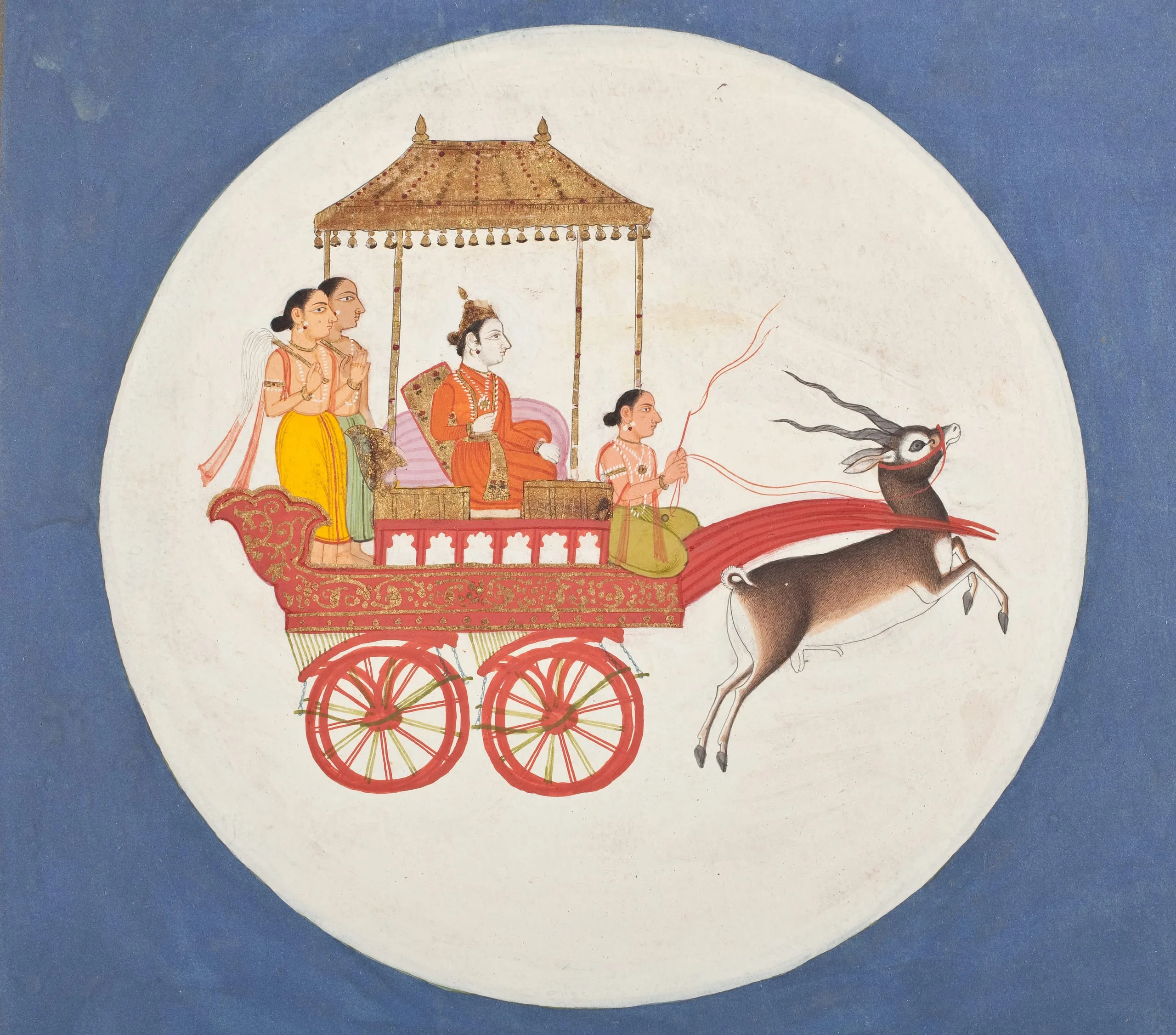
Chandra, the Moon God, is among the most ancient of Indian deities. He is the celestial regent of Monday (somvar) and a guardian of the direction (dikpala) of the North. In the Vedic and epic literature, the Moon God is primarily referred to by the name Soma, while in the Puranas the name Chandra is given prominence. The full moon is believed to be beneficial, but the new moon is considered maleficent.
This folio is from a Shakunavali (Book of Dreams and Omens). It was presumably based on the Svapna-Darshana (Dream Visions) or Svapna-Phala (Dream Fruits), which are texts dealing with the interpretation of dreams and omens by astrologers for divination purposes.
The Sanskrit verse in the header reads, “One should view the form of the moon, which is always beautiful and conductive to the daily welfare, wives, and children, and increase of grain, wealth, prestige, and royal patronage.”
In front of a full moon that functions as his nimbus, the crowned Chandra rides in a chariot drawn by his iconographic attribute of an antelope. He is accompanied by a charioteer and two attendants bearing honorific fly whisks made from the white tail-hairs of a yak (cauri or chowri).
Additional folios from this dispersed series are in the Bharat Kala Bhavan, Varanasi; National Museum of Asian Art, Washington (S2018.1.26); Rijksmuseum, Amsterdam (RP-T-1993-489); San Diego Museum of Art (1990.621); Chirimar Collection; and Kanoria Collection, Patna.
See also M.69.13.6, M.83.1.9, and M.79.191.8.