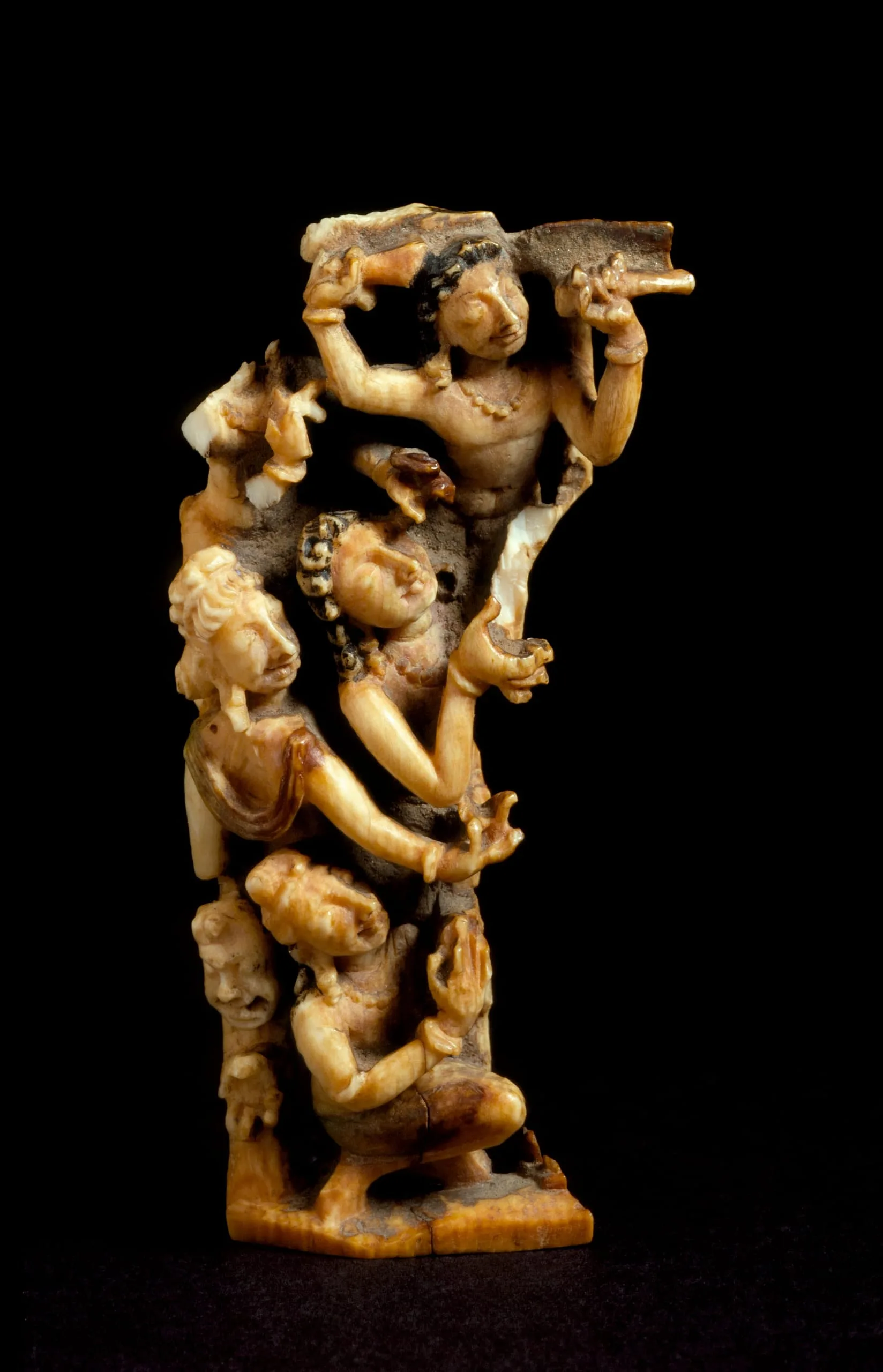
This fragment of figures from an openwork ivory panel may have originally been part of a Kashmiri Buddhist shrine depicting the Temptation of the Buddha by the demonic forces of Mara, the god of desire. Additional life scenes of the Buddha also served as the principal subject of such Kashmiri ivory shrines, which were typically triptychs in composition with flanking divinities or attendants. The ivory shrines were often encased in an architectural frame made of deodar wood.
The LACMA example has five complete figures and one unidentifiable fragmentary figure in the upper left corner. Traces of paint decorate the surface, and some examples have gilding. The two figures in the upper right and middle right with long black curly hair are celestials honoring the auspicious event. The two figures in the middle left and lower right with earrings and their hair in a bun are likely Regents of the Directions (Lokapalas). The middle left figure has his back partially turned to the viewer. He wears a scarf (dupatta) over shoulders. The lower right figure is squatting and holds his hands in the gesture of adoration (anjali mudra). The figure in the lower left is the head of a snarling demon with his hand reaching out.
Comparable Kashmiri ivory panels and figures are in the Asia Society Museum, New York (1979.42), British Museum, London (1968,0521.1), Cleveland Museum of Art (1971.18, 1972.35.1-.2, and 1986.70), Chhatrapati Shivaji Maharaj Vastu Sangrahalaya, Mumbai (58.42), Metropolitan Museum of Art, New York (1979.287 and 1988.148.1), Museum of Fine Arts, Boston (63.14,95), Victoria and Albert Museum, London (IS.8–1978), and Kanoria Collection, Patna.
See Stanislaw Czuma, "A Unique Addition to the School of Kashmiri Ivories," Bulletin of the Cleveland Museum of Art 75:8 (October 1988), pp. 298-319.