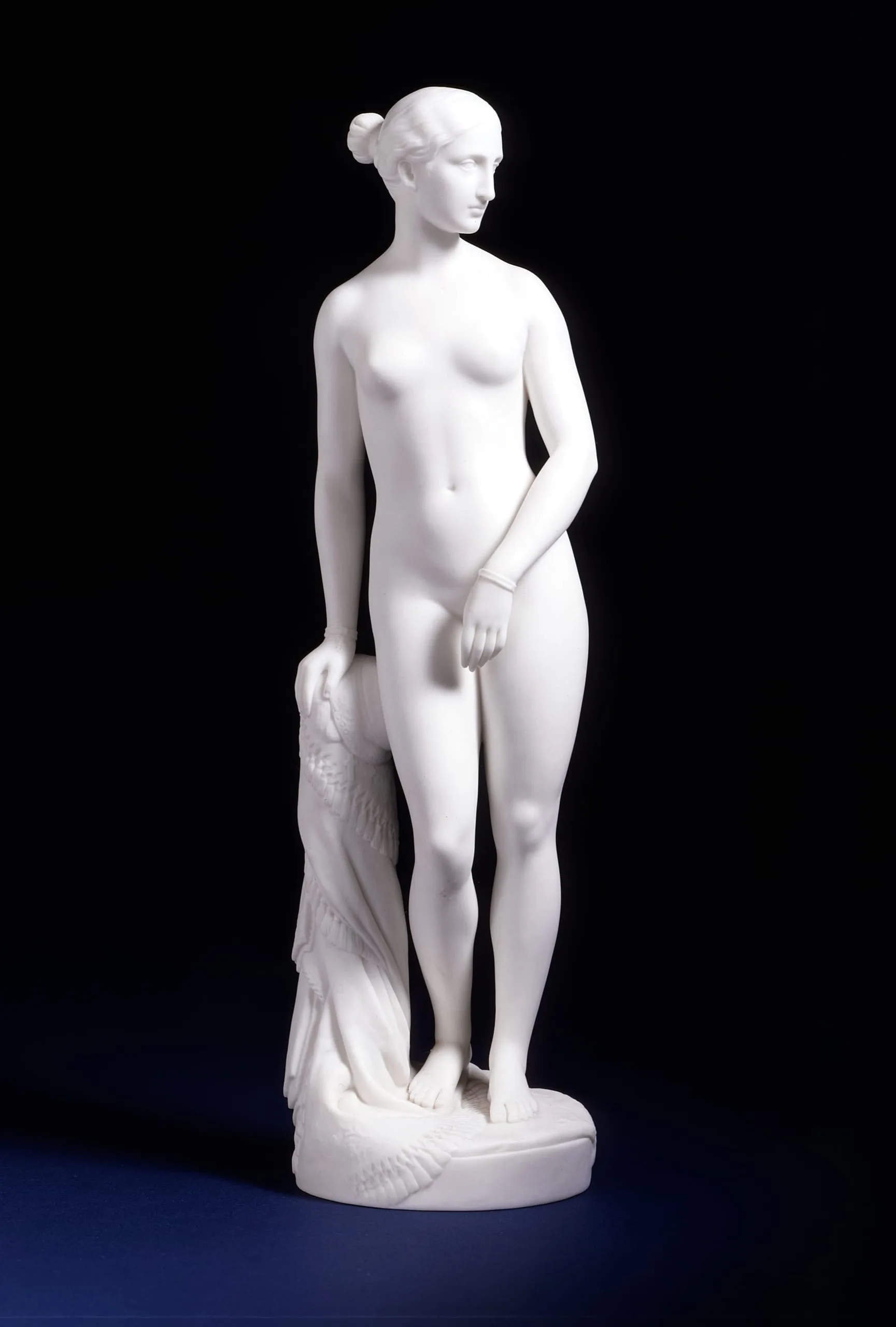
This statuette is a Minton and Co. reproduction of Hiram Powers’s sculpture The Greek Slave. Powers completed the first marble version in 1844 before producing five additional full-scale copies. The plinth of this statuette bears a molded mark and date, “Minton & Co Augt 1848,” indicating the date Minton first began manufacturing copies. Under its base is incised pattern number 207, well documented in the Minton pattern book, as well as the mark of the “repairer,” the skilled craftsperson who assembled figures from their molded parts, dating this specific copy to April of 1851. Although Minton also reproduced the chains linking the figure’s wrists, this fragile element is almost always missing in surviving examples.
Parian porcelain is a highly vitrified form of bisque porcelain with a hard-fired feldspathic body. Developed in the 1840s by several manufacturers, including Minton and Copeland, Parian quickly outmoded bisque because of its creamier color and resistance to stains. Parian was named after a type of Greek marble primarily used for sculpting figures, particularly scaled-down versions of existing sculptures. Factories in both England and the United States produced Parian figures of all types and quality. Works by Minton and Copeland are still considered to be the finest made.
The original Greek Slave was one of the most popular sculptures of the nineteenth century. Representing a Greek Christian maiden about to be sold by the infidel Turks, it was America’s first view of a nude female sculpture. Powers envisioned her not only as an ideal female figure but also as a political symbol appealing to both the abolition movement in the United States and the Greek struggle for independence. The original sculpture toured America from 1847 to 1849 and was seen by more people than any other work of art at that time. It was exhibited in London at the Great Exhibition in 1851, by which time it had already been reproduced in Parian.
Rosie Mills
Edited by Cynthia Kok, 2025