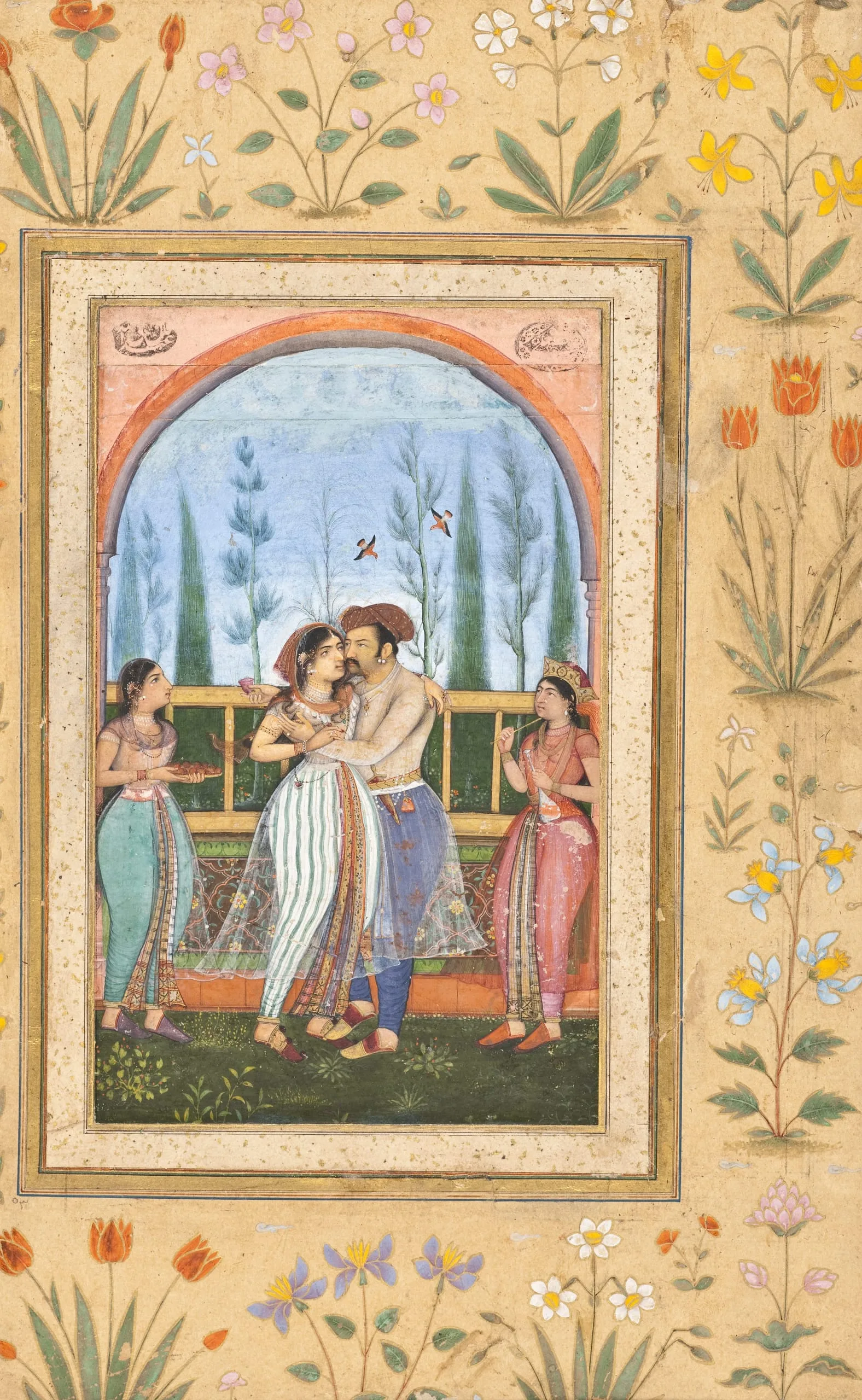
Most Mughal painting specialists concur that this is a portrait of Emperor Jahangir (r. 1605-1627). His likeness is close to other known images, and he wears a pierced earring with two pearls indicating he may be an ‘ear-bored slave’ or follower of the Sufi saint Khwaja Muin al-Din Chishti. Jahangir had both ears pierced and started wearing pearl earrings in August 1614 after crediting the saint with his recovery from a severe illness. The emperor is holding a cup of wine, of which he is known to have been particularly fond and typically had laced with opium. Jahangir is embracing and staring intently into the eyes of an elegant woman, who is presumably his beloved wife, Nur Jahan (1577-1645), although a few scholars question her identification. Jahangir and Nur Jahan married in 1611 when she was a widowed handmaiden. She was a dynamic empress who managed the affairs of state when her husband was incapacitated and was particularly influential on religious policy and trade matters, artistic and architectural development, and gardening. (A related portrait of Nur Jahan, Jahangir, and Prince Khurram (the future Emperor Shah Jahan) enjoying a garden feast, attributed to circa 1640-1650, is in the Freer Gallery of Art, Washington, F1907.258).
The two seal stamps in the spandrels read Abdullah (left) and Hasan Ali (right), who were likely later owners. (Translations by B. N. Goswamy and Robert Skelton.) The painting may have been remounted in Shah Jahan-period floral borders.