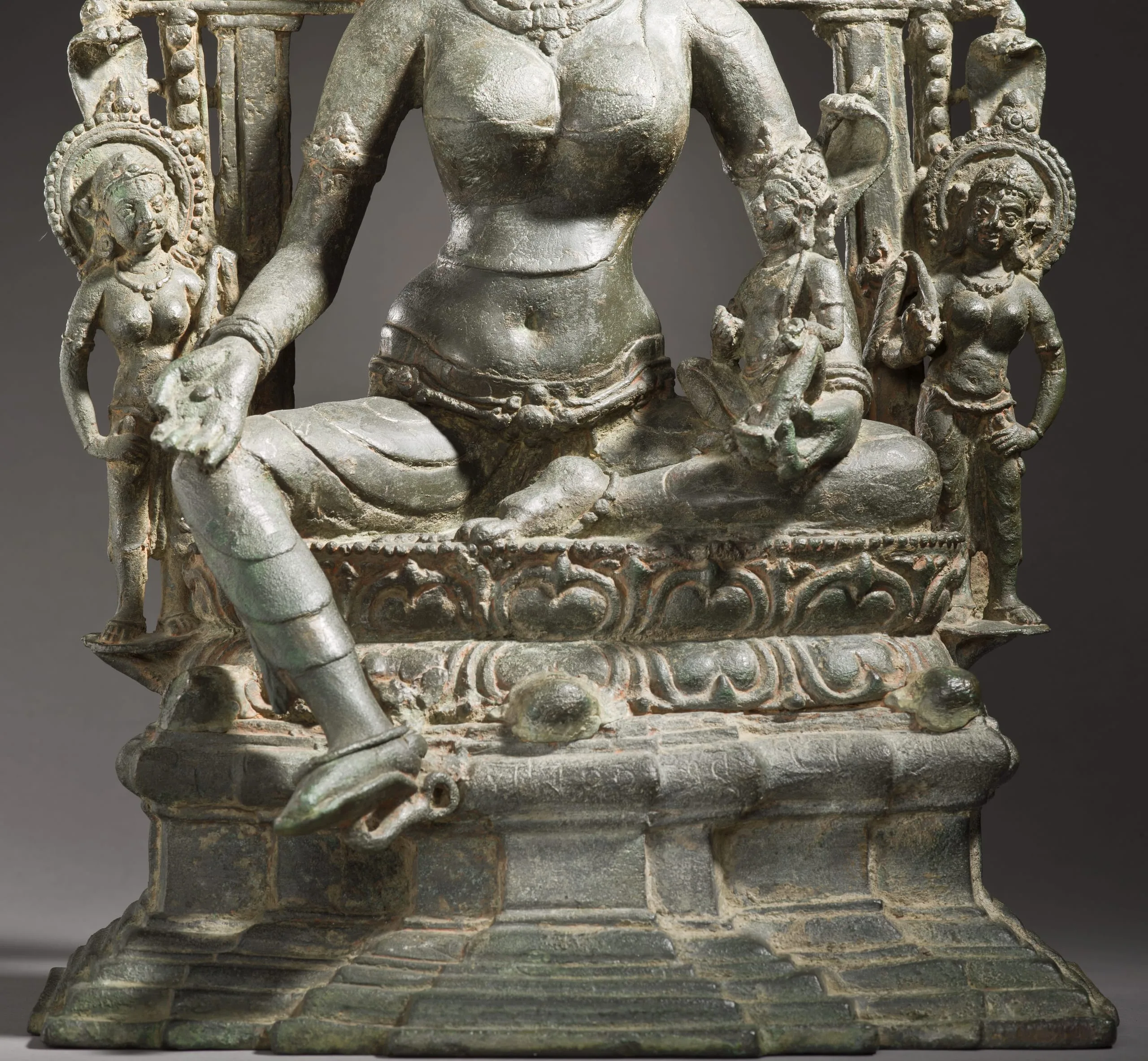
Manasa is the Hindu goddess of serpents. She is worshipped primarily in eastern and northeastern India for the prevention and cure of snakebites. In this role, the goddess is also known as Vishahari (the destroyer of poison) and Vishadhari (the controller of poison). In another important role, she is also venerated as a fertility goddess generally called Manasa Devi. Manasa is married to the sage Jaratkaru. Their son is the sage Astika. Manasa has various origin stories. In one myth, her father is the great god Shiva, whose semen fell into a lotus and traveled through its roots into the nether region of Patala where it engendered a beautiful girl. Her stepmother is Chandi, who hated and rejected her. In another myth, Manasa is the daughter of the Vedic sage Kashyapa and Kadru, the mother of all snakes, and she is the sister of the great serpent Ananta or Shesha. Manasa is believed to be benevolent to her devotees and protects them from snakes, but she is malevolent towards her non-worshippers and inflicts them with snakebite and, thereby, death.
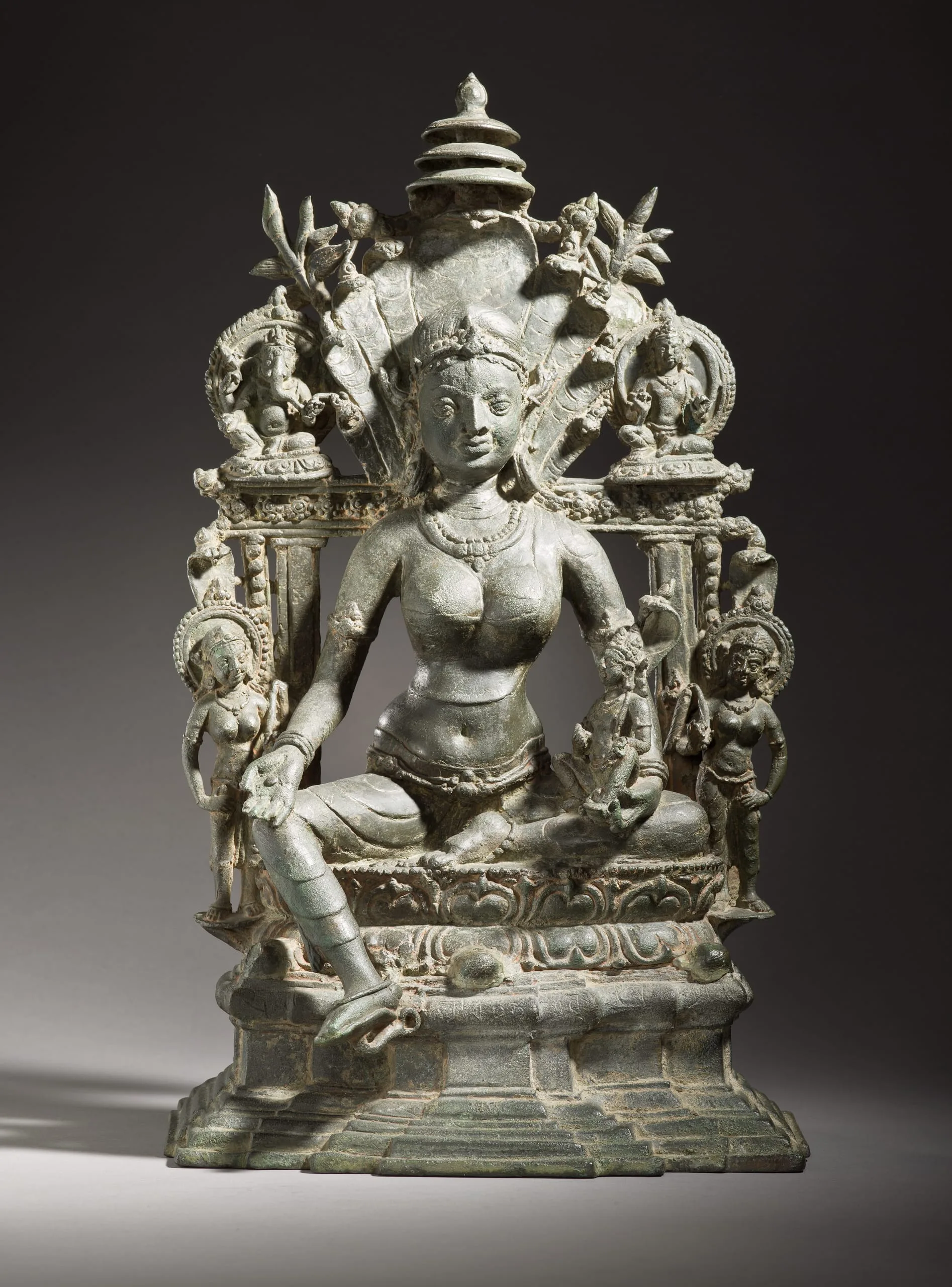
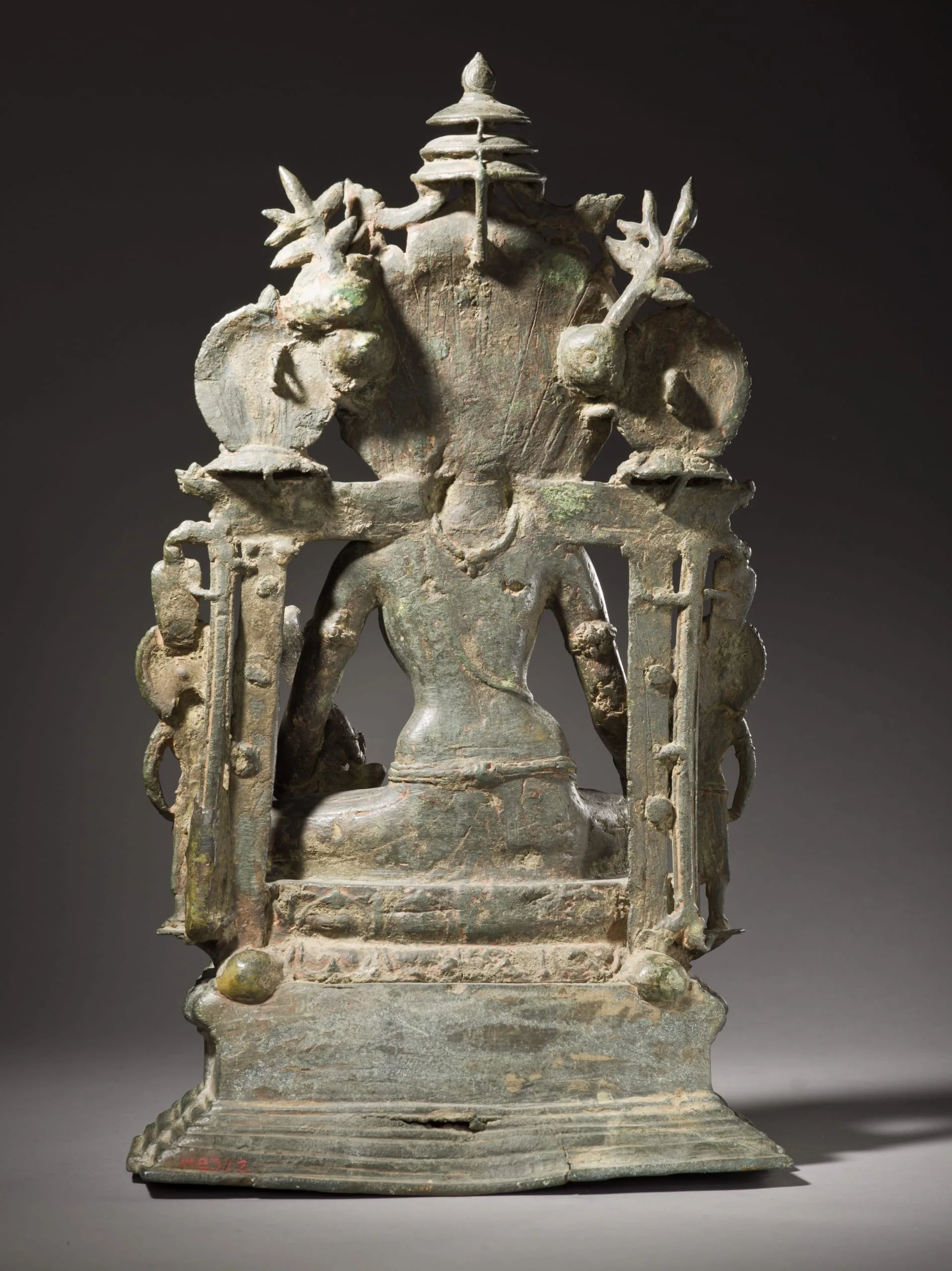
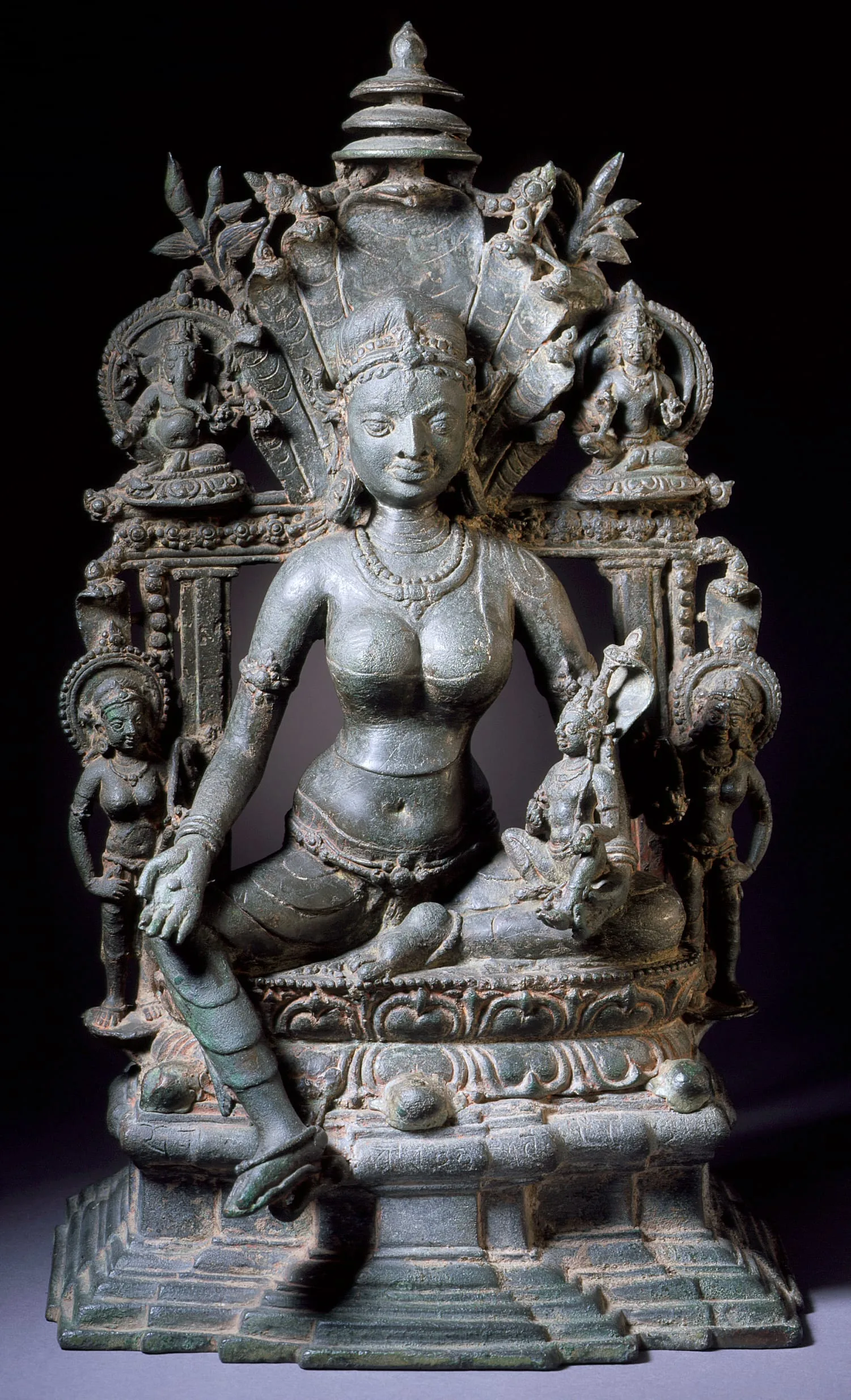
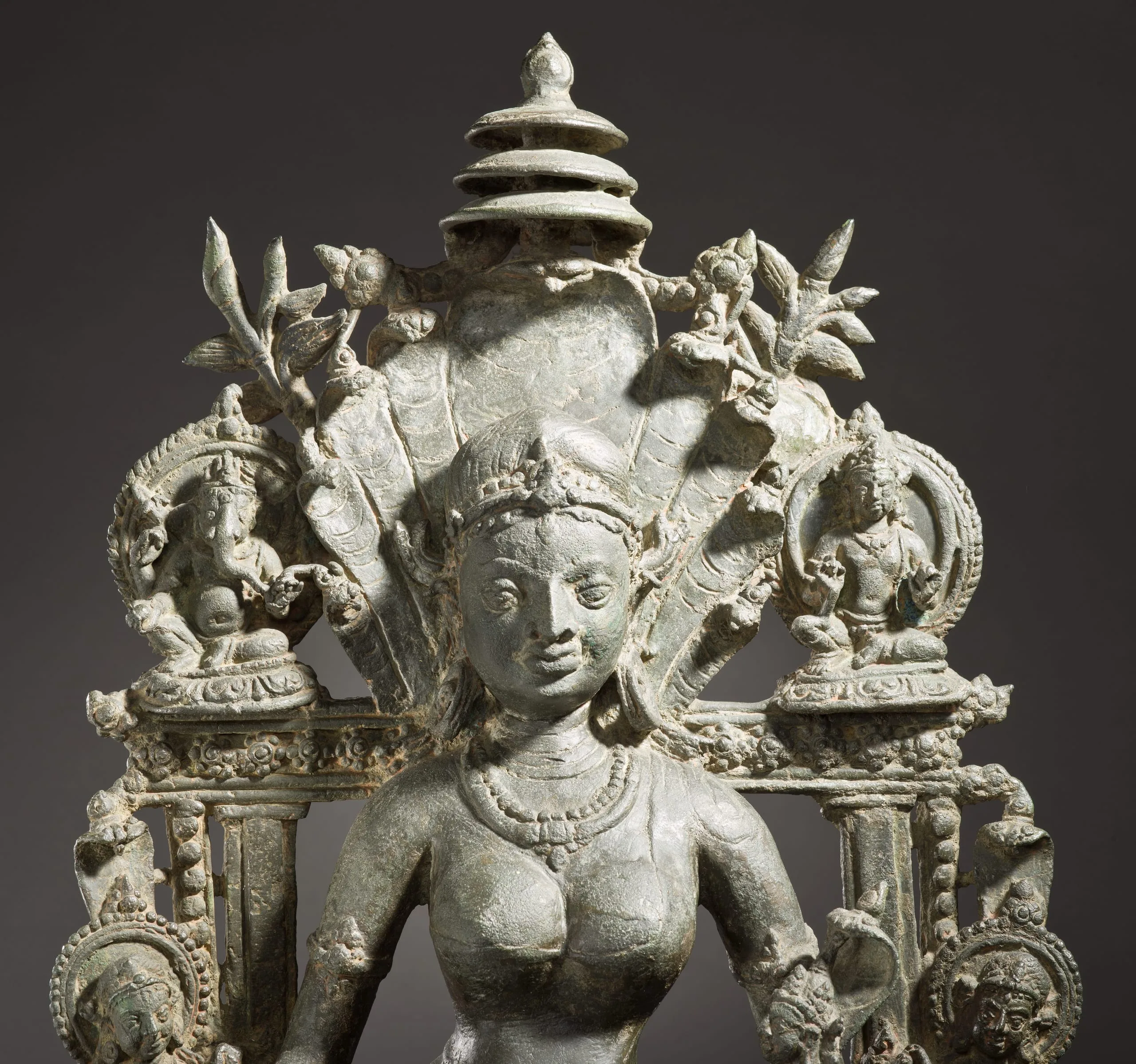
In this large bronze representation, Manasa is enthroned on a lotus base on a tiered pedestal with a faint inscription reading, devi [xx]sa, which likely identified the goddess as Devi Manasa. (Translation by Pratapaditya Pal.) The goddess is crowned, shaded by a seven-headed cobra hood, and sits under an honorific parasol (chattra). She is seated in the relaxed posture (lalita asana) with her right leg pendant and supported by the pericarp of a lotus flower (karnika). Her right hand displays the gesture of charity (varada mudra) and is graced in the open palm with a raised circular sacred marking (lakshana). Her left hand supports her son who likewise has a snake canopy. She is flanked by two standing female attendants who also have snake canopies. The throneback is adorned with two subsidiary images at her shoulder level. On the left, the elephant-headed Ganesha with four arms sits while eating sweetmeats (ladhus) with his trunk. On the right, is a seated figure who has been identified as Yayu, the Wind God, with a billowing scarf around his shoulders (Pal 1988, p. 172, no. 77). More likely, though, he probably represents Yama, the God of Death, with a large noose used to capture souls. In a comparable bronze sculpture of Manasa, attributed to Bihar, 10th century, now in the Linden Museum, Stuttgart, this corresponding figure with a analogous noose can be conclusively identified as Yama based on his buffalo (mahisha) mount named Ugra. Theologically, given his function as the God of Death, Yama is also a more suitable affiliated deity than Vayu. Similarly, the pairing of Ganesha and Yama is theologically appropriate and all-encompassing given the former’s protective role and the latter’s menacing role.
Additional comparable images of Manasa are in the British Museum, London (1969,0115.1) and Metropolitan Museum of Art, New York (2011.499).