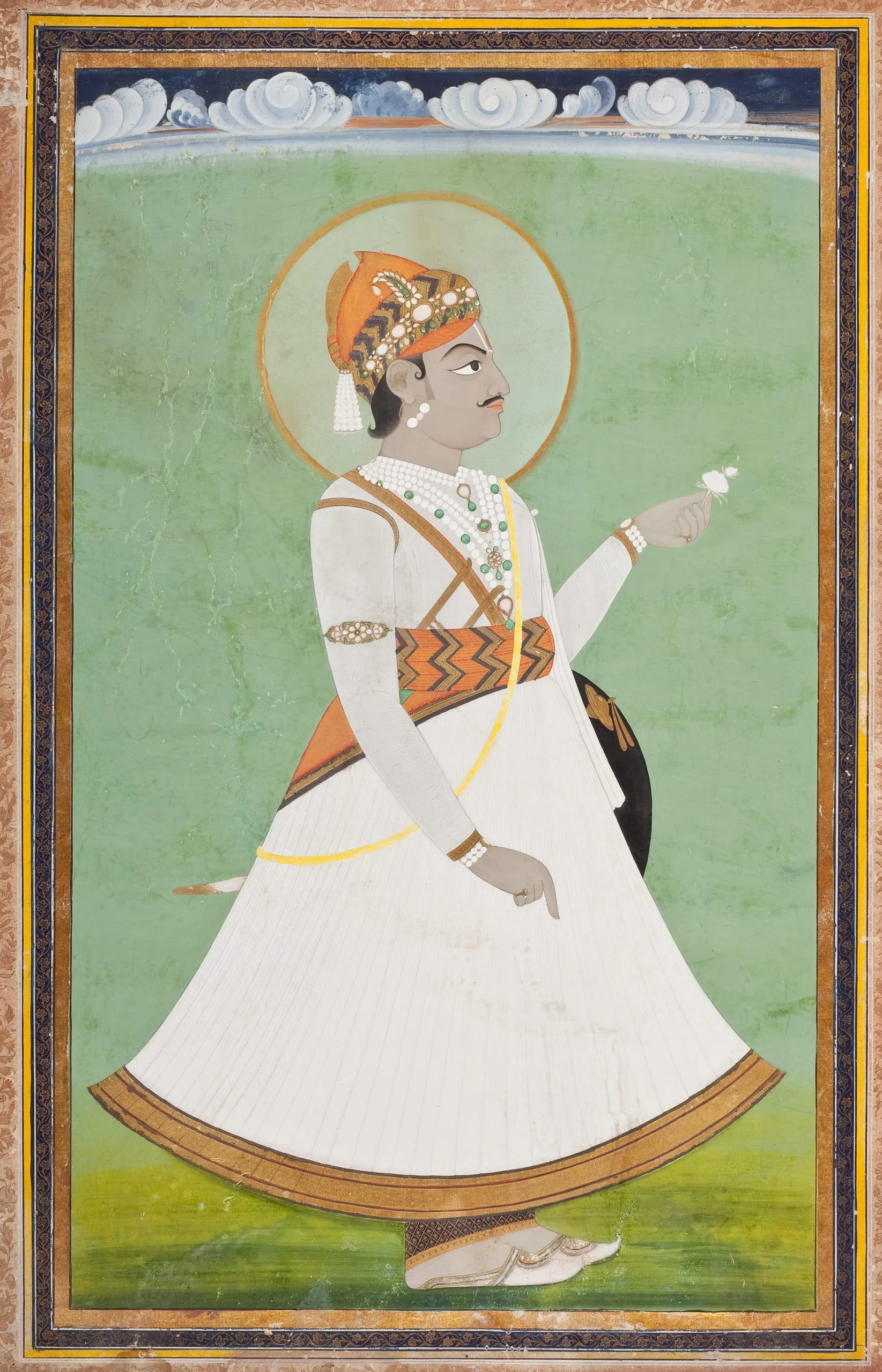
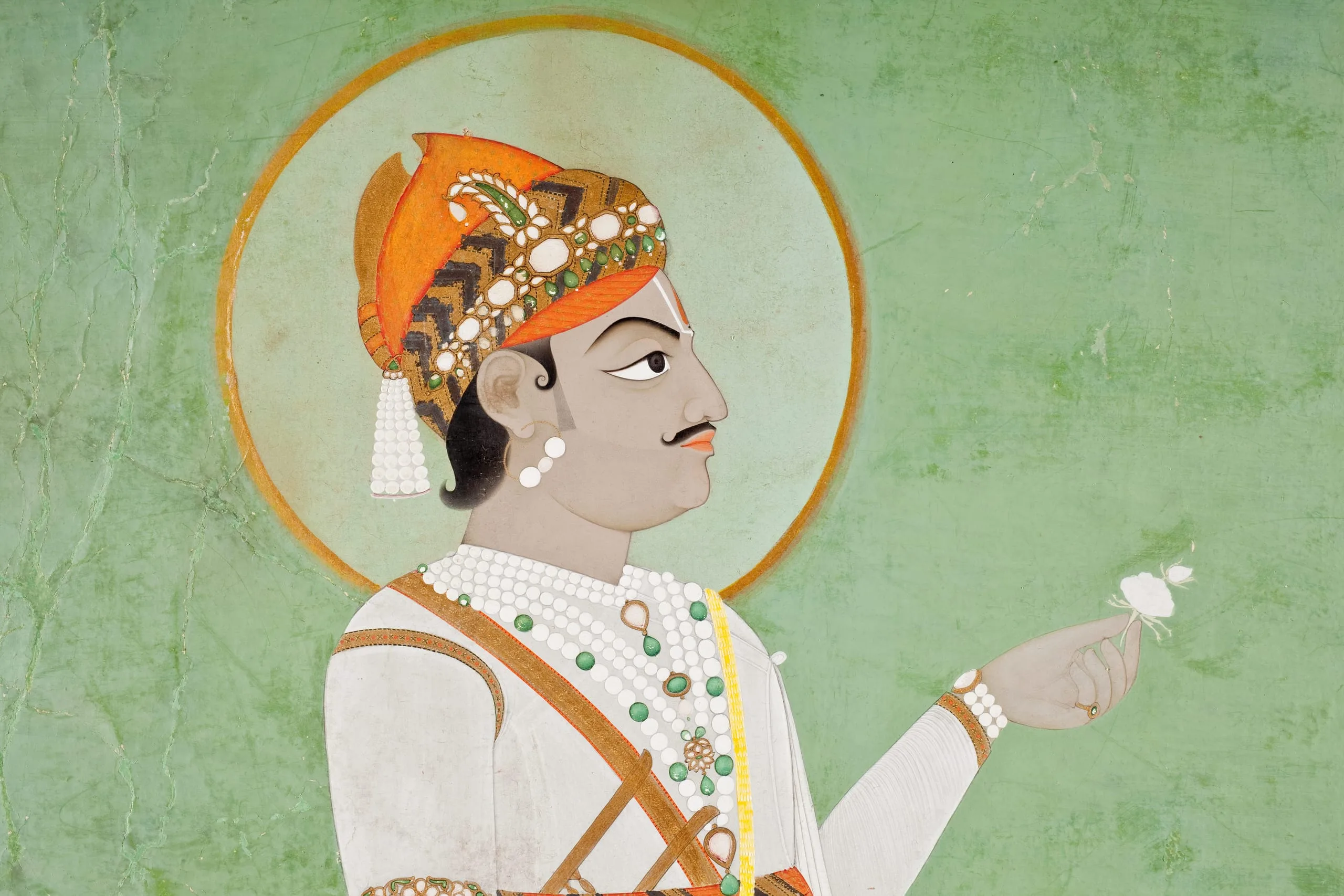
Maharaja Pratap Singh of Jaipur (r. 1778-1803) was born in 1764 and died in 1803. Jaipur was founded in 1727 by Maharaja Sawai Jai Singh II (r. 1699-1743). Previously, the dynasty of Kachwaha Rajputs had ruled from the nearby Amber Fort, which had been established in 1128. In 1562, Raja Bharmal (r. 1498-1574) accepted Mughal suzerainty under Emperor Akbar (r. 1556-1605) and entered into a strong military and matrimonial alliance. As the Mughal Empire declined in the 18th century, Jaipur was weakened by internal and external conflicts. By the reign of Pratap Singh, the Marathas of the Deccan had invaded much of Rajasthan and were exacting tribute from the princely kingdoms. In 1787, Pratap Singh joined a Rajput confederacy to defeat the Marathas led by Maharaja Mahadaji Shinde (or Mahadi Sindhia, r. 1768-1794). Pratap Singh was a great patron of the arts, as well as a composer, musician, and poet under the pen name of Brijnidhi. In 1799, Pratap Singh commissioned and had built the renowned Hawa Mahal (Palace of the Winds), which was designed by Lal Chand Ustad. This portrait of Pratap Singh by the leading Jaipur artist Sahib Ram (active circa 1750-1820) has a devanagari inscription on the top border identifying the subject as “Sawai Pratap Singhji.” He carries a white rose as a symbol of cultural refinement. Comparable portraits of Pratap Singh are in the Victoria and Albert Museum, London (IS.223-1952) and British Museum, London (1920,0917,0.238).