The Bhagavata Purana (Ancient Stories of the Lord) is traditionally ascribed to the legendary poet-sage Vyasa in the 8th-10th century CE. It stresses the path of devotion (bhakti) to Krishna, the eighth incarnation of Vishnu, the Hindu God of Preservation. To fulfill his role as the guardian of the world and savior of humanity, Vishnu appears as a succession of heroic animals and semi-mortal saviors, called avatars, through which he intervenes in times of unrighteousness.
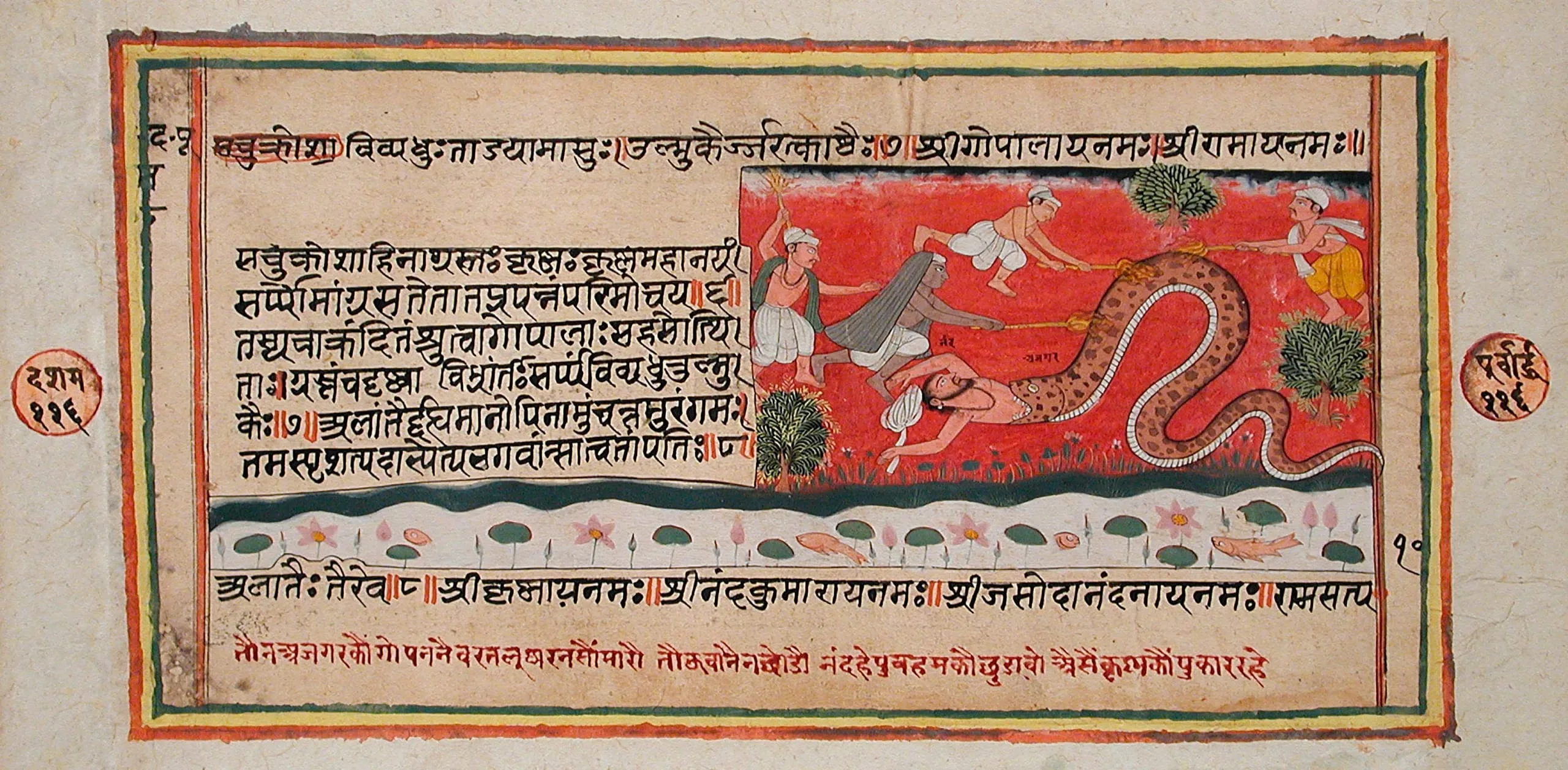
One night Nanda, the foster-father of Krishna, and other cowherd men and families were sleeping in the Ambika Forest in Vrindavan after bathing in the Sarasvati River and worshiping Sadashiva, an omnipotent form of Shiva. While they slept a hungry python named Sudarshana began to swallow Nanda, who cried out in distress for Krishna. The cowherd men awoke and began beating the serpent with flaming torches to no avail. Krishna tapped the great snake with his foot and it immediately transformed back into its semidivine form. Sudarshana explained that he had mocked some homely sages and been cursed to take the form of a serpent (Bhagavata Purana 10:34:1-19).
Recto: Nanda is being swallowed by the python.
Verso: Cowherd men attempt to disengage the python by beating it with flaming torches.
Additional folios from this dispersed series are in the Brooklyn Museum (83.164.1 and 83.164.2), Museum Rietberg, Zurich (RVI 1930, 1931, 1932), Philadelphia Museum of Art (2004-149-18), and formerly the Ehrenfeld Collection.