- Title
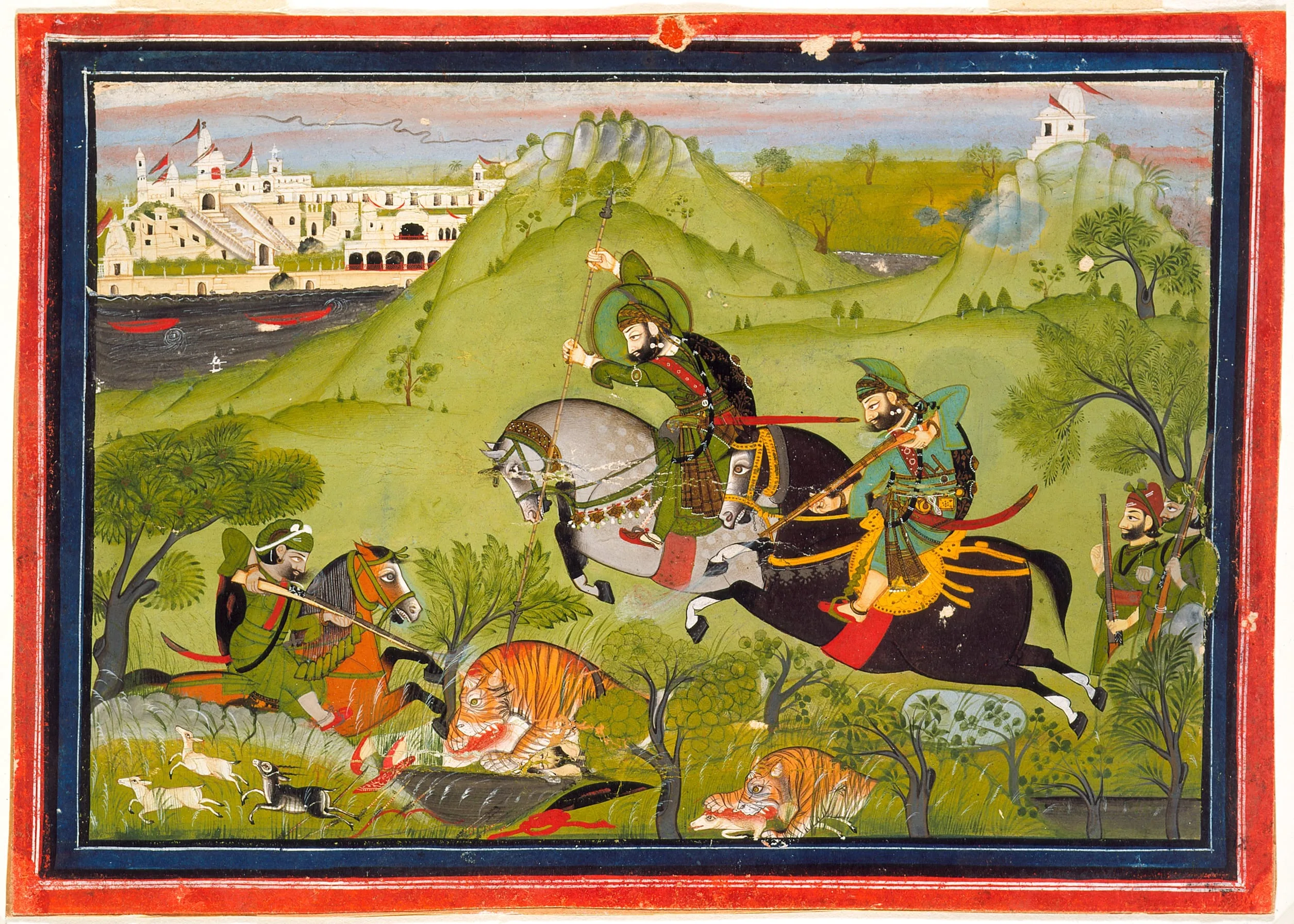
- Maharana Ari Singh II of Udaipur (r. 1761-1773) Hunting Tigers
- Date Made
- circa 1765-1768
- Medium
- Opaque watercolor, gold, and silver on paper
- Dimensions
- Sheet: 8 1/2 x 12 in. (21.59 x 30.48 cm); Image: 7 1/8 x 10 3/4 in. (18.1 x 27.31 cm)
- Accession Number
- M.81.280.1
- Curatorial Notes
This representation of a royal tiger hunt likely portrays Maharana Ari Singh II of Udaipur (r. 1761-1773) and his foster brother Rupji. Probably painted in the first seven years of his reign while he was a prolific patron of painting and the arts, it epitomizes the ‘action portrait’ compositions of the period. See also M.2003.214.1–.2. Ari Singh II is depicted beardless in dated portraits until 1765 and bearded thereafter, hence this portrait was presumably painted in circa 1765-1768, after which the Mewar economy collapsed due to incessant tribute demands by the encroaching Marathas and the royal patronage of painting was severely curtailed until its revival under Maharana Bhim Singh (r. 1778-1828).
In this dramatic encounter, the nimbate Ari Singh II thrusts his hunting weapon of choice, a lance, into a tiger mauling a fallen hunter. Rupji, his constant companion riding beside him, shoots the tiger with a rifle. Another mounted hunter also shoots at the tiger. Two retainers on foot stand ready with fresh rifles. All the hunters are dressed in green garments, indicating that it was the important annual Spring hunt. In the upper left corner in the distance is a temple compound, perhaps the Raja Ghat Temple on the shores of Lake Pichola.
- Selected Bibliography
- Pal, Pratapaditya. The Classical Tradition in Rajput Painting. New York: The Gallery Association of New York State, 1978.