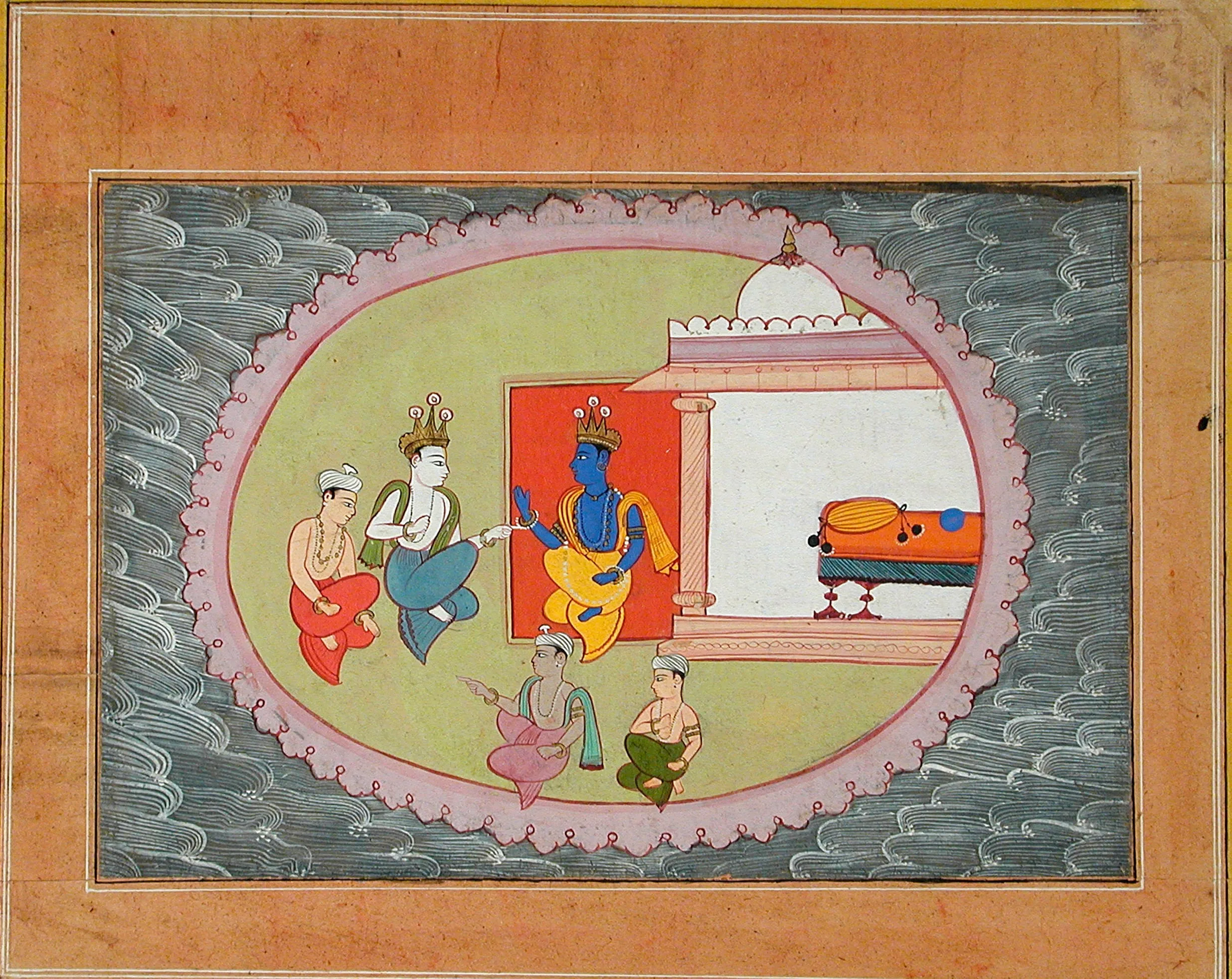
The Bhagavata Purana (Ancient Stories of the Lord) is traditionally ascribed to the legendary poet-sage Vyasa in the 8th-10th century CE. It stresses the path of devotion (bhakti) to Krishna, the eighth incarnation of Vishnu, the Hindu God of Preservation. To fulfill his role as the guardian of the world and savior of humanity, Vishnu appears as a succession of heroic animals and semi-mortal saviors, called avatars, through which he intervenes in times of crisis or unrighteousness.
Two devanagari inscriptions on the reverse identify the subject as follows: Having killed Jarasandha Krishna arrives at Dvaraka. Jarasandha was a king of Magadha (ancient Bihar) who vowed to kill Krishna after Krishna had slayed the evil King Kamsa of Mathura, who was Jarasandha’s son-in-law. Jarasandha kept attacking Mathura, so Krishna had a magnificent citadel named Dvaraka magically built overnight on reclaimed from the Gulf of Kutch, Gujarat, and the citizens of Mathura teleported to it. Here, Krishna and Balarama are shown conversing outside of a palatial pavilion. The fortified palace with battlements is shown surrounded by the ocean.
This folio and its series mate M.84.229.4 are from a widely dispersed Bhagavata Purana. Additional folios are in the Art Institute of Chicago (2007.384), Cleveland Museum of Art (2018.186), Metropolitan Museum of Art, New York (1977.441, 1978.535, 2001.437, and 2002.176), Museum of Fine Arts, Houston (2008.292), and Philadelphia Museum of Art (2004-149-17).