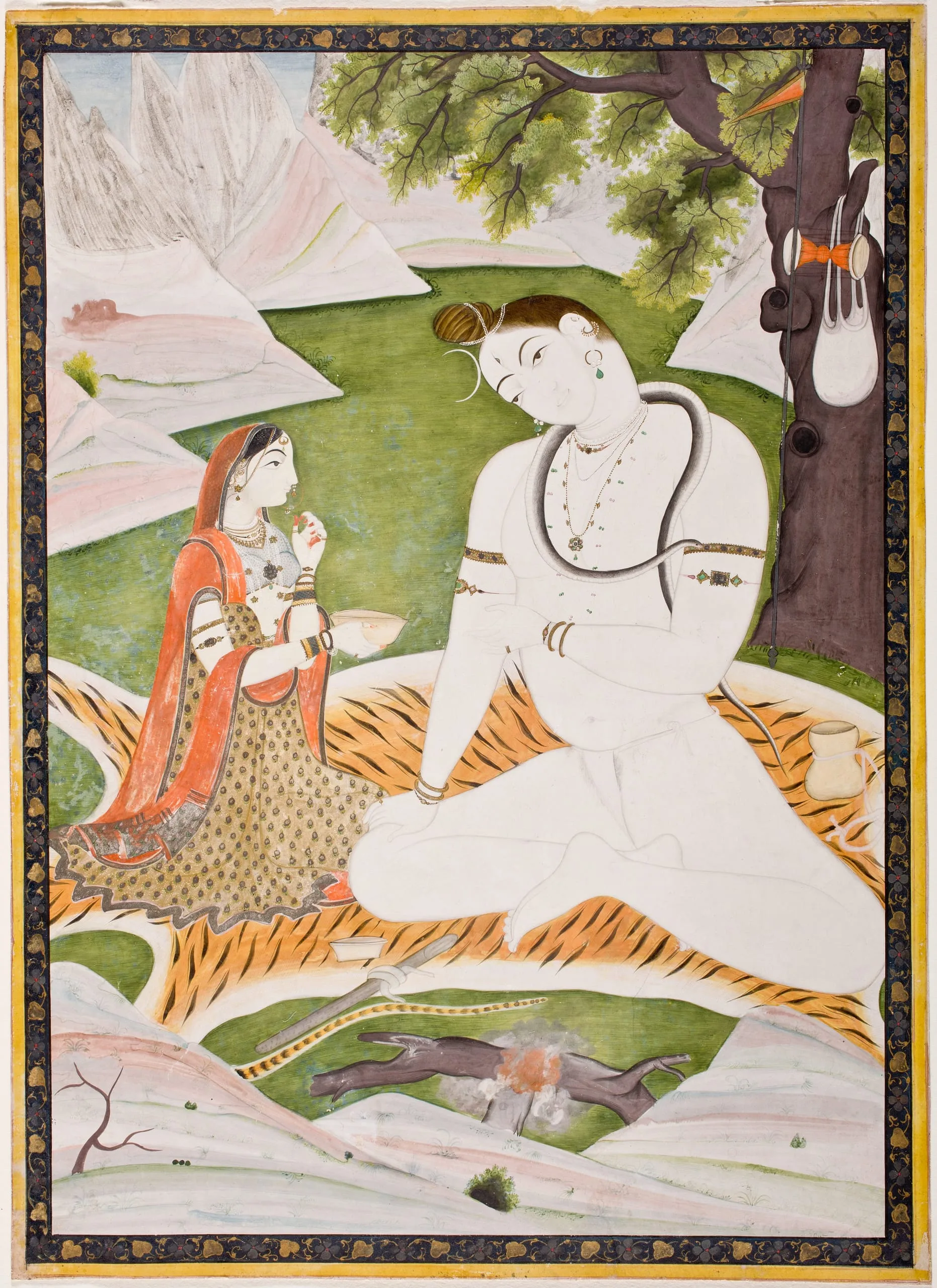
Shiva, the Hindu god of destruction, is a complex, multifaceted deity who assumes various manifestations to perform diverse functions or embody different philosophical principles. He has cosmic personas and roles, as well as spiritual and humanitarian guises. He has been called the erotic ascetic, as he is both the paramount practitioner of asceticism and yoga, and, conversely, an incomparable lover and devoted family man. Shiva’s chief wife, Parvati, is the daughter of Parvata, the personification of the Himalayas. She is the gracious feminine aspect of Shiva’s spiritual energy (shakti) and a fertility and mother deity.
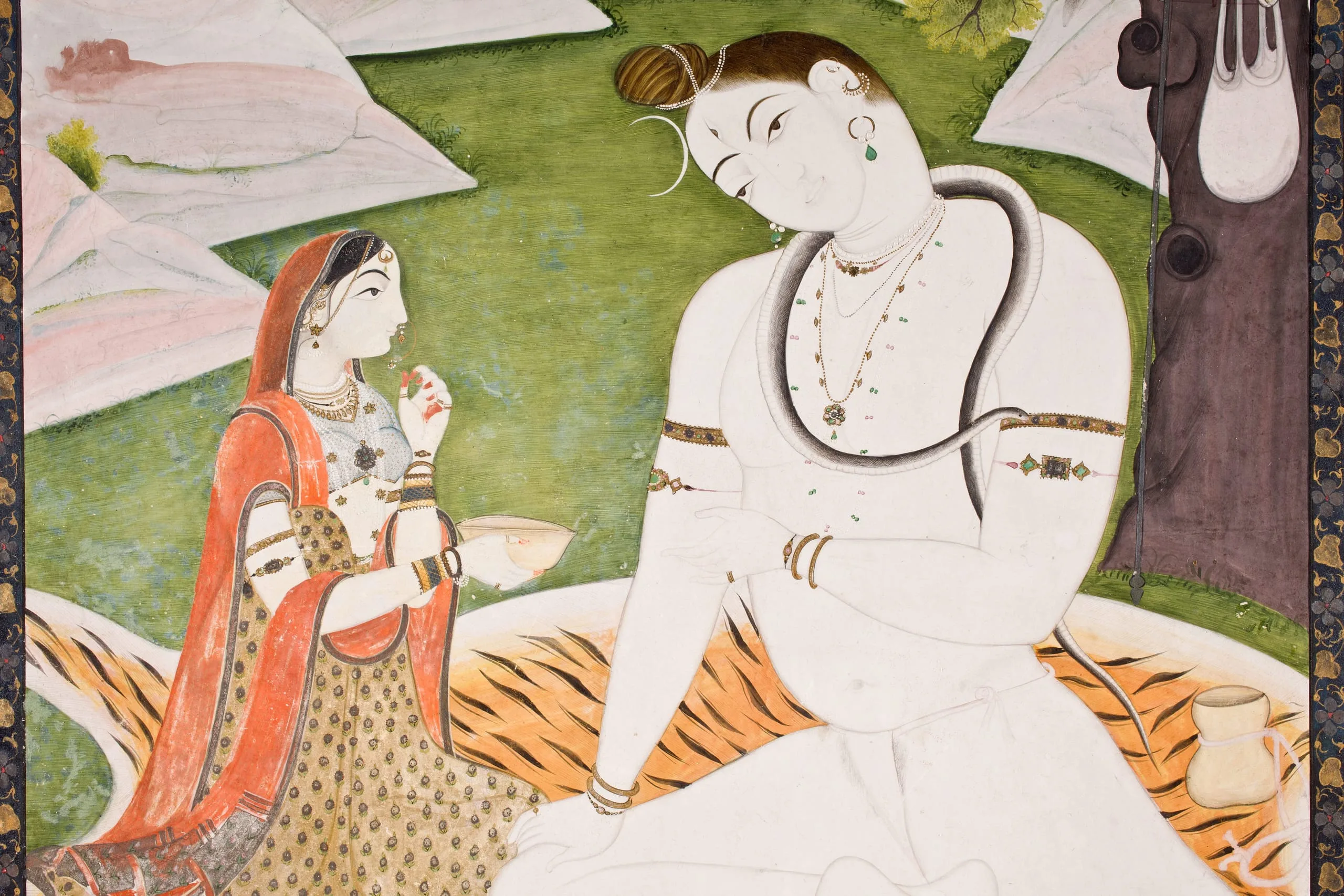
Shiva and Parvati sit on a tiger skin in a valley in the Himalayan mountains. Shiva’s body is ashen white from being smeared with cremation ashes. He has a third eye of wisdom and his emblematic crescent moon on his forehead. His right hand rests on his thigh and his left hand is about to receive a bowl of bhang, his favored intoxicating drink. Parvati is heavenly adorned with fine garments and precious jewelry, including a forehead ornament, nose ring, necklaces, armlets and bracelets. She holds her left hand in the symbolic ring gesture (kataka mudra) often used to hold a flower. Her right hand holds a bowl of bhang to give to her husband. Leaning against or suspended from the tree behind them are Shiva’s trident standard, hourglass-shaped drum, and ascetic’s shoulder pouch.
This painting is a copy of the original in the Sirmaur royal ancestral collection, Nahan.