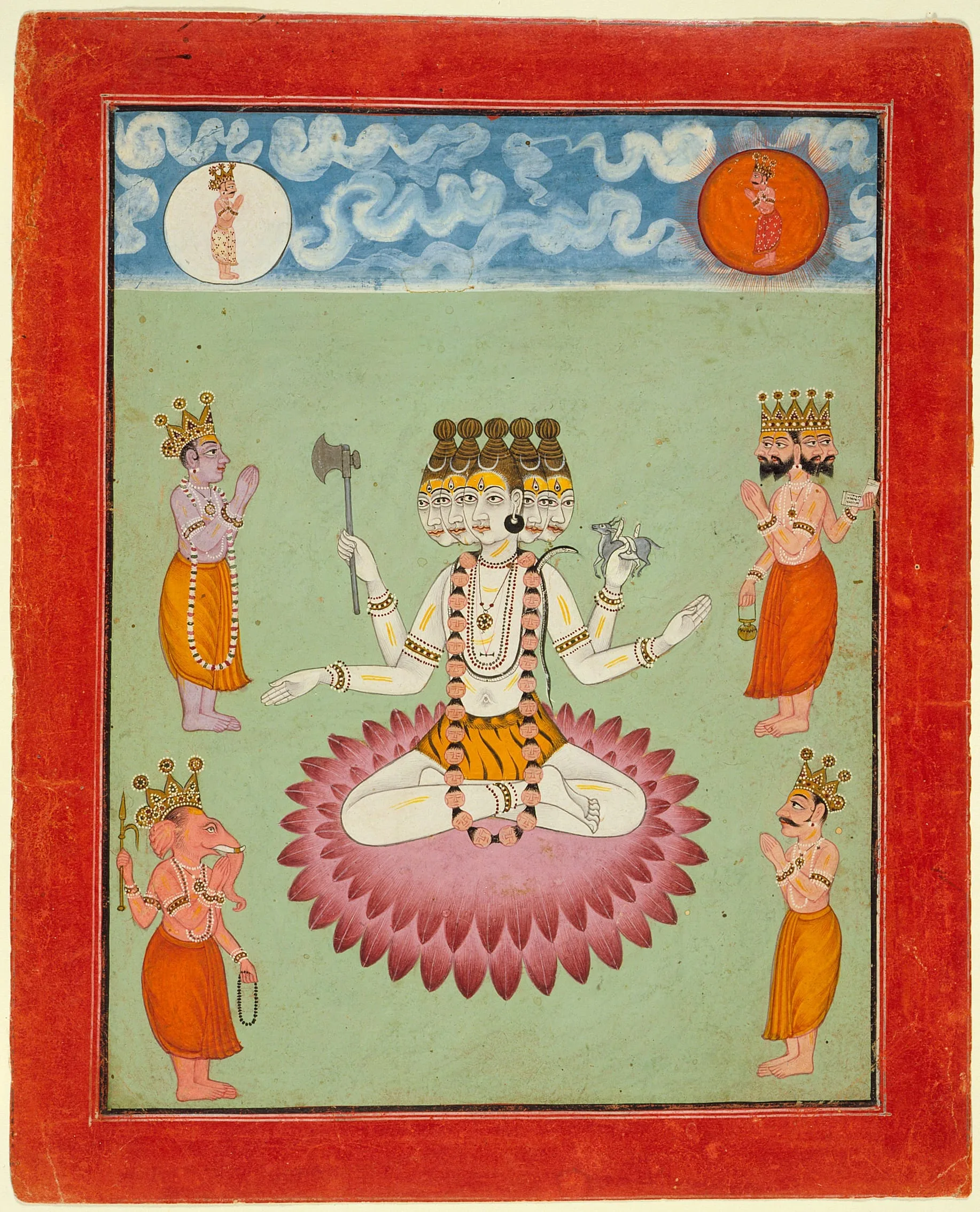
Sadashiva (Everlasting Shiva) is the supreme manifestation of the Hindu god Shiva in the Shaiva Sidhhanta devotional doctrine. It incorporates his five theological aspects symbolized by his five faces, which serve as foci of meditational practices. The five faces are Sadyojata, cosmic creation (facing West, representing earth); Vamadeva, world preservation (North, water); Aghora, cycle of absorption and renewal (South, heat); Tatpurusha, power of obscuration in samsara (life-death-rebirth cycle) (East, wind); and Ishana, leading to the final release (moksha) (Zenith, sky). Collectively, the five faces are known as the Panchabrahmas (Five Creators). They represent the cosmic re-cyclative powers of the universe.
Sadashiva is seated in the lotus position (padmasana) on a lotus base. Each of his five faces has Shiva’s third eye of wisdom and his emblematic crescent moon. He has yellow sectarian markings and wears a kanphata (ear-split) rhinoceros horn earring, tiger skin loincloth, and long garland of skulls. His upper hands hold an axe and antelope. His lower hands are in the symbolic gestures of ‘fear-not’ (abhaya mudra) and ‘gift-giving’ (varada mudra).
Sadashiva is being adored by the elephant-headed Ganesha, the blue-skinned Vishnu, the four-headed Brahma, and a crowned figure, likely a generic god or the royal patron of the painting. In the sky are the Sun-God Surya and Moon-God Chandra. The Hindi inscription on the reverse references Nurpur and the date 1696 (samvat 1754).