- Title
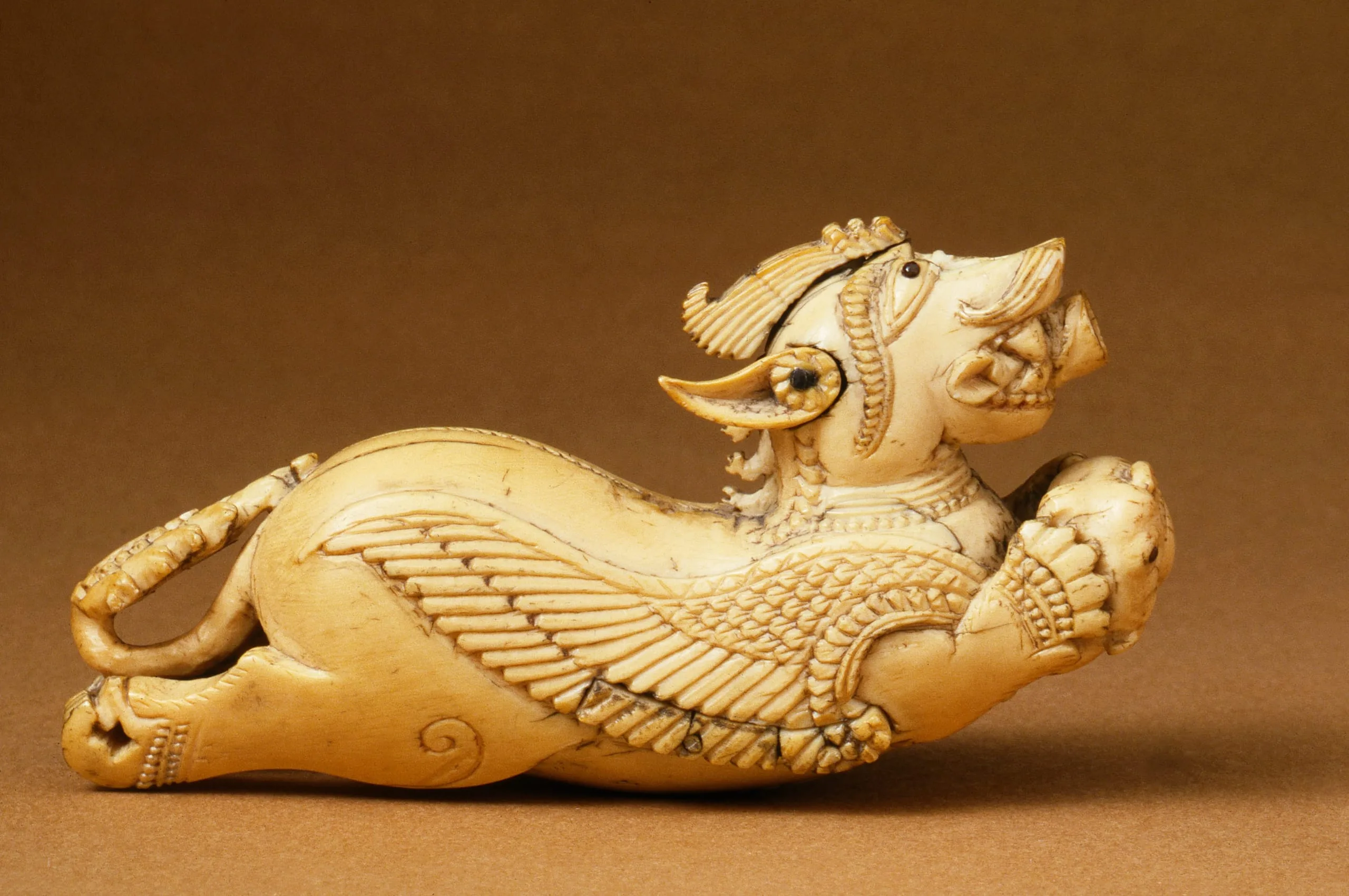
- Powder Primer Flask (baruddan) in the Form of a Winged Lion Crushing an Elephant
- Date Made
- late 17th - 18th century
- Medium
- Ivory; copper alloy brads
- Dimensions
- 2 5/8 x 5 x 1 5/8 in. (6.67 x 12.7 x 4.13 cm)
- Accession Number
- M.81.140
- Curatorial Notes
This ivory powder primer flask is carved in the form of a winged lion crushing an elephant between its forepaws. The all-powerful dominance of the leonine creature is expressed by the hierarchical scale of the animals. The lion's hind legs are extended horizontally behind him in a posture that symbolizes flying. A short cylindrical tube held in his mouth served as a spout for filling and dispensing the priming powder. The crest of the lion’s mane and his ears were fashioned separately, with the latter secured with brads. The lion's tail curves back to his hindquarters and may have functioned as a suspension loop to enable the flask to be attached to a waist sash. The lower edge of his wing has been repaired
Powder primer flasks were used to prime the flashpan and touchhole of early muskets. The weapons were fired by igniting the priming powder, in turn detonating the charge powder, which was loaded from larger containers known as powder horns. South Asian primer flasks are made of a variety of materials, including ivory, jade, nautilus shells, and ibex horns. Ivory primer flasks fashioned in the shape of an antelope and decorated with lively hunting scenes are significant for being among the earliest Mughal decorative objects known to have reached Europe in the mid-17th and early 18th centuries. Stylistic relationships with paintings and extant drawings of primer flasks suggest that pictorial artists may have participated in their design.