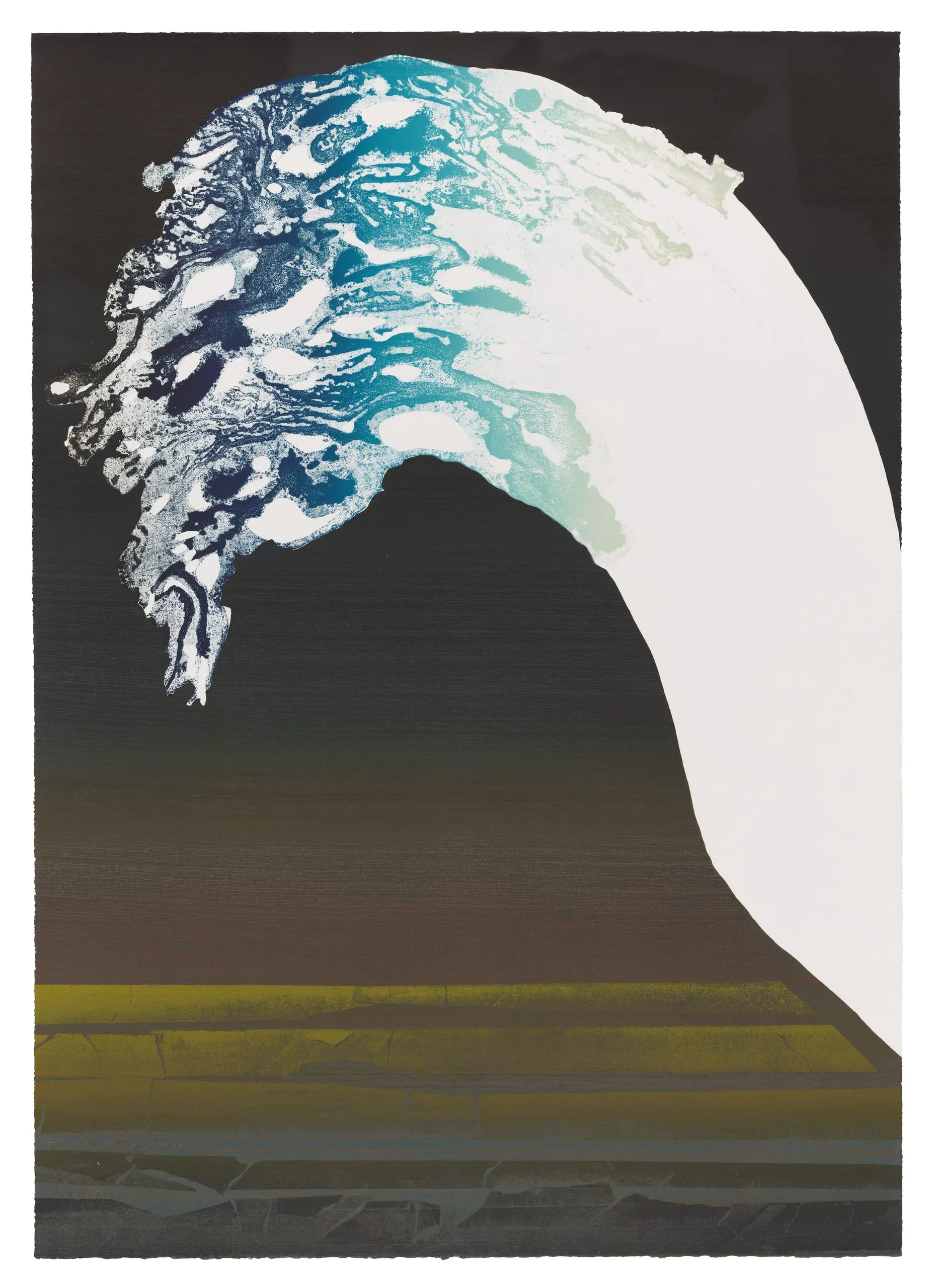
June Wayne explored wave imagery in her lithographs throughout the 1970s, and when asked what inspired this thematic focus, she replied: “Nature annoys and intrigues me. It annoys me because it is absolutely disinterested in what I think” (Belloli 2009: 23). Capturing the essence of a wave presented a variety of challenges. “As an artist how do you make a wave look like it’s towering above? How do you get that verticality? How do you get that vividness? That is a real problem, a technical and aesthetic problem. I did it by literally making the waves stand up, which meant carving an edge on one side. . . . In this case [White Tidal Wave II] I literally tore the piece of paper, tore it to give me the kind of energy, and the edge, but also to make it feel very physical. And this idea of having a wave come up like that, as though it were in a plume, is mostly contrary to reality, and yet I had to make it so convincing that you accept it even though you know it is absurd” (Wayne 2009). The untouched paper plays an integral role in the composition: “That beautiful white is the paper itself. The paper is really doing the work in this image. It is a very large area to keep clean while printing” (ibid.).
Wayne’s commitment to feminism and her deep interest in scientific subjects such as DNA, quantum physics, and the cosmos were expressed in a multifaceted visual practice that encompassed painting, printmaking, and tapestry design. Her bold depictions of planetary forces merged art and science, utilizing formal abstraction and often vibrant color, and presenting viewers with original ways of seeing the world. Inspired by her training with printmakers in Paris in the 1950s, Wayne championed the resurgence of lithography as a fine-art form in the United States. In 1960, she established the Tamarind Workshop for Lithography in Los Angeles; the workshop relocated to the University of New Mexico at Albuquerque in 1970 and is still thriving.
Claudine Dixon
2025
Selected Bibliography
Belloli, Jay. “A Conversation with June Wayne.” In Impact: The Big Print. OCC Arts Pavilion Press and the Los Angeles Printmaking Society, 2009.
Wayne, June. Video conversation with June Wayne in her Tamarind/Hollywood studio, 2009,
https://www.mbabram.com/white-tidal-wave-state-