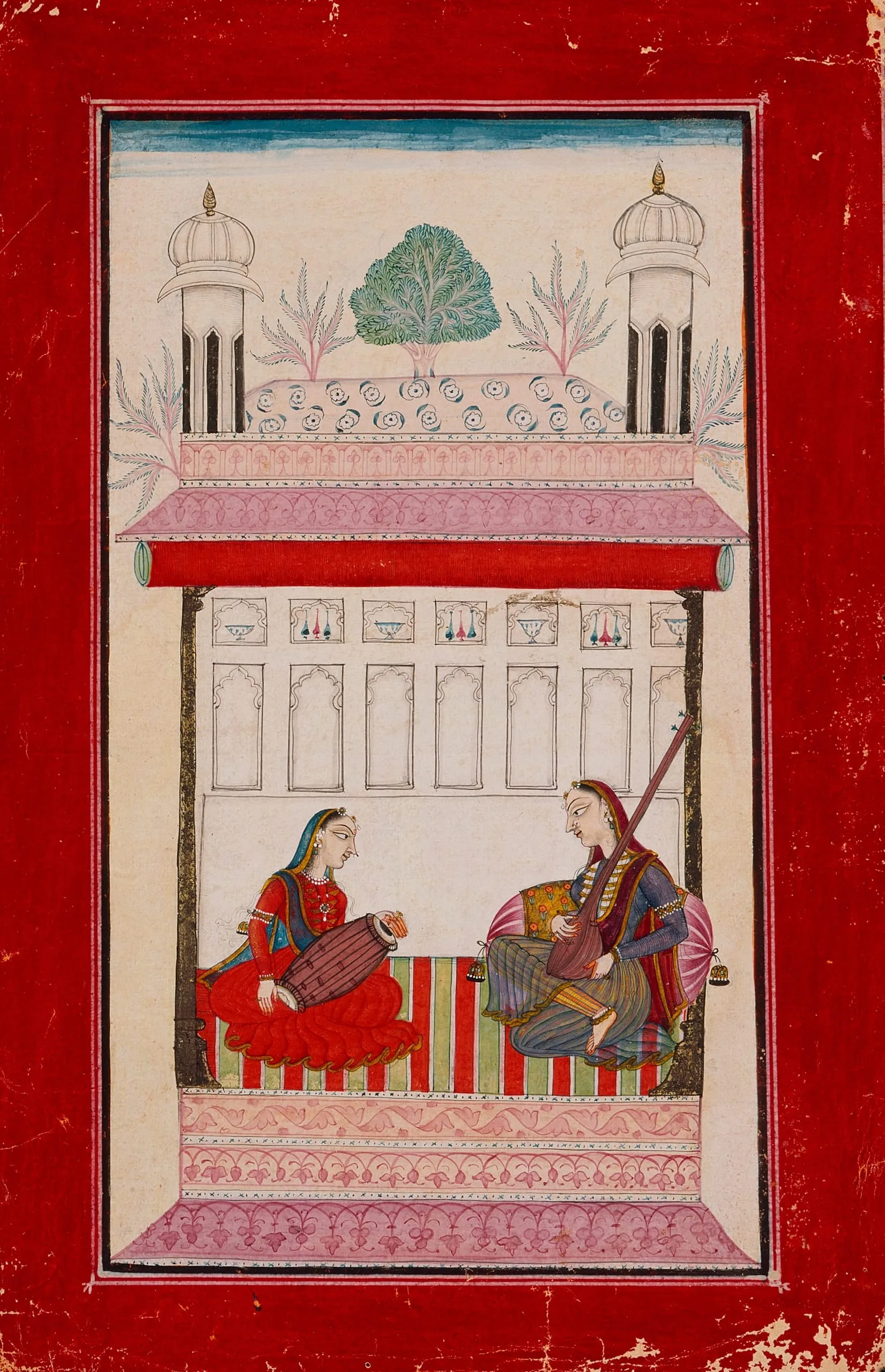
Karnati Ragini (also known as Kanhra or Kanada Ragini, from Karnataka, see M.81.29) is the second wife of Shri Raga in the variant ragamala (garland of melodies) classification system known as Meshakarna’s system (developed by Meshakarna, a court priest from Rewa, Madhya Pradesh, in his Ragamala of 1570), which was followed in Pahari ragamalas. Meshakarna’s system has six males (ragas), each of whom who has five or six wives (raginis) and eight or nine sons (ragaputras). In the more widespread Rajasthani classification system, Kanada Ragini is the third wife of Dipak Raga. Meshakarna compares the melodies to a sound in nature or a human activity. Karnati Ragini is likened to the sound of a wind-torn garment and envisioned as a dark--skinned woman dancing and frolicking. In this and commonly in other Pahari ragamalas, however, the melody is personified as a courtly woman playing a drone instrument (tambura) or a sitar, and her confidante is playing a drum (mridangam) or clapping the beat. For example, see a comparable Karnati Ragini from Kulu, Himachal Pradesh, attributed to circa 1700-1710 in the Victoria and Albert Museum, London (IS.63-1953, misidentified as Kamati Ragini on the V&A website). Here, the heroine plays a tambura and her companion plays a mridangam.
Two additional folios from this dispersed series were formerly in the collection of Dr. Alma Latifi (1879-1959), Mumbai. Compare especially the Vinoda Ragini (see William Archer, 1973, 2:179 Kahlur (Bilaspur) 31(ii).