LACMA

ShopMembershipMyLACMATickets
LACMA
Los Angeles County Museum of Art
5905 Wilshire Blvd.
Los Angeles, CA 90036
info@lacma.org
(323) 857-6000
Sign up to receive emails
Subscribe
© Museum Associates 2025

Museum Hours

Monday

11 am–6 pm

Tuesday

11 am–6 pm

Wednesday

Closed

Thursday

11 am–6 pm

Friday

11 am–8 pm

Saturday

10 am–7 pm

Sunday

10 am–7 pm


  • About LACMA
  • Jobs
  • Building LACMA
  • Host An Event
  • Unframed
  • Press
  • FAQs
  • Log in to MyLACMA
  • Privacy Policy
© Museum Associates 2025
Collections

Unknown
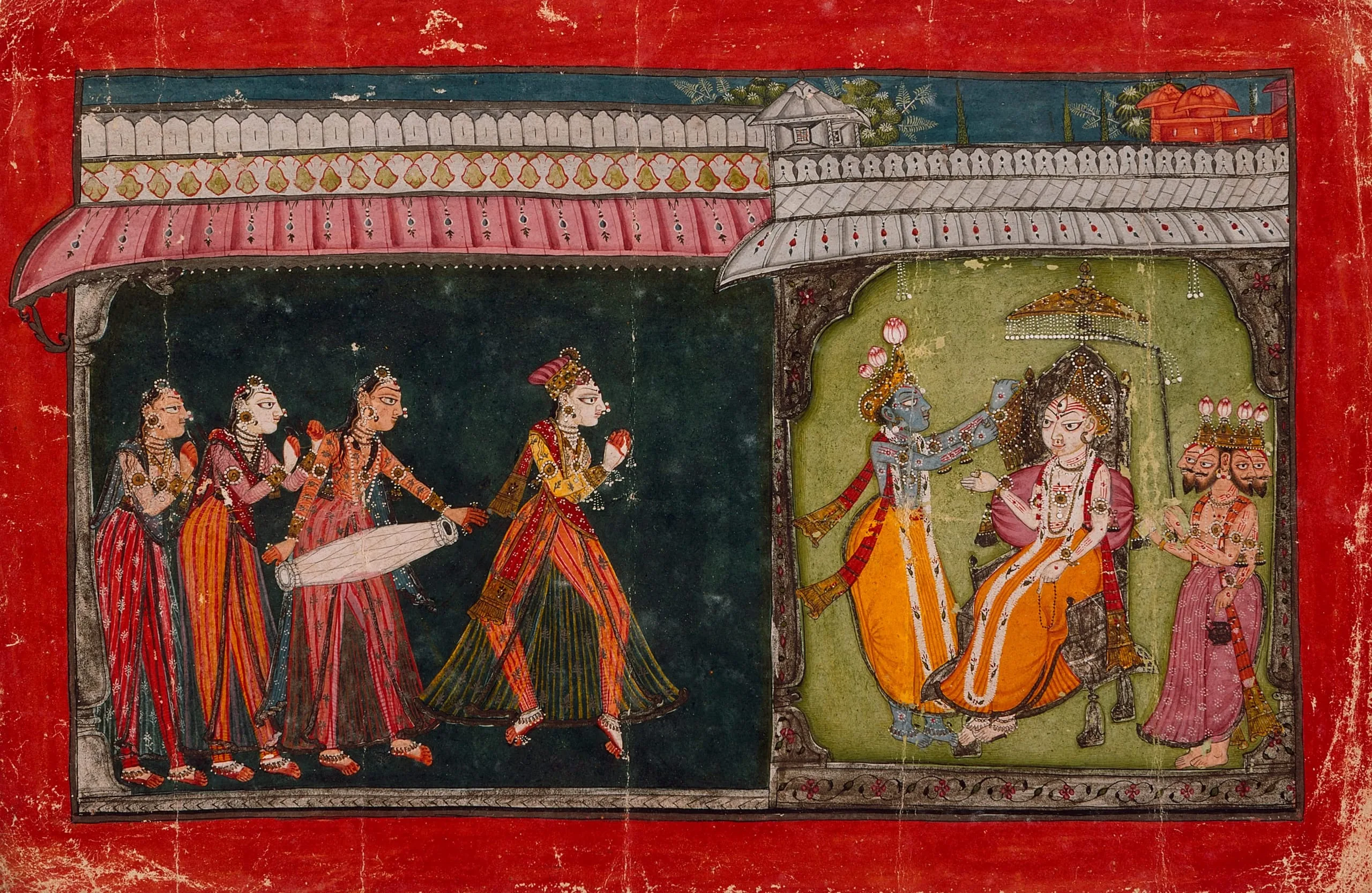
Enthroned Shiva Adored by Vishnu and Brahma with Entertainerscirca 1675-1680

Not on view
Indian manuscript painting divided into two scenes: women with a drum approach a male figure at left; a blue-skinned deity reaches toward a seated woman at right, all richly colored against deep teal and sage backgrounds
Artist or Maker
Unknown
Title
Enthroned Shiva Adored by Vishnu and Brahma with Entertainers
Place Made
India, Jammu and Kashmir, Basohli
Date Made
circa 1675-1680
Medium
Opaque watercolor, gold, and silver on paper
Dimensions
Image: 5 7/8 x 10 1/4 in. (14.92 x 26.03 cm); Sheet: 7 3/8 x 11 1/4 in. (18.73 x 28.57 cm)
Credit Line
From the Nasli and Alice Heeramaneck Collection, Museum Associates Purchase
Accession Number
M.81.8.11
Classification
Drawings
Collecting Area
South and Southeast Asian Art
Curatorial Notes
In this expression of sectarian rivalry, Shiva, the Hindu god of destruction, sits enthroned in a pavilion. He has a single crowned head with his third eye of wisdom and red sectarian markings. He wears a long floral garland and profuse jewelry. He holds a rosary in his left hand. His right hand is held in the symbolic gesture of 'gift-giving’ (varada mudra). Shiva is being adored by Vishnu, the blue-skinned god of preservation; and Brahma, the four-headed god of creation, who holds an honorific parasol over Shiva and carries a manuscript of the Vedas and an ascetic’s water vessel. In a separate chamber in front of the deities, a group of female entertainers celebrates the auspicious occasion. A dancer performs accompanied by a drummer playing a mridangam drum and two women playing hand cymbals. Rising above the pavilion’s roofline are a second-story structure, flowering trees and cypresses, and a distant compound.
Selected Bibliography
  • Rosenfield, John. The Arts of India and Nepal: The Nasli and Alice Heeramaneck Collection. Boston: Museum of Fine Arts, Boston, 1966.