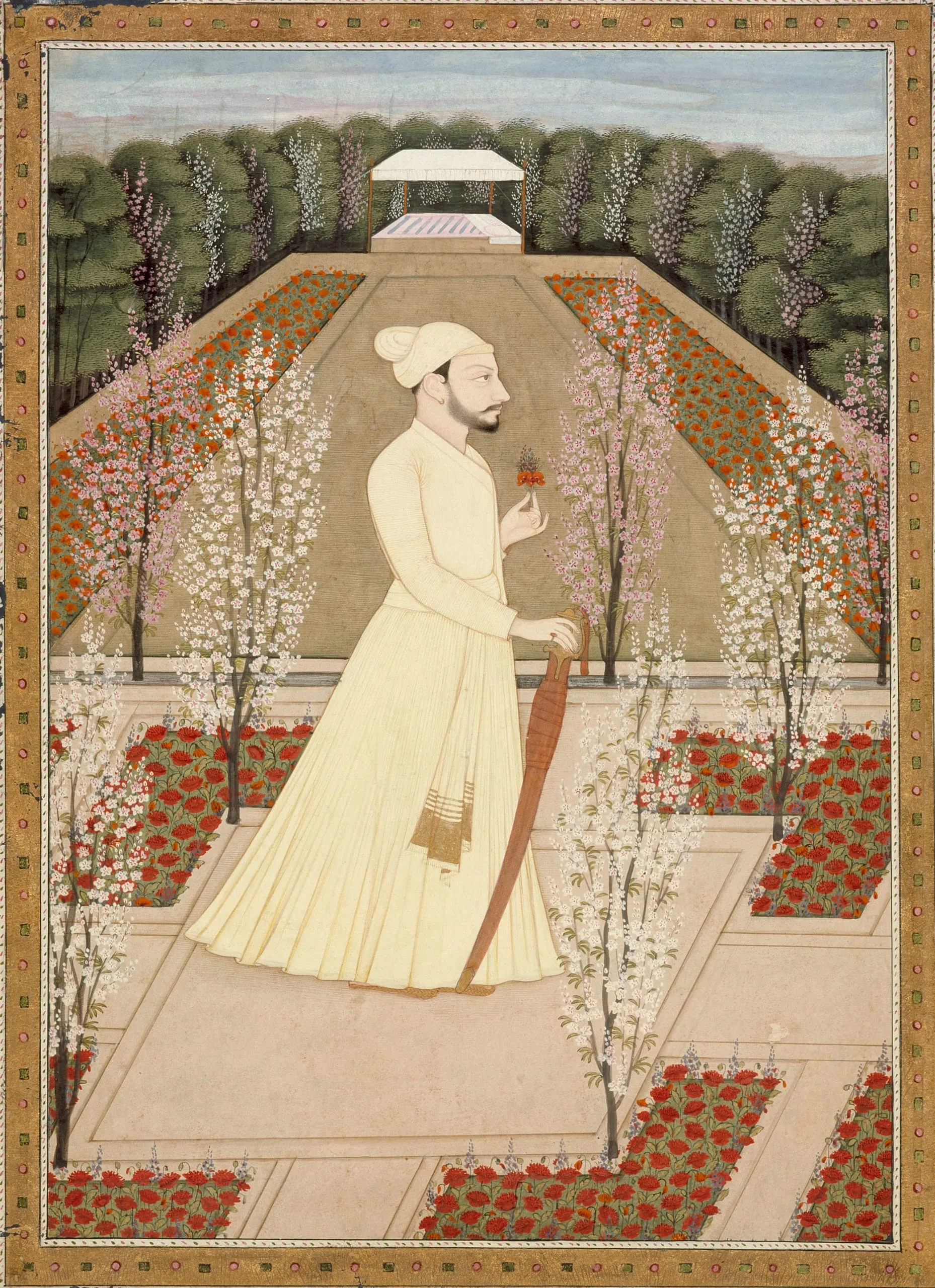
Raja Amrit Pal of Basohli (r. 1757-1776) was born in 1745. He succeeded his father Raja Jit Pal (r. 1736-1757) at the age of twelve in 1757 and ruled for nineteen years. In 1759 he married a daughter of Raja Abhaya Chand of Kangra (r. 1747-1760), who was the mother of his successor, Raja Vijay Pal (r. 1776-1806). Amrit Pal abdicated his throne in 1776 after an astrologer’s prediction that he would die at the holy city of Varanasi (Benares), in present-day Uttar Pradesh. As foretold, he died at age thirty-three in Varanasi in 1778. Said to be a scholarly and devout ruler, Amrit Pal spent much of his reign at the Jammu court with his father-in-law Raja Ranjit Dev (r. 1735-1781).
The artist Ranjha (circa 1750-1830, active circa 1778-1827) was the fourth son of the celebrated artist Nainsukh of Guler (circa 1710-1778, active circa 1730-1778).
In this painting, Amrit Pal stands in a flowering garden represented in linear perspective with an empty canopied bed in the distance. His only jewelry is an earring and a pinky ring. He wears a long white coat (jama) with a matching turban and waist sash, the ends of the latter embellished with gold embroidery. He holds a bouquet and the hilt of a sheathed sword with its sword belt wrapped around the scabbard.
This painting was formerly in the collection of Maharaja Dr. Karan Singh, Sadr-i-Riyasat [President] of Jammu and Kashmir" and previously in the collection of Pahda Kunj Lal, the family physician of the Rajas of Basohli.