- Title
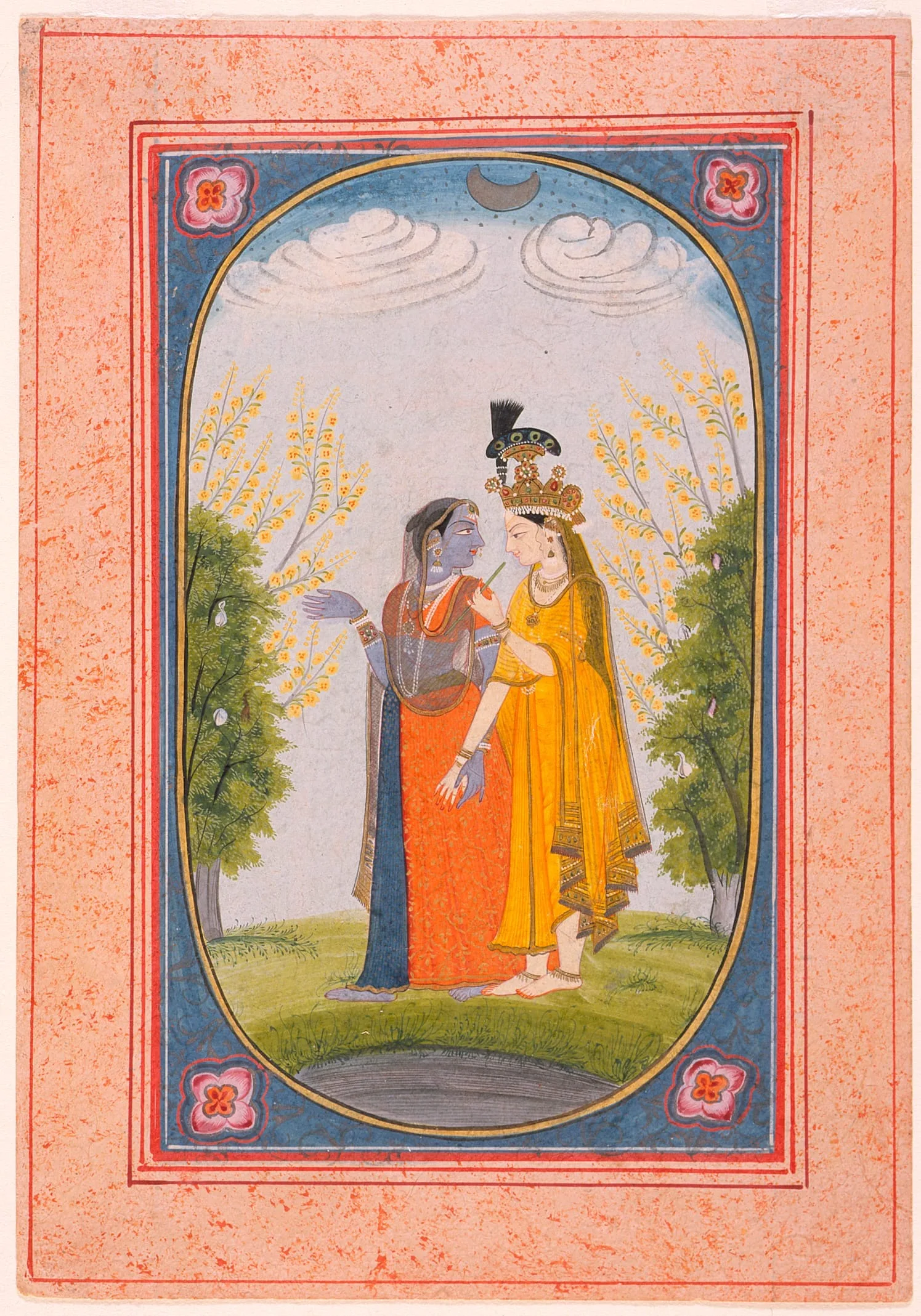
- Radha and Krishna Dressed in Each Other’s Clothes
- Date Made
- circa 1800-1825
- Medium
- Opaque watercolor and gold on paper
- Dimensions
- Sheet: 8 x 5 1/2 in. (20.32 x 13.97 cm); Image: 6 1/4 x 3 3/4 in. (15.88 x 9.53 cm)
- Accession Number
- M.80.232.4
- Curatorial Notes
South Asia has an extensive literary tradition based on encounters between lovers. The female lovers or heroines (nayikas) and male lovers or heroes (nayakas) are classified into two general categories—lovers in union and lovers in separation—each of which has many subcategories. The nayika-nayaka tradition also integrated the later romantic legends of the longing between the Hindu goddess Radha and god Krishna and their divine love-play (lila).
Here, in an iconic rather than narrative representation, Radha and the blue-skinned Krishna have exchanged their garb and accoutrements. They are tenderly holding hands and gazing into each other’s eyes while walking in a lush forest setting that has been interpreted as the spring season in Braj and the culmination of their illicit affair. The silver crescent moon in the star-filled sky indicates that the white background behind the lovers is that of a moonlit night rather than a bright spring day. Accordingly, this charming night scene may evoke Krishna’s last night of dalliance in Braj before leaving his adolescence to journey to Mathura and begin his adulthood. See also M.71.1.11.
- Selected Bibliography
Markel, Stephen. "The Enigmatic Image: Curious Subjects in Indian Art." Asianart.com, July 28, 2015. http://asianart.com/articles/enigmatic.
Blondet, José Luis. Six Scripts for Not I: Throwing Voices (1500 BCE-2020 CE). Los Angeles: Los Angeles County Museum of Art, 2020.