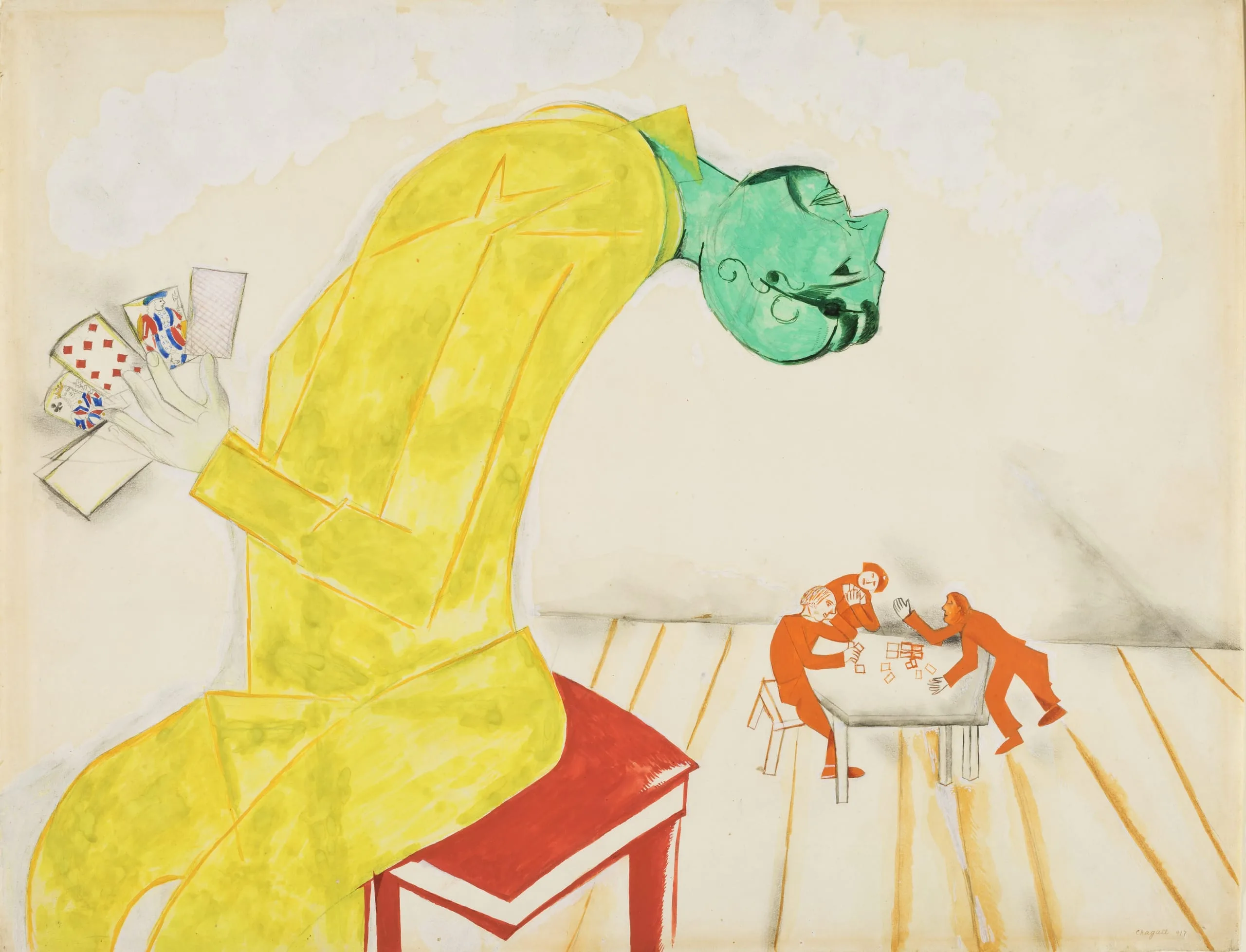
The Gamblers is related to a commission Marc Chagall received in 1919 to design scenery for a production of Nicolati Gogol's 1843 play of the same name at the Hermitage Theater in St. Petersburg. The influence of Russian folk art and mysticism that came to define the artist's work is perceptible in the drawing, which is characterized by bold and expressive colors and anatomical and spacial distortions. The spare palette of The Gamblers, as well as its simplicity and clarity of drawing and composition, bespeak its connection to a theater set.
The monumental and isolated figure in the drawing's foreground is Ikharev, the central character of Gogol's play. He throws his bilious green head back in despair, sickened by a universal corruption in which he is himself complicit. The absurdity and paradox that lay at the heart of Gogol's aesthetic held particular appeal for Chagall. A larger reading of The Gamblers suggests that it be viewed as a meditation on man's alienation and the capriciousness of fate.
Chagall had returned to Russia in 1914 after several years in Paris, where he observed and absorbed the lessons of Cubism among other early-twentieth-century artistic movements. In this second Russian period (which lasted until 1923, when he returned to Paris), Chagall was closely involved with the theater, first in Vitebsk, Belorussia, as the Bolshevik-appointed Commissar of Fine Arts, and later in Moscow and St. Petersburg.