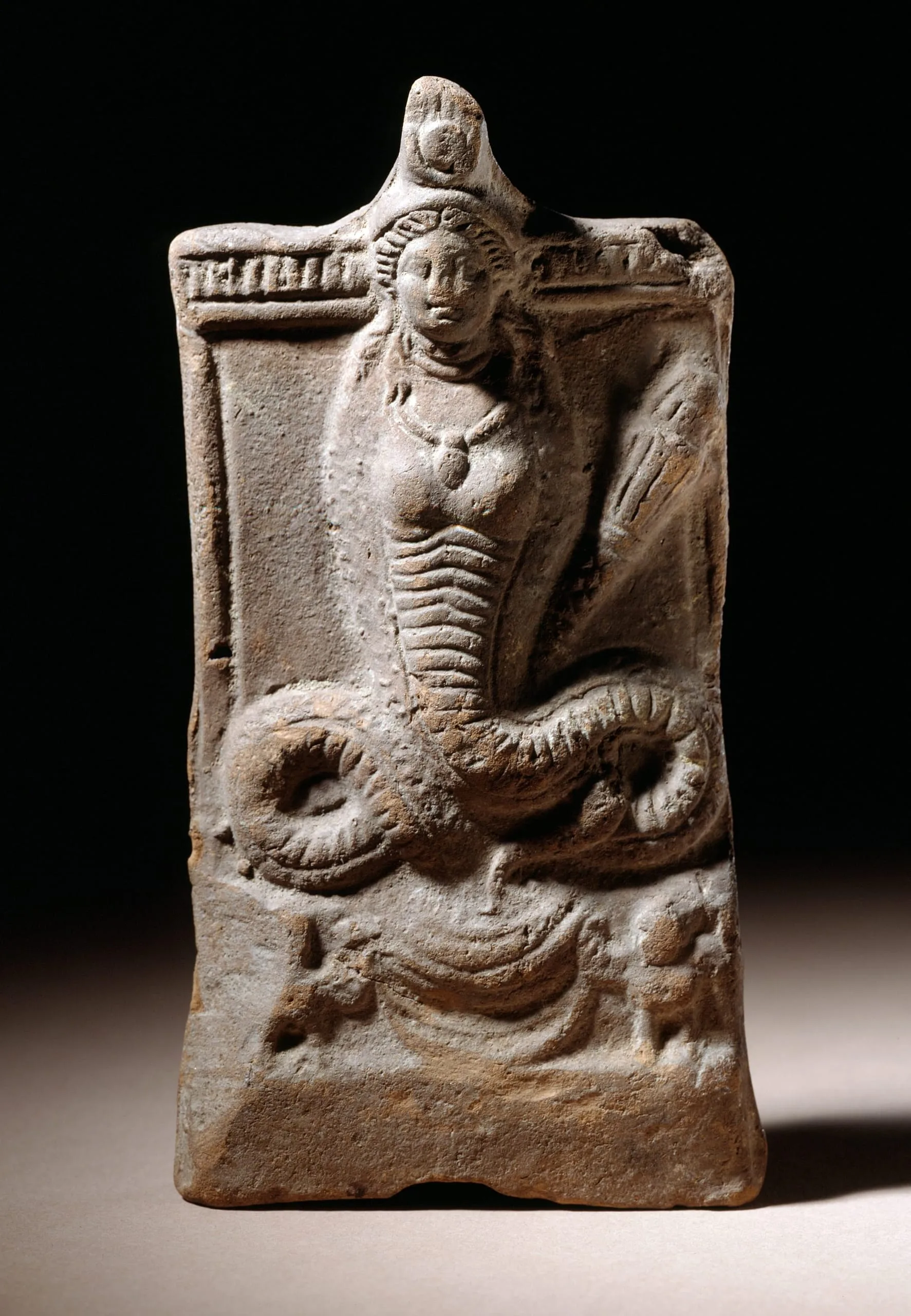
During the Roman period, terracotta images were widely distributed and served on household shrines or were dedicated as votive offerings in temples. Here, the head and upper torso of Isis in her traditional form with a headdress of horns and a sun disk is merged with the agrarian deity Thermouthis, identified by her reptilian body and curving snakelike tail. Thermouthis was the Greek designation for an earlier deity, Renenutet, known to Egyptians as the goddess of harvest, grain, and general fertility of the land. Perched on a cloth-covered throne supported by two putti or sphinxes, she holds a torch and wears a necklace with an oval pendant. The hollow terracotta was mold-made, and an identical version is in the collection of the Royal Ontario Museum (916.1.430).
Provenance: With Georges Anastase Michaelides (1900-1973), Cairo, 1950. Jerome Snyder, gifted 1980 to; LACMA.
Publication
Michaïlidès, G. “Considérations sur la religion égyptienne en marge d’une collection inédite.” Bulletin de l’Institut d’Égypte 33 (195051): 198, pl. IVB