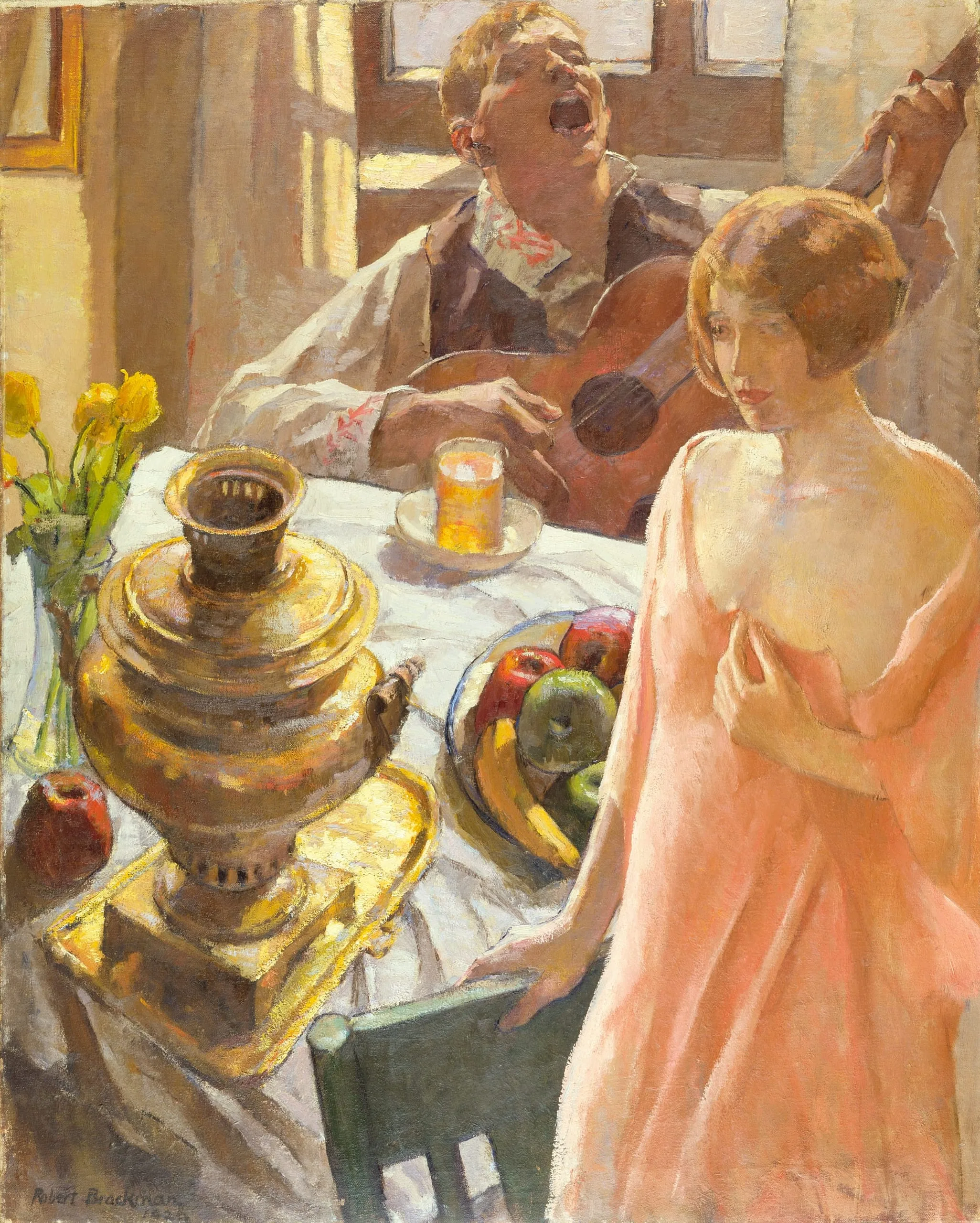
Although Brackman later became the bête noir of the modernists, he apparently had trouble placing his works in national exhibitions during the early 1920s: "The academicians found me too modern and the moderns, too academic," he recalled in an interview in 1961. Indeed, the modernist elements found in A Song continued to influence his art even after his study of the Renaissance masters had led him toward a very deliberate classicism. As a young man he had admired the styles of Pierre-Auguste Renoir (1841-1919), Claude Monet (1840-1926), Paul Cézanne (1839-1906), and other French painters. His overriding interest in the effects of light and color-which was derived from the impressionists and proved to be the foundation of his technique as a painter -- can be readily detected in A Song. From the works of Cézanne, whom he acknowledged as the source for his lifelong enthusiasm for still life, Brackman derived the use of rich color for modeling, faceted forms, tilted tabletops, and a balance of two-dimensional and threedimensional elements. With its strong color, disorienting perspective, and boisterous energy, A Song reflects these influences more directly than his better known, more classical works.
The singer’s shirt and the samovar may refer to the artist’s Russian origins, but because of the singer’s expression and the angle of his face it is difficult to determine whether the painting was intended as a self-portrait. The combination of a seminude figure with a still life in a studio setting was to become a familiar Brackman theme. A Song was one of numerous paintings by Brackman owned by the music publisher Irving Mills, an early patron.
The inscriptions on the canvas and its verso may be by different hands. The last digit in the date on the front is ambiguous, suggesting 3, 5, or 6. A review of Brackman’s 1926 exhibition at Babcock Galleries in New York definitely identifies this painting as The Song. Given the prominence of the samovar, however, it is possible that the painting may have been exhibited the year before as The Samovar in his one-man show at the Milch Galleries.