LACMA

ShopMembershipMyLACMATickets
LACMA
Los Angeles County Museum of Art
5905 Wilshire Blvd.
Los Angeles, CA 90036
info@lacma.org
(323) 857-6000
Sign up to receive emails
Subscribe
© Museum Associates 2025

Museum Hours

Monday

11 am–6 pm

Tuesday

11 am–6 pm

Wednesday

Closed

Thursday

11 am–6 pm

Friday

11 am–8 pm

Saturday

10 am–7 pm

Sunday

10 am–7 pm


  • About LACMA
  • Jobs
  • Building LACMA
  • Host An Event
  • Unframed
  • Press
  • FAQs
  • Log in to MyLACMA
  • Privacy Policy
© Museum Associates 2025
Collections

Unknown
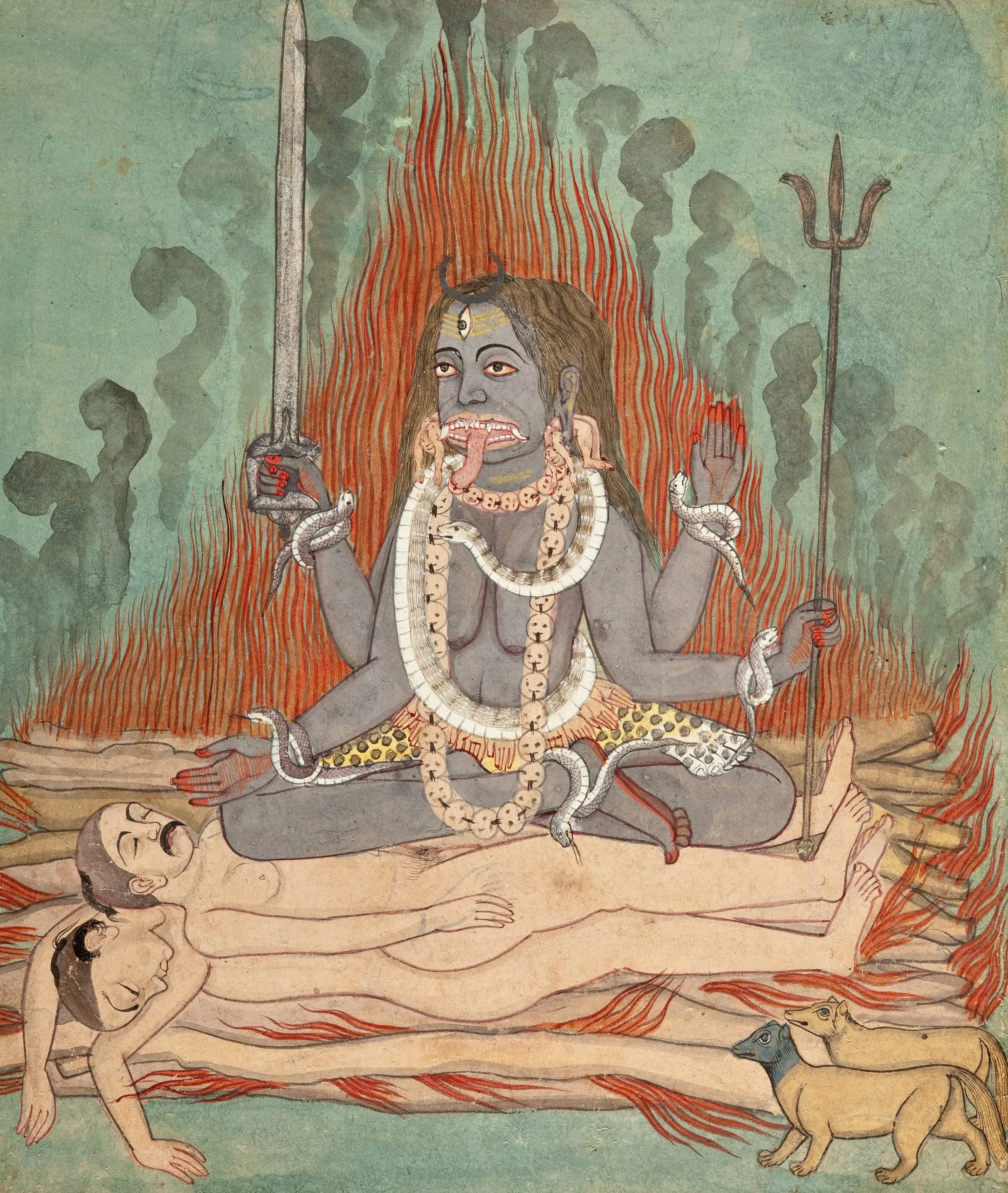
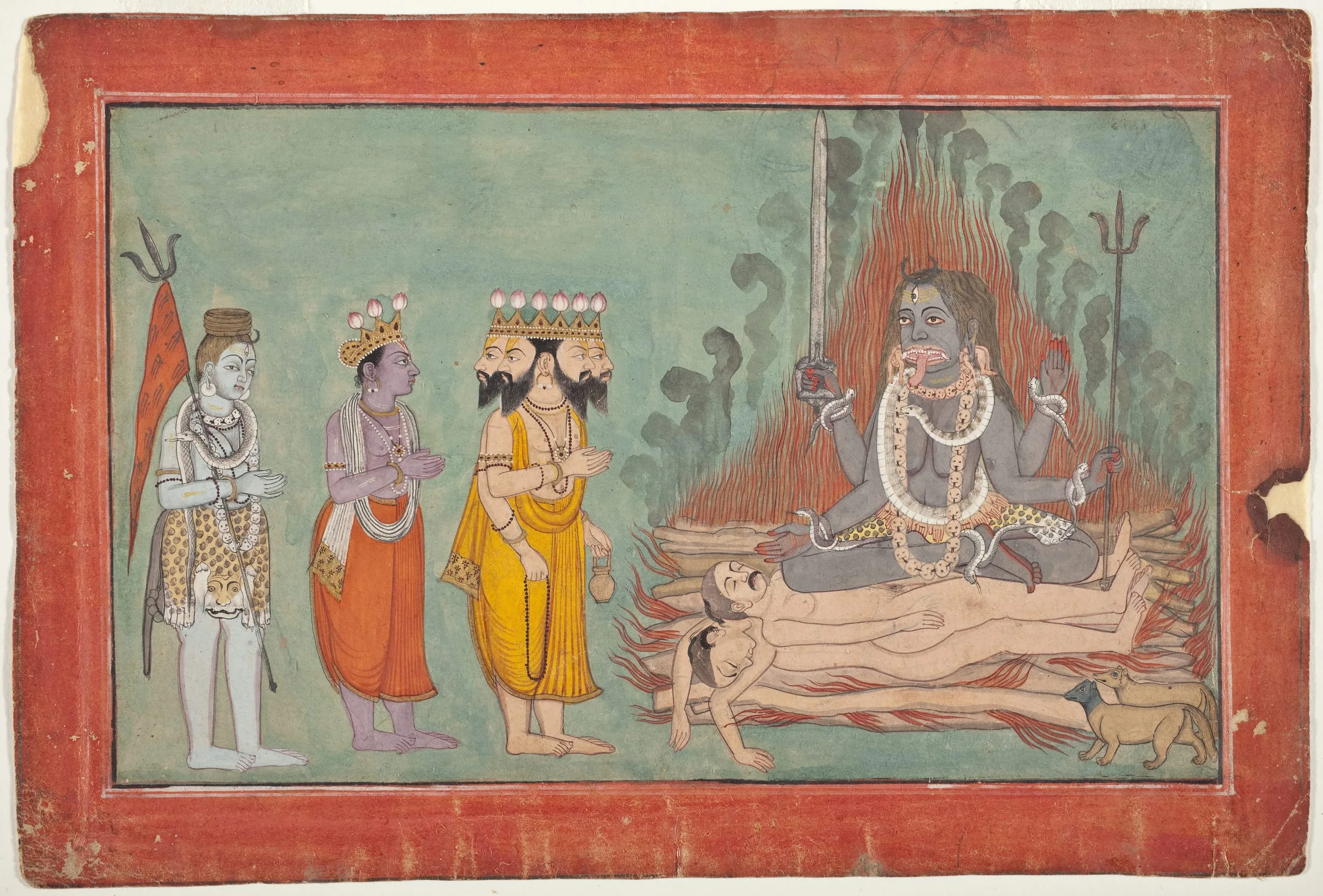
Kali is Adored by Brahma, Vishnu, and Shivacirca 1740

Not on view
Indian painting on paper showing five divine figures, one seated amid flames atop a reclining figure, with three attendant figures gesturing in reverence to the left
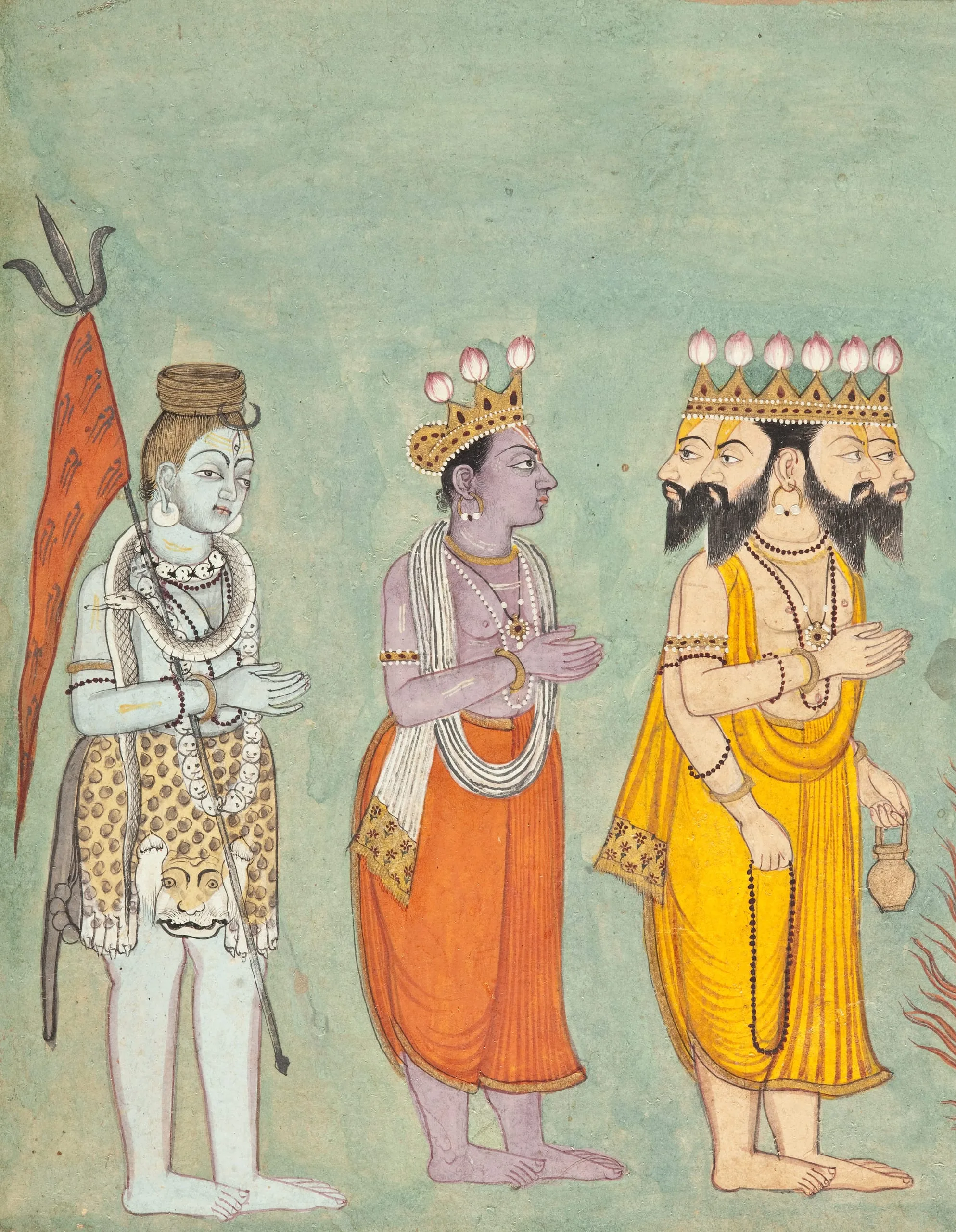
Indian opaque watercolor painting depicting three standing figures against a pale green background. Left figure is blue-skinned, holding a trident and red banner, wearing a leopard-skin dhoti and serpent garland. Center figure has lavender skin, wears a gold crown with lotus buds and orange dhoti, hands folded. Right figure displays four bearded heads beneath a lotus-adorned crown, dressed in golden yellow robes, holding a small vessel, with a rudrākṣa mala around the neck. All figures wear elaborate jewelry and pearl necklaces.
Indian opaque watercolor depicting a four-armed blue-skinned deity seated in lotus position atop a recumbent pale figure amid flames. The deity holds a sword and trishula, adorned with a skull garland and coiled snakes, against a teal background with rising fire and smoke. A small dog stands at lower right.
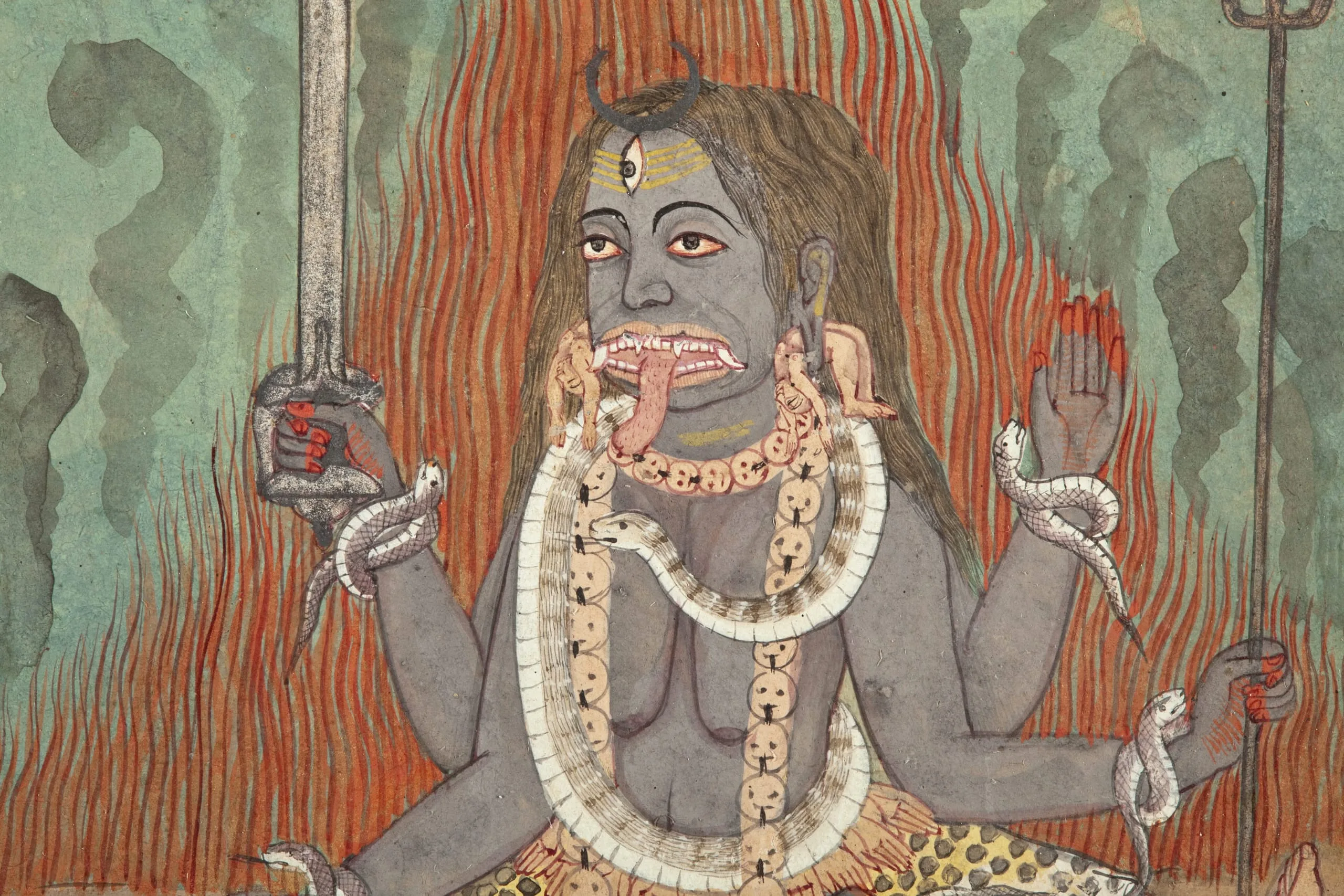
Indian painting, possibly opaque watercolor, depicting a blue-skinned multi-armed deity seated before red flames, adorned with a garland of skulls and white serpents, tongue extended, holding a trident and other implements, rendered in fine line work with muted green background.
Artist or Maker
Unknown
Title
Kali is Adored by Brahma, Vishnu, and Shiva
Place Made
India, Jammu and Kashmir, Basohli
Date Made
circa 1740
Medium
Opaque watercolor, gold, silver, and ink on paper
Dimensions
Image: 6 x 9 3/4 in. (15.24 x 24.77 cm); Sheet: 7 3/4 x 11 1/2 in. (19.69 x 29.21 cm)
Credit Line
Purchased with funds provided by Dorothy and Richard Sherwood and Indian Art Special Purpose Fund
Accession Number
M.80.101
Classification
Drawings
Collecting Area
South and Southeast Asian Art
Curatorial Notes

Between approximately 300 BC and AD 500, the earlier Vedic religion of India, which involved sacrifices, rites, and prayers performed by an elite priestly caste, was superseded by a pantheistic, sectarian-based form of personal worship now known as Hinduism. The temporal cycles of the universe became paramount and were personified and worshipped in the form of three gods: the creator Brahma; the preserver Vishnu, who maintains harmony and order; and the destroyer Shiva, whose obliteration of the universe enables it to be reborn in the next cosmic era. Vishnu and Shiva each became the devotional focus of a major sect of Hinduism, Vaishnavism and Shaivism, respectively. Brahma's importance waned, although he is still worshipped in certain life rituals such as marriages.

In addition to the gods, and often surpassing them in popular belief and reverence, are the various Hindu goddesses that are associated with a wide range of philosophical principles, creative and destructive powers, virtues such as compassion and devotion, and social ideals such as caste duty. Unlike male Hindu divinities, which are regarded as complex individual deities, Hindu goddesses are generally considered to be alternate manifestations of a single primal transcendental goddess, Devi (The Great Goddess), who reveals herself in various guises to fulfill different purposes.

Here, in an expression of sectarian rivalry, the frightful goddess Kali, the destroyer of time, is being adored by Brahma, Vishnu, and Shiva.
Selected Bibliography
  • El Universo de la India: Obras Maestras del Museo de Arte del Condado de Los Angeles. Santiago: Centro Cultural Palacio La Moneda, 2012.