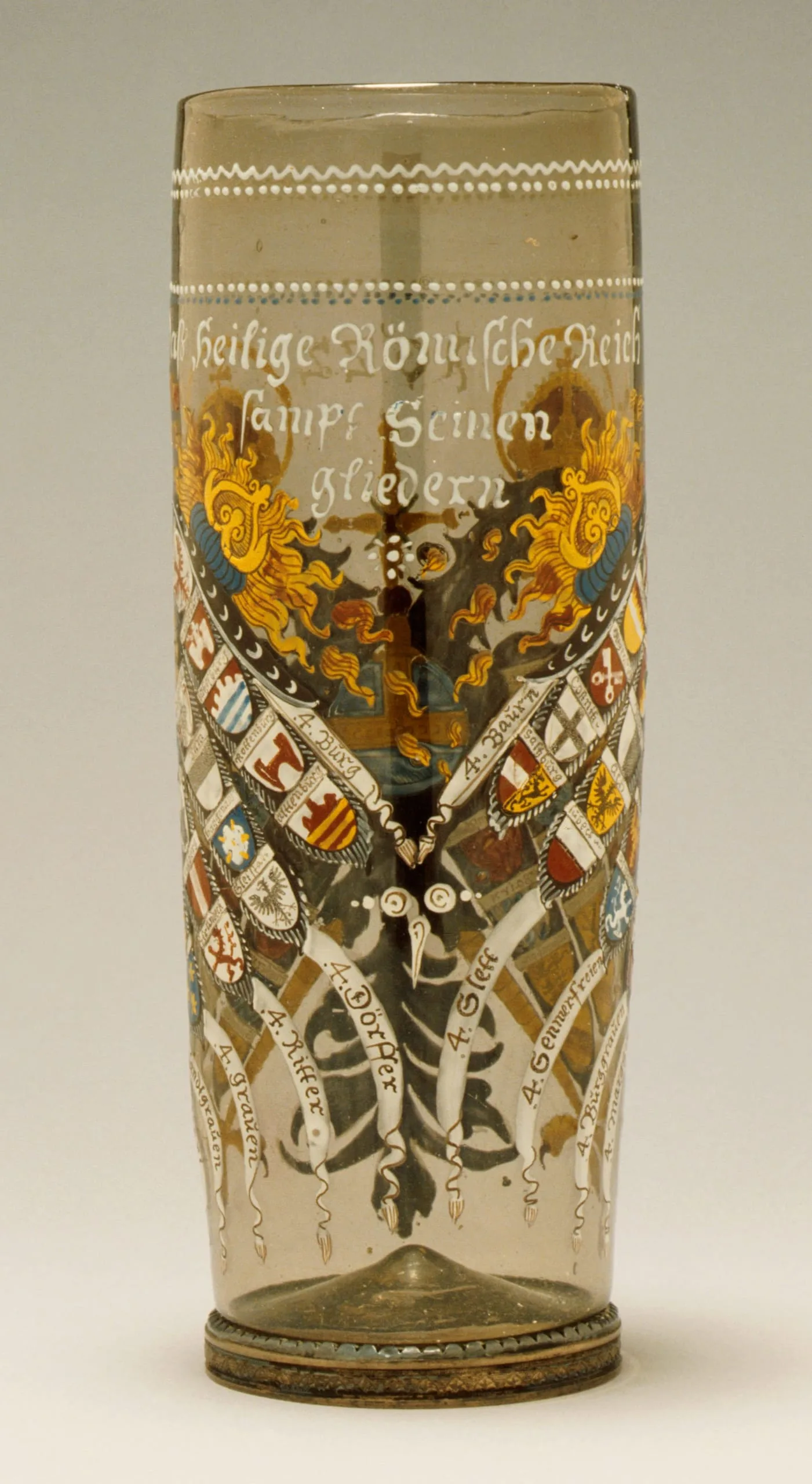
The Reichsadler, or Imperial Eagle, appeared frequently as a decorative motif on drinking vessels from the sixteenth to the eighteenth century. The double-headed eagle served as the coat of arms of the Holy Roman Empire, a monarchy that covered much of France, Germany, Italy, and parts of Central Europe at the height of its power. This tankard depicts a particular version of the Reichsadler known as the Quaternion Eagle, in which fifty-six coats of arms of the prince-electors, estates, and imperial cities of the empire constitute the eagle’s wing feathers. The eagle’s heads are crowned and haloed to signify the monarchy’s divine right to rule, and the holy cross on its chest represents the empire’s Christian foundations. Glass artists achieved the bright colors of the Quaternion Eagle with enamel paints. They combined crushed clear glass, pigments, and a gum binder that allowed the mixture to be brushed onto a glass vessel, which was then fired to fuse the applied powder to the body. Firing the enamel revealed its bright colors and made the decoration durable and stable.
Initially, Venetian glassmakers produced vessels with heraldic motifs for a Northern European market, even after enameled glass fell out of fashion in Venice. As craftspeople and their techniques migrated north, Bohemia and Silesia—part of present-day Germany, Poland, and the Czech Republic—became known as centers of glasswork in the sixteenth and seventeenth centuries. Additional glassmaking districts formed near Potsdam and Dresden, with specific sites determined by the availability of wood for fuel. Because glassmakers circulated between these centers of production, it is now difficult to attribute works to a specific manufacturer.
Beakers with the Quaternion Eagle were popular throughout the Holy Roman Empire, with the term Humpen referring generally to drinking vessels of a cylindrical form. Inscribed “the Holy Roman Empire and all its members,” such glasses represented the unity of the empire and signaled the owner’s allegiance to centers of power. Toasting was an important custom in early modern drinking culture. Individuals of the lower aristocracy and professional classes often owned tankards decorated with symbols of the professional, religious, or political affiliations to which they would toast during community gatherings.
Cynthia Kok
April 2025