LACMA

ShopMembershipMyLACMATickets
LACMA
Los Angeles County Museum of Art
5905 Wilshire Blvd.
Los Angeles, CA 90036
info@lacma.org
(323) 857-6000
Sign up to receive emails
Subscribe
© Museum Associates 2025

Museum Hours

Monday

11 am–6 pm

Tuesday

11 am–6 pm

Wednesday

Closed

Thursday

11 am–6 pm

Friday

11 am–8 pm

Saturday

10 am–7 pm

Sunday

10 am–7 pm


  • About LACMA
  • Jobs
  • Building LACMA
  • Host An Event
  • Unframed
  • Press
  • FAQs
  • Log in to MyLACMA
  • Privacy Policy
© Museum Associates 2025
Collections

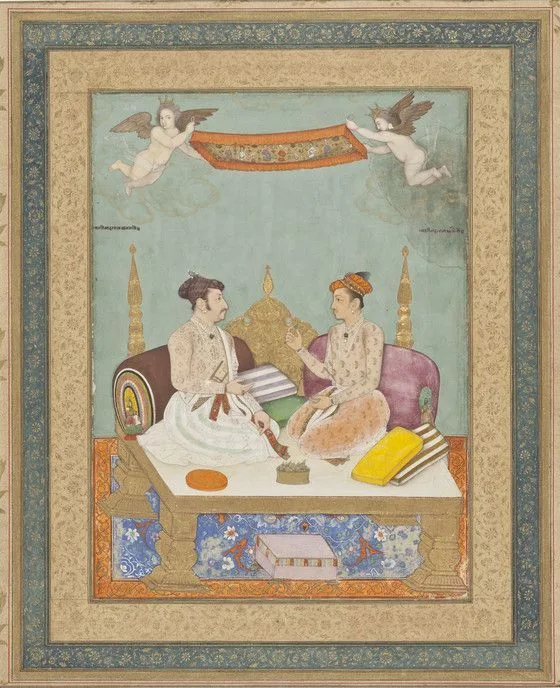
Maharaja Jai Singh of Amber and Maharaja Gaj Singh of Marwar, Folio from the Amber Albumcirca 1630

Not on view
Mughal-style opaque watercolor painting of two men seated cross-legged on a decorated platform, facing each other, with two winged cherubs holding a patterned banner above, set within ornate gold-floral borders
, Maharaja Jai Singh of Amber and Maharaja Gaj Singh of Marwar, Folio from the Amber Album
Title
Maharaja Jai Singh of Amber and Maharaja Gaj Singh of Marwar, Folio from the Amber Album
Place Made
India, Rajasthan, Amber
Date Made
circa 1630
Medium
Opaque watercolor, gold, gesso, and ink on paper
Dimensions
Image: 9 7/8 x 7 1/4 in. (25.08 x 18.42 cm); Sheet: 17 3/4 x 13 1/2 in. (45.09 x 34.29 cm)
Credit Line
From the Nasli and Alice Heeramaneck Collection, Museum Associates Purchase
Accession Number
M.80.6.6
Classification
Drawings
Collecting Area
South and Southeast Asian Art
Curatorial Notes

This painting has been reidentified by Catherine Glynn and Ellen Smart (1997) as depicting Maharaja Jai Singh of Amber (r. 1621-1667; right) enthroned with Maharaja Gaj Singh of Marwar (r. 1619-1638; left). It was previously thought to represent Gaj Singh and the Mughal Prince Shah Shuja, despite the correct identifications given in the Hindi inscriptions above them.

Jai Singh assumed the throne at the age of twelve during the reign of Emperor Jahangir (r. 1605-16217). He later supported Prince Aurangzeb in a successful bid for the throne and served him with distinction by subduing the Maratha ruler Shivaji (r. 1674-1680). In 1666, however, Jai Singh incurred the wrath of Emperor Aurangzeb (r. 1658-1707) by failing to capture the Bijapur Fort. Aurangzeb then conspired with Jai Singh’s youngest son to award him the throne of Amber over his elder brother if he would poison his father in 1667.

Gaj Singh ruled Marwar, one of the leading Rajput courts in Rajasthan. In 1615 he attended Jahangir’s court and fought against Prince Khurram, the future Emperor Shah Jahan (r. 1628-1658), when Khurram rebelled against the emperor in 1622-1624. Gaj Singh, reconciled with Shah Jahan, was appointed governor of the Deccan in 1633. He died in Agra in 1638.

The floral border with gold flowering plants, along with a variant on the reverse with a vacant space for calligraphy, corroborates the Amber attribution based on comparison with other known folios from the Amber Album.

See also M.2001.24.
Selected Bibliography
  • Pal, Pratapaditya, Thomas W. Lentz, Sheila R. Canby, Edwin Binney, 3rd, Walter B. Denny, and Stephen Markel. "Arts from Islamic Cultures: Los Angeles County Museum of Art." Arts of Asia 17, no. 6 (November/December 1987): 73-130.

  • Seligman, Thomas K., and Usha R. Balakrishnan. Enduring Splendor: Jewelry of India's Thar Desert. Los Angeles: Regents of the University of California, 2017.