- Title
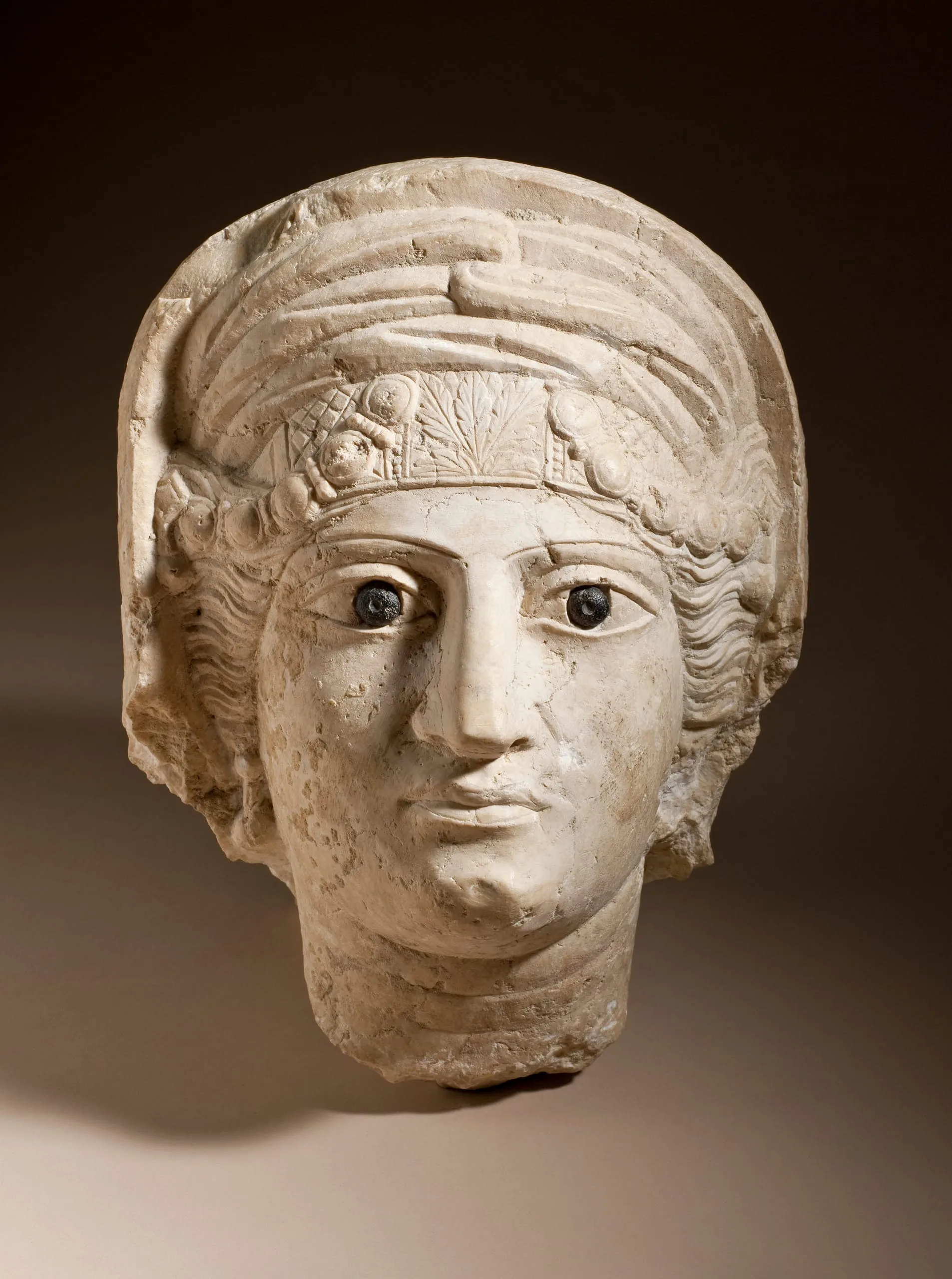
- Funerary Head from Palmyra
- Date Made
- 3rd century
- Medium
- Limestone and glass
- Dimensions
- 10 3/4 × 7 × 5 in. (27.31 × 17.78 × 12.7 cm)
- Accession Number
- M.82.77.2
- Curatorial Notes
The ancient oasis city of Palmyra in Syria was an important waypoint along caravan trade routes between the Persian Gulf and Mediterranean Sea. As the wealth of the city grew during the first and second centuries, local citizens built four major necropolises to commemorate the dead, which included communal burial towers with stacked burial niches (loculi). These loculi were often decorated with high-relief portraits of the deceased and a short dedicatory inscription. This head once belonged to a larger panel that showed the deceased from the waist up (see M.76.174.249). The details of the woman’s dress, including a turbanlike headdress with two strings of descending jewelry and a richly patterned diadem, hint at the finery that would have adorned the rest of her body. Despite its fragmentary state, this sculpture retains an important and rare detail: inlaid black glass eyes, a common original feature of such funerary sculptures.
2024