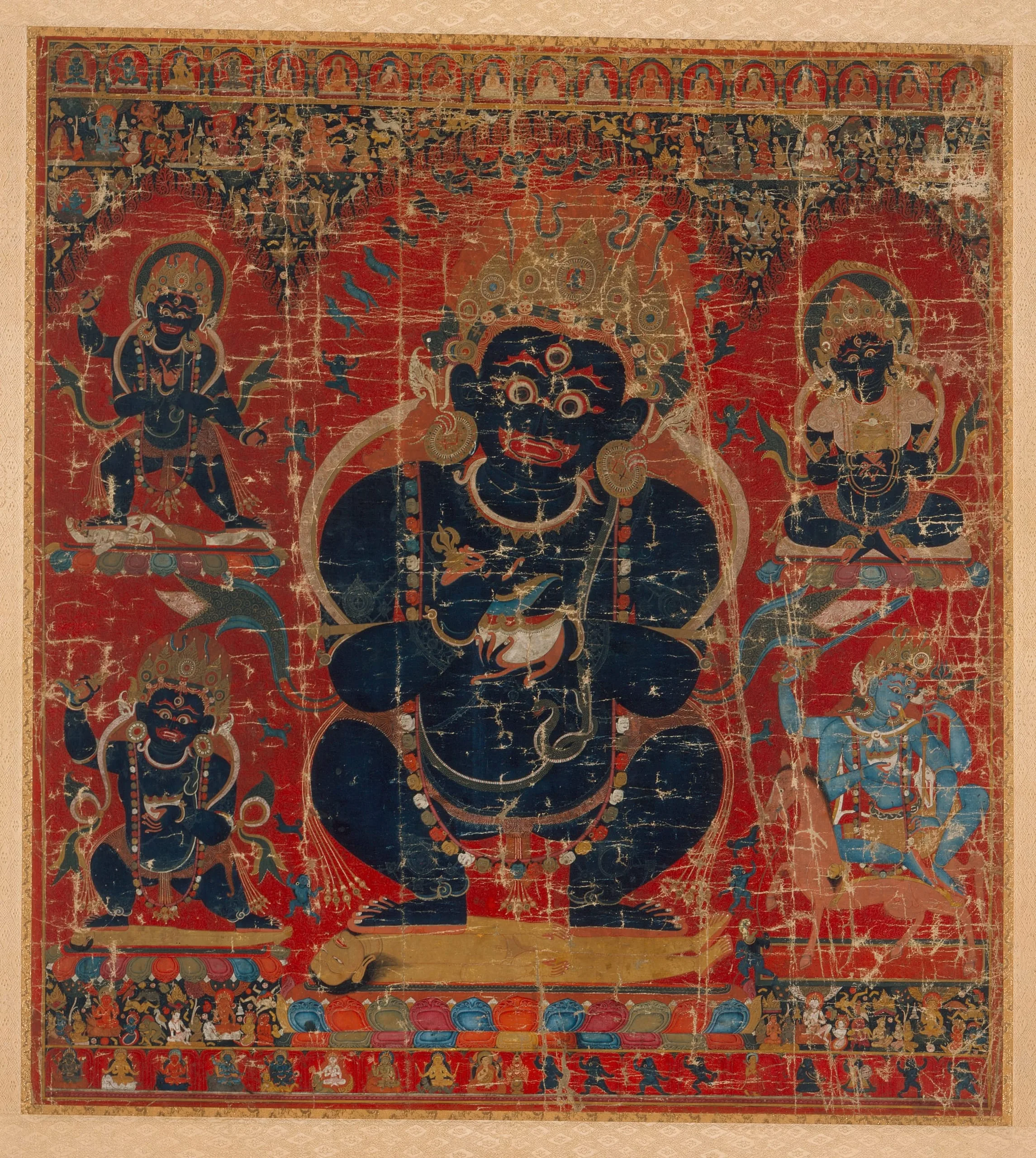
Because his worship is very popular among Tibetan and Mongolian nomads, Mahakala (the Great Black One) is popularly referred to as the "Lord of the Pavilion." According to Tibetan texts, this form of Mahakala stands on top of a defeated enemy amongst a swirling sea of flames. His right hand lifts a chopper, while his left hand holds a skull cup full of blood. Resting across his arms is a magic club, his most distinctive attribute in this form. The club is derived from the wooden gongs used to call monks to assembly and symbolizes Mahakala’s role as the protector of the famed Nalanda monastery in eastern India, and hence, all Buddhist monasteries. Mahakala is crowned with the central blade of his crown bearing a diminutive identifying image (bimba) of the Jina Buddha Akshobhya, who is the emanation source deity of Mahakala.
Mahakala is here surrounded by four major figures. On his upper right is the four-armed wrathful Bhutadamara Vajrapani. On his lower left is the two-armed Legden Nagpo, an emanation of Mahakala. Both deities stand in a militant posture (alidha asana). On his upper left is the two-armed fierce goddess Ekajata wearing a flowered bodice (choli). On his lower right is the great ferocious protectress of the Buddhist religion, Palden Lhamo (Glorious Goddess; Sanskrit: Shri Devi). She has blue skin, is crowned, and wears a serpent belt and a long garland of severed skulls (mundamala). In her four-arms she holds a sword (UR), skull cup with blood (LR), trident (UL) and spear (LL). She rides a wild ass (khyang) in a sea of blood.
In the register along the top of the painting are monks of the Sakyapa lineage led by Vajradhara, Mahakala, the Mahasiddha Indrabhuti, and another unidentified mahasiddha. The lower register along the bottom of the painting are, from left to right, the Eight Guardians of the Directions (ashta dikpala), a seated monk holding a bell (ghanta) and thunderbolt (vajra), four dancing dakinis (Female Sky-goer), a walking Buddha or monk, and four more figures, three of them appear to be angry deities. See also M.77.19.11 and M.79.184.