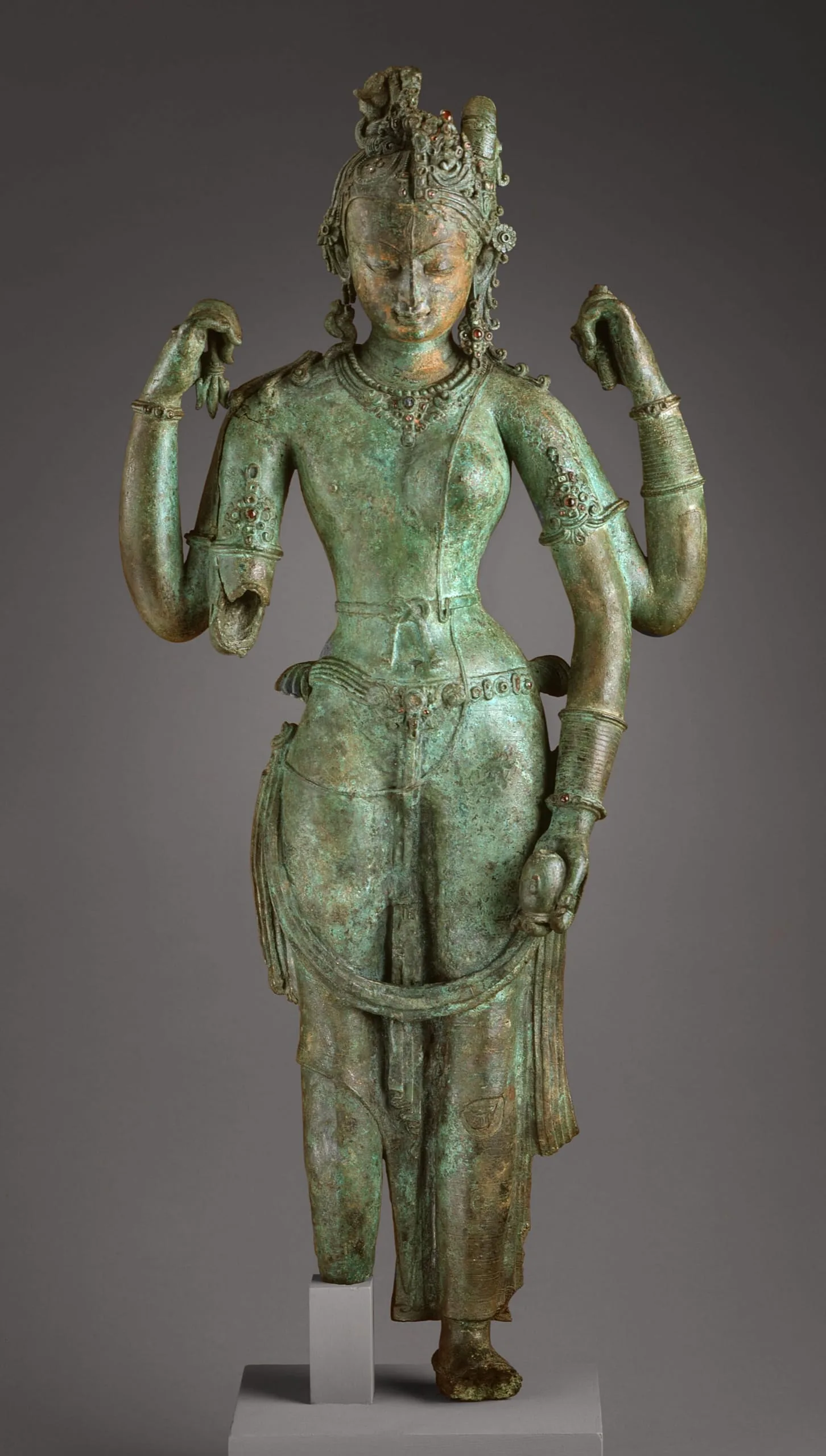
One of the earliest of its type known from Nepal, this jeweled representation of the god Siva and his consort Uma depicts them as one being, Ardhanarisvara, the Lord Whose Half Is Woman. The concept of the androgynous image uniting Siva and Uma was devised by theologians to emphasize the nonduality of the divine principle uniting masculinity and femininity. The fact that such images were conceived in a male-dominated civilization reveals the great importance of the feminine principle in Hindu religious thought.
The gods of the Hindu pantheon are considered to be timeless and unaging beings. They are often represented with a lithe, feminine grace, which permitted the artist to join this figure's distinctly male and female halves with minimal disorientation. Uma has a wide hip and prominent breast; Siva is more angular, his waist less sharply curved. His knee-length roman dips gracefully downward to become Uma's ankle-length garment. His matted locks are piled high in contrast to Uma's elegant coiffure. Balancing these carefully delineated distinctions, the three surviving arms have similar slender, rounded shapes. A strong vertical ellipse, described by the shoulders, lowered arm, and the sash slung across the lower legs, unites the composition. A second ellipse, suggested by the two raised arms, with its apex at the brow, overlaps and encompasses the first. These circumferences reveal themselves slowly, encouraging an unhurried meditation on the smooth, curved forms and reinforcing the sense of cosmic unity the image is intended to convey. Its sense of calm and balance shows the influence of Indian Gupta art.