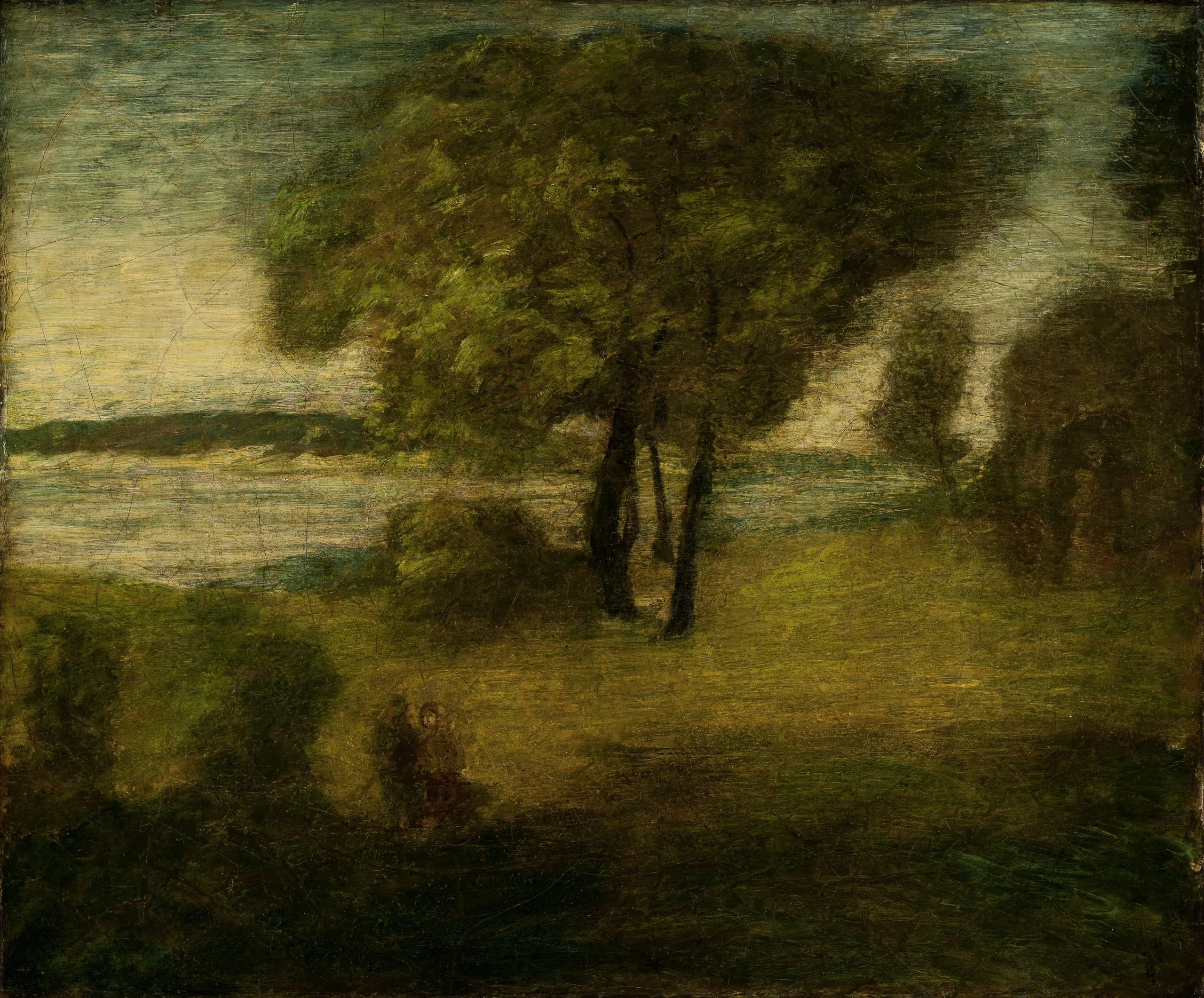
Ryder’s work is among the most powerfully visionary and formally expressive that our country has produced. So strong are his small paintings that Ryder’s life-work of only about 160 paintings has been sufficient to generate a posthumous reputation amounting at times to adulation.
Although firmly based in naturalism, Ryder’s style involved the extreme simplification of elements and their arrangement in terms of an overall rhythmic force and harmony. Like others of his pure landscapes, The River is closer to naturalism than to the dramatic designs characteristic of Ryder’s literary subjects and nocturnal marines. The scale of the indistinct figures in the left foreground and near the center of the right edge of the painting suggests that they are staffage rather than specific literary characters. As a delicately colored daytime scene rather than his characteristically more emotional nocturnal or crepuscular views, The River also partakes more of the quality of a straightforward landscape, albeit with the visionary feeling that informs all of the artist’s works.
Ryder never dated his paintings, and the unequal deterioration of different works adds to the difficulty of establishing dates. Ryder’s friend, the artist Charles Melville Dewey (1849-1937), suggested that The River could be dated between 1884 and 1894. He also indicated that the painting stood on an easel at Ryder’s bedside during his last illness. Because Ryder is known to have reworked his paintings again and again, it is difficult to determine how much of the final design dates from the period specified by Dewey. As is characteristic of Ryder’s work, scientific examination of The River reveals a substantially different earlier design. Infrared photography, which can show changes just below the surface layer, reveals changes near the center of the right-hand edge of the painting: there is a second ghostly figure, and the distinctly rounded, archlike shape of the dark area behind the figures suggests that it is the entrance to a cave or building (see illustration). These two figures probably represent an earlier placement of the two figures in the left foreground rather than additional figures relating to them in a narrative sense.
The fact that the painting came into the possession of Ryder’s executor, Charles Melville Dewey, raises the question of whether The River may have been completed by Dewey, who had restored certain deteriorated paintings with Ryder’s approval and presumably with his advice. Perhaps he was the one who filled and inpainted the large cracks, work that appears to have been done before the painting was acquired by Paul Rodman Mabury in 1920. It was Lloyd Goodrich’s opinion that Dewey did not repaint the picture; he wrote to the museum in 1962, "I hasten to add that your painting seems to me entirely characteristic of Ryder in style and technique, and that it shows no evidence of having been tampered with."