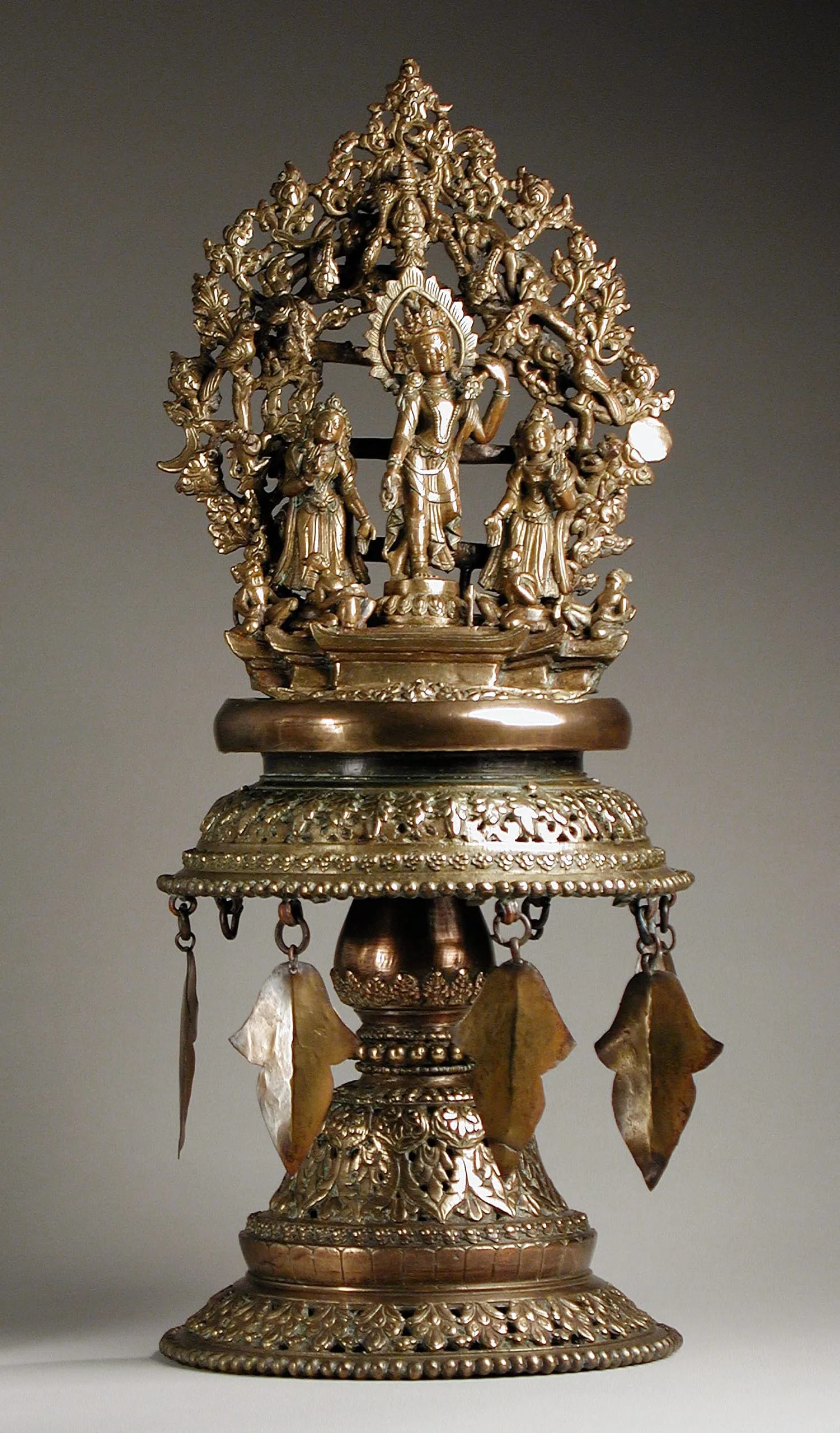
Ornate oil lamps may have entered the artistic traditions of Southern Asia through early trade contact with Roman and Byzantine oil lamps. They have long been used in places of worship and for domestic rituals by adherents of all the major religions throughout the diverse regions of South Asia, Southeast Asia, and the Himalayas. Burning oil lamps help demarcate and purify a sacred space, and they can symbolize a practitioner’s enlightenment. See Sean Anderson, Flames of Devotion: Oil Lamps from South and Southeast Asia and the Himalayas (Los Angeles: UCLA Fowler Museum of Cultural History, 2006).
This ornate lamp features a flaring pedestal base with tiers of openwork floral and foliate motifs, lotus petals, and pearl borders. The neck above the mid-ridge is plain. Hastate-form leaves dangle like tassels from the broad shoulder supporting the round copper burner dish for the oil and wick. The finial is an elaborate shrine with the Buddhist divinity Chintamani Lokeshvara (Wish-Fulfilling Gem Lord of the World) and attendants beneath an aureola (prabhavali) in the form of two celestial wish-fulfilling trees (kalpa vriksha) that form a luxurious canopy of foliage inhabited by birds and monkeys. Embodying wealth, abundance, and fertility, Chintamani Lokeshvara is a Newar form of the Bodhisattva Avalokiteshvara. He is nimbate and wears copious jewelry. His right hand is held in the gesture of charity (varada mudra) symbolic of his munificence. He stands gracefully with his legs crossed at the ankles and his left hand reaching up to grasp a garland of gems dangling from a wish-fulfilling tree. Directly above Chintamani Lokeshvara’s nimbus is his diminutive identifying image (bimba) of the Jina Buddha Amitabha, who is the emanation source deity of Avalokiteshvara. Above Amitabha is a small stupa symbolizing Chintamani Lokeshvara’s spiritual connection to the Five Jina Buddhas. At the outer ends of the horizontal axis of the aureola are a sun disk and crescent moon representing respectively transcendent wisdom and compassion, and their union producing enlightenment. Chintamani Lokeshvara is flanked by the goddesses Green (Shyama) Tara (proper right) and White (Sita) Tara (proper left). They both display the gesture of charity with their inner hands. At the base of the shrine, two demigods (yakshas) collect gems falling from the wish-fulfilling tree. They are flanked by two animal-headed demigods sitting on a folded leg and gazing upward at the deities.
See Himalayan Art Resources, no. 85774, https://www.himalayanart.org/items/85774. See also M.84.93. A comparable Nepalese lamp base is in the Fowler Museum of Cultural History, UCLA (X2001.11.85).