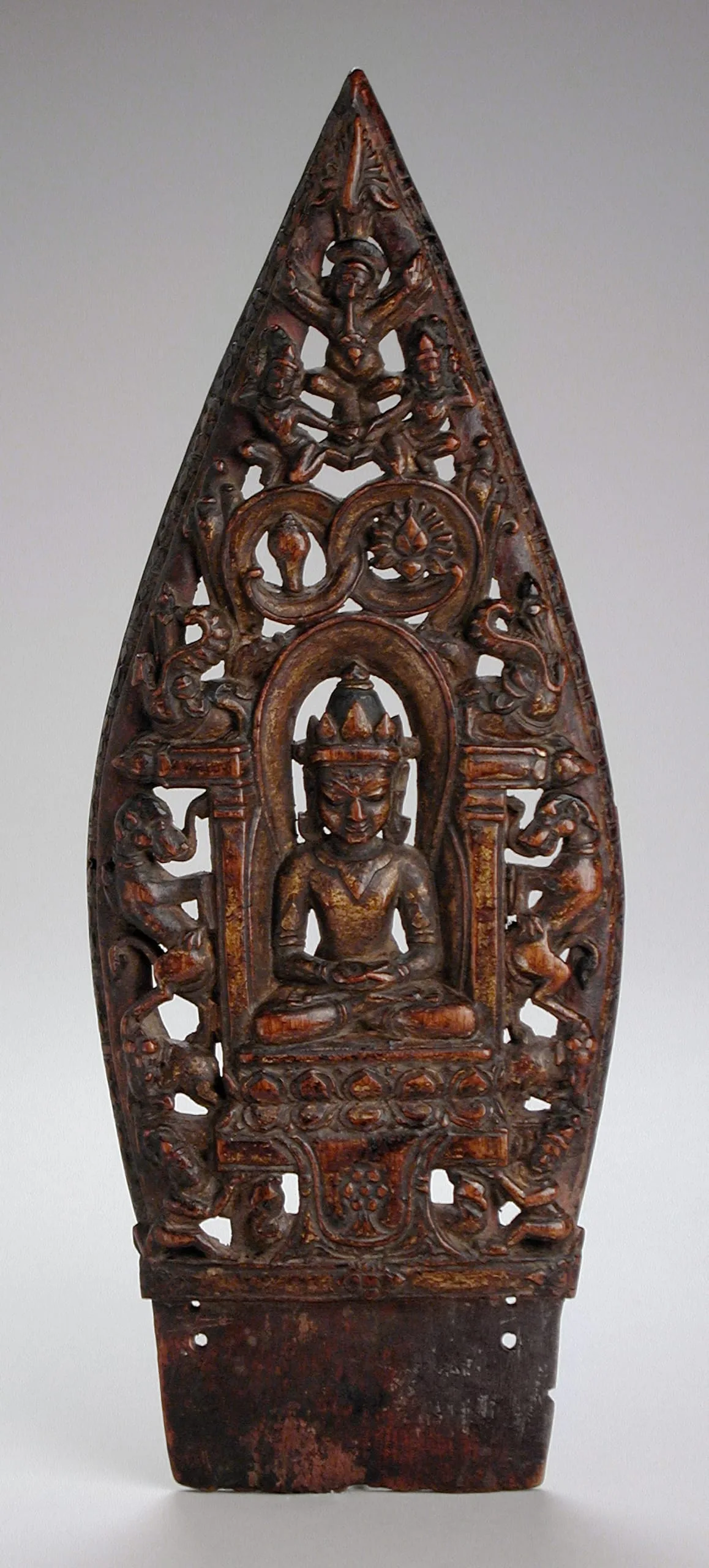
Amitabha, the Jina Buddha of Infinite Light, is the presiding deity on this wooden plaque from a Vajrayana Buddhist ritual diadem consisting of five crown points, each graced by a different Jina Buddha (see its mate M.79.151.1). The Five Jina Buddhas are Amitabha (Infinite Light), Vairochana (Intensely Luminescent One), Akshobhya (Unshakeable One), Ratnasambhava (Jewel Born), and Amoghasiddhi (Unfailing Success). These five Buddhas, who are emanations of the Adi Buddha (Primordial Enlightened One), represent the state and qualities of Buddhahood and the essence of the Buddhist Dharma. Each Buddha has a specific mudra, insight, symbol, color, vehicle, and rules a cardinal direction or the zenith. See M.74.139.15 and M.91.116.
Amitabha is the transcendental Buddha of discriminating wisdom. He is also widely worshipped throughout Asia as the Buddha presiding over the Sukhavati (Pure Land of Bliss) Paradise in the West, where Buddhists can be reborn endlessly while they wait to attain enlightenment. Amitabha is nimbate, crowned, and has elongated earlobes symbolizing his renunciation of the material world. His hands are held in the gesture of meditation (dhyana mudra). He is seated in the meditation posture (padma asana) on a lotus throne supported by serpent kings (naga raja). His peacock (mayura) mounts flank the throne’s overhanging carpet. There is a complex throneback (see also M.2001.1). It has the standard iconographic side elements of an elephant being trampled by a rearing horned leonine creature (vyala or shardula). Lying on the throne crossbars are heralding mythical aquatic creatures (makara). Above Amitabha’s head are roundels with two of the Eight Auspicious Symbols of Buddhism (Ashta Mangala), the lotus and conch. Two more serpents and an elephant-headed Garuda with outstretched arms stand on the roundels beneath a Bodhi Tree (Ficus religiosa) at the crown apex.