LACMA

ShopMembershipMyLACMATickets
LACMA
Los Angeles County Museum of Art
5905 Wilshire Blvd.
Los Angeles, CA 90036
info@lacma.org
(323) 857-6000
Sign up to receive emails
Subscribe
© Museum Associates 2026
  • About LACMA
  • Jobs
  • Host An Event
  • Unframed
  • Press
  • FAQs
  • Log in to MyLACMA
  • Privacy Policy
© Museum Associates 2026
Collections

Unknown
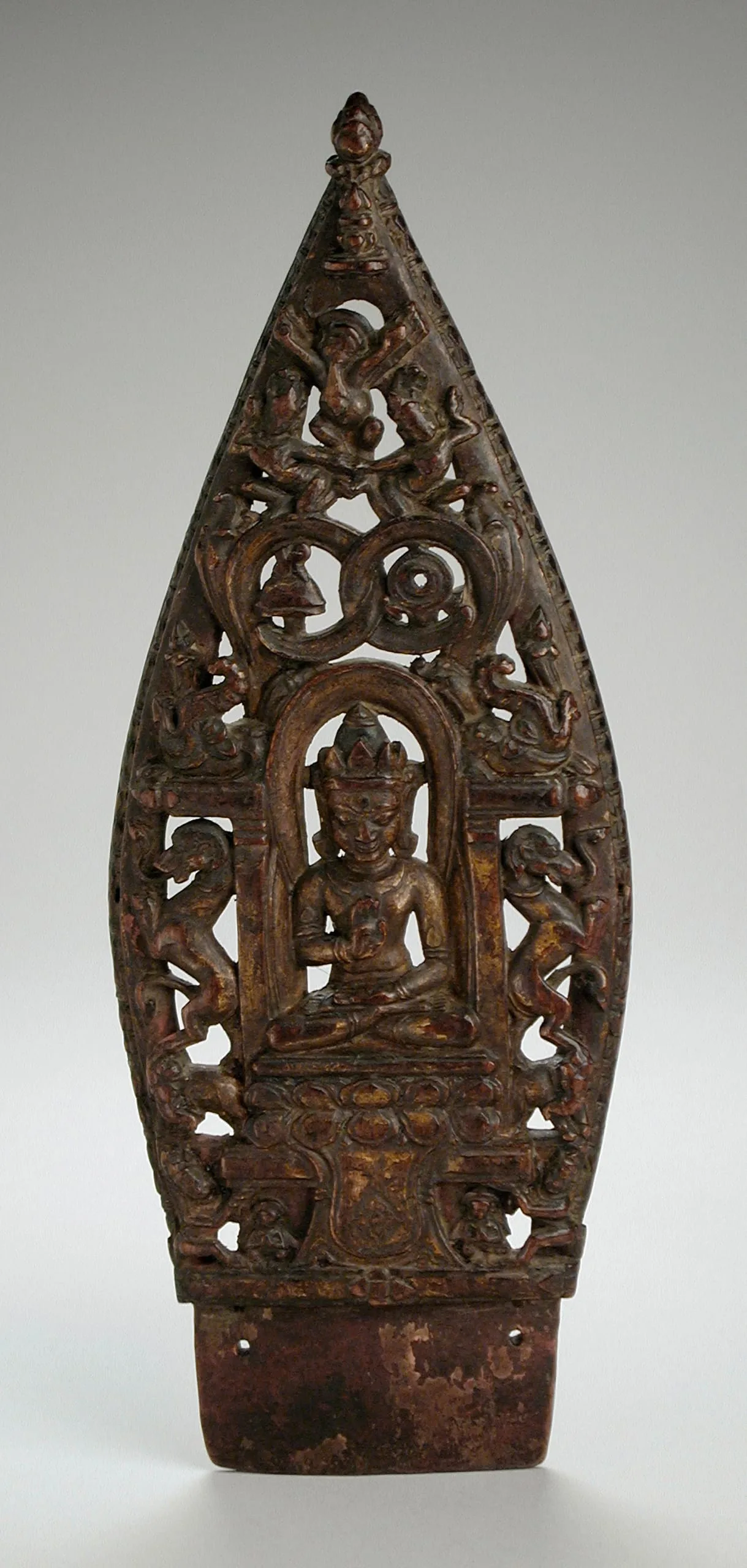
Ritual Diadem Plaque with the Jina Buddha Amoghasiddhi13th-14th century

Not on view
Bronze sculpture of a flame-shaped aureole with openwork scrolling decoration, centered on a crowned seated figure in a niche, with traces of gold and red pigment

Unknown, Ritual Diadem Plaque with the Jina Buddha Amoghasiddhi, 13th-14th century, Los Angeles County Museum of Art, Gift of Dr. and Mrs. Pratapaditya Pal, photo © Museum Associates/LACMA

Artist or Maker
Unknown
Title
Ritual Diadem Plaque with the Jina Buddha Amoghasiddhi
Place Made
Western or Central Tibet
Date Made
13th-14th century
Medium
Wood with traces of gilding and lacquer
Dimensions
12 1/2 x 5 in. (31.75 x 12.7 cm)
Credit Line
Gift of Dr. and Mrs. Pratapaditya Pal
Accession Number
M.79.151.1
Classification
Sculpture
Collecting Area
South and Southeast Asian Art
Curatorial Notes

Amoghasiddhi, the Jina Buddha of Unfailing Success, is the presiding deity on this wooden plaque from a Vajrayana Buddhist ritual diadem consisting of five crown points, each graced by a different Jina Buddha (see its mate M.79.151.2). The Five Jina Buddhas are Amitabha (Infinite Light), Vairochana (Intensely Luminescent One), Akshobhya (Unshakeable One), Ratnasambhava (Jewel Born), and Amoghasiddhi. These five Buddhas, who are emanations of the Adi Buddha (Primordial Enlightened One), represent the state and qualities of Buddhahood and the essence of the Buddhist Dharma. Each Buddha has a specific mudra, insight, symbol, color, vehicle, and rules a cardinal direction or the zenith. See M.74.139.15 and M.91.116.

Amoghasiddhi is the transcendental Buddha of perfected action. He is nimbate, crowned, and has elongated earlobes symbolizing his renunciation of the material world. His right hand is held in the gesture of reassurance (abhaya mudra). His left hand is in his lap held palm upward in a half-gesture of meditation (ardha dhyana mudra). He is seated in the meditation posture (padma asana) on a lotus throne supported by serpent kings (naga raja). His Garuda mounts with their hands held in the gesture of adoration (anjali mudra) flank the throne’s overhanging carpet. There is a complex throneback (see also M.2001.1). It has the standard iconographic side elements of an elephant being trampled by a rearing horned leonine creature (vyala or shardula). Lying on the throne crossbars are heralding mythical aquatic creatures (makara). Above Amitabha’s head are roundels with two of the Eight Auspicious Symbols of Buddhism (Ashta Mangala), the bell and wheel. Two more serpents and an elephant-headed Garuda with outstretched arms stand on the roundels beneath a thunderbolt (vajra) at the crown apex.
Selected Bibliography
  • Pal, Pratapaditya. Art of Tibet. Los Angeles; Berkeley, CA: Los Angeles County Museum of Art; University of California Press, 1983.
  • Pal, Pratapaditya. Art of Tibet. Expanded edition. Los Angeles: Los Angeles County Museum of Art, 1990.
  • Little, Stephen, Tushara Bindu Gude, Karina Romero Blanco, Silvia Seligson, Marco Antonio Karam. Las Huellas de Buda. Ciudad de México : Instituto Nacional de Antropología e Historia, 2018.
  • Little, Stephen, and Tushara Bindu Gude. Realms of the Dharma: Buddhist Art across Asia. Los Angeles: Los Angeles County Museum of Art, 2025.