LACMA

ShopMembershipMyLACMATickets
LACMA
Los Angeles County Museum of Art
5905 Wilshire Blvd.
Los Angeles, CA 90036
info@lacma.org
(323) 857-6000
Sign up to receive emails
Subscribe
© Museum Associates 2025

Museum Hours

Monday

11 am–6 pm

Tuesday

11 am–6 pm

Wednesday

Closed

Thursday

11 am–6 pm

Friday

11 am–8 pm

Saturday

10 am–7 pm

Sunday

10 am–7 pm


  • About LACMA
  • Jobs
  • Building LACMA
  • Host An Event
  • Unframed
  • Press
  • FAQs
  • Log in to MyLACMA
  • Privacy Policy
© Museum Associates 2025
Collections

Unknown
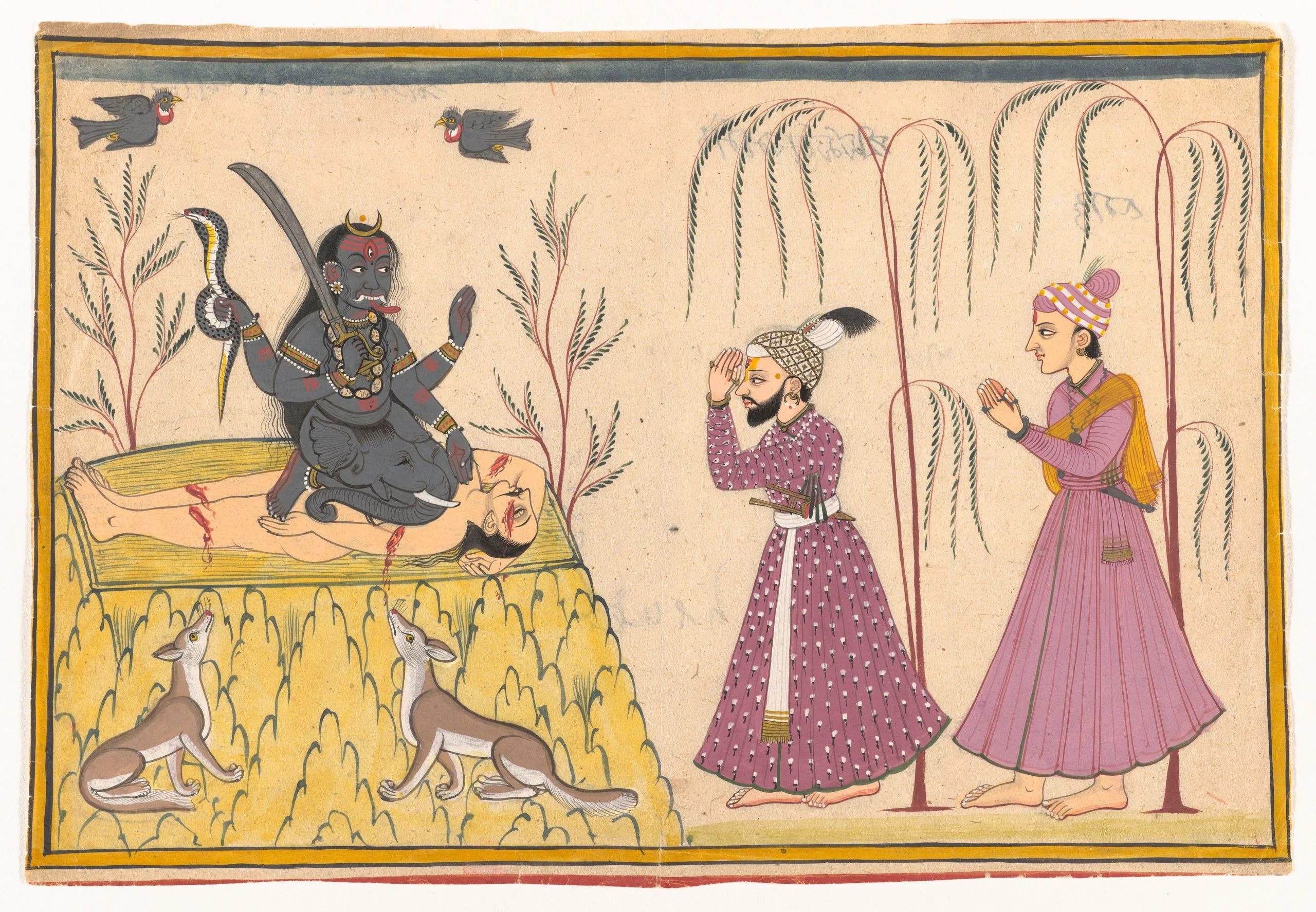
Raja Surma Sen of Mandi (r. 1781-1788) and His Attendant Nagatu Worshipping the Goddess Kalicirca 1785

Not on view
Indian opaque watercolor painting showing a blue multi-armed deity seated on a prone figure, flanked by grain stalks and jackals, while two robed men in turbans press their palms together in veneration beneath willow trees
Artist or Maker
Unknown
Title
Raja Surma Sen of Mandi (r. 1781-1788) and His Attendant Nagatu Worshipping the Goddess Kali
Place Made
India, Himachal Pradesh, Mandi
Date Made
circa 1785
Medium
Opaque watercolor, gold, and silver on paper
Dimensions
Sheet (Sheet): 7 7/8 x 11 5/8 in. (20.0025 x 29.5275 cm) Image (Image): 7 1/4 x 11 1/8 in. (18.415 x 28.2575 cm) Frame: 14 × 19 in. (35.56 × 48.26 cm)
Credit Line
Indian Art Special Purpose Fund
Accession Number
M.79.66
Classification
Drawings
Collecting Area
South and Southeast Asian Art
Curatorial Notes

Raja Surma Sen of Mandi (r. 1781-1788) was the son of Raja Shamsher Sen of Mandi (r. 1727-1781; see M.74.5.10). While a young prince Surma Sen was targeted by Dhurchatia, the ambitious and powerful stepbrother of Shamsher Sen who wished to seize control of the kingdom for himself rather than allow Surma Sen to succeed his father. Consequently, in 1774 Surma Sen fled first to Bilaspur and then to Kangra, both in present-day Himachal Pradesh, where he was generously given refuge by Raja Tegh Chand of Kangra (r. 1774-1775). Surma Sen returned triumphantly to Mandi with Tegh Chand’s military aid and Dhurchatia was exiled to asylum in rival Suket.

In this painting, the barefoot Surma Sen and his attendant Nagatu are paying obeisance to the four-armed Hindu goddess of destruction, Kali (“Destroyer of Time”). Kali is a terrifying manifestation embodying the divine wrath of the Hindu goddess Durga (“Unconquerable One”). Kali is envisioned with horrific imagery. She is depicted here with fangs, a lolling tongue, a third eye on her forehead, and Shiva’s crescent moon as a tiara. Kali holds a sword and a cobra in her right hands and her left hands are held in the gestures of fear not and charity (towards Surma Sen). She wears a garland of skulls and an elephant head skirt. She knells on a corpse on a mountain top cremation ground venerated by jackals and crows.

A comparable portrait of Surma Sen is in the Harn Museum of Art, University of Florida, Gainesville (PA-69-29).
Selected Bibliography
  • Larson, Gerald et al. In Her Image: The Great Goddess in Indian Asia and the Madonna in Christian Culture. Santa Barbara: UCSB Art Museum, University of California, 1980.