LACMA

ShopMembershipMyLACMATickets
LACMA
Los Angeles County Museum of Art
5905 Wilshire Blvd.
Los Angeles, CA 90036
info@lacma.org
(323) 857-6000
Sign up to receive emails
Subscribe
© Museum Associates 2026
  • About LACMA
  • Jobs
  • Building LACMA
  • Host An Event
  • Unframed
  • Press
  • FAQs
  • Log in to MyLACMA
  • Privacy Policy
© Museum Associates 2026
Collections

Unknown
The Arhat Abheda15th-16th century

Not on view
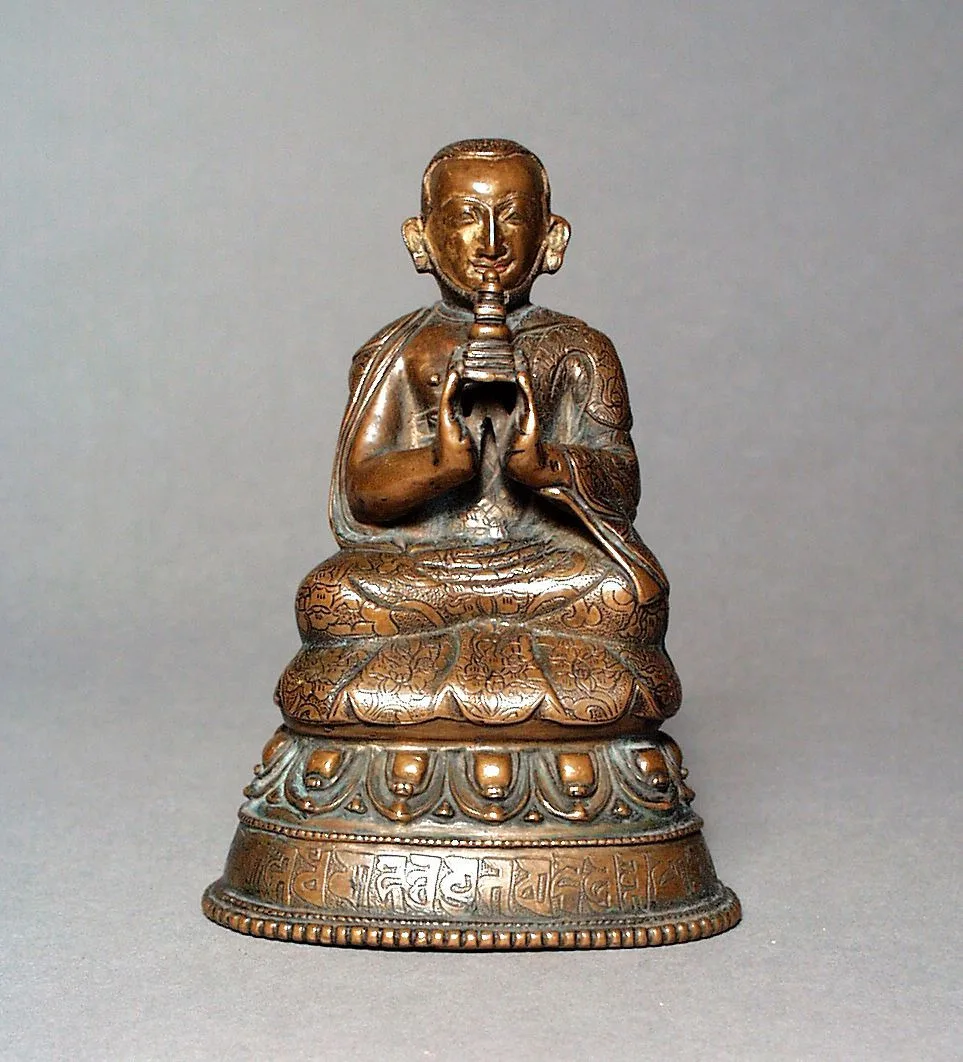
Small bronze sculpture of a robed seated figure holding a ritual object, on an inscribed lotus throne with beaded base, warm reddish-gold patina

Unknown, The Arhat Abheda, 15th-16th century, Los Angeles County Museum of Art, Indian Art Special Purpose Fund, photo © Museum Associates/LACMA

Artist or Maker
Unknown
Title
The Arhat Abheda
Place Made
Eastern Tibet
Date Made
15th-16th century
Medium
Leaded copper-zinc-tin alloy with traces of paint
Dimensions
6 1/2 x 4 1/2 in. (16.51 x 11.43 cm)
Credit Line
Indian Art Special Purpose Fund
Accession Number
M.79.67
Classification
Sculpture
Collecting Area
South and Southeast Asian Art
Curatorial Notes

The Arhat (Buddhist saint) Abheda (Without Fracture) was also known as Abheda the Elder or Subinda. A contemporary of the historical Buddha Shakyamuni (traditionally dated to 563–483 BCE), he was born into a wealthy Brahmin family in Rajagriha (modern Rajgir), Bihar. He is one of the Sixteen (and later Eighteen) Great Arhats who were perfected individuals commissioned by the Buddha to be custodians of the Dharma (Buddhist law) until the arrival of the future Buddha, Maitreya. He is represented in his standard iconography as supporting an enlightenment stupa (reliquary monument) with both hands. He has cropped hair, wears a flowered outer robe (sanghati), and is seated cross-legged on a lotus base.

The Sanskrit inscription in siddha script inscribed around the base is the Buddhist creed: The Buddha has explained the cause of all things that arise from a cause. He, the great monk, has also explained their cessation.

See also M.2005.154.1. A comparable sculpture of Abheda, albeit attributed to the 18th-19th century, is in the British Museum, London (1954,0222.2).
Selected Bibliography
  • Pal, Pratapaditya. Art of Tibet. Los Angeles; Berkeley, CA: Los Angeles County Museum of Art; University of California Press, 1983.
  • Reedy, Chandra L. Himalayan Bronzes: Technology, Style and Choices. Newark: University of Delaware Press, 1997.
  • Pal, Pratapaditya. Art of Tibet. Expanded edition. Los Angeles: Los Angeles County Museum of Art, 1990.