- Artist or Maker
- Basawan
India, active circa 1565-1598 - Title
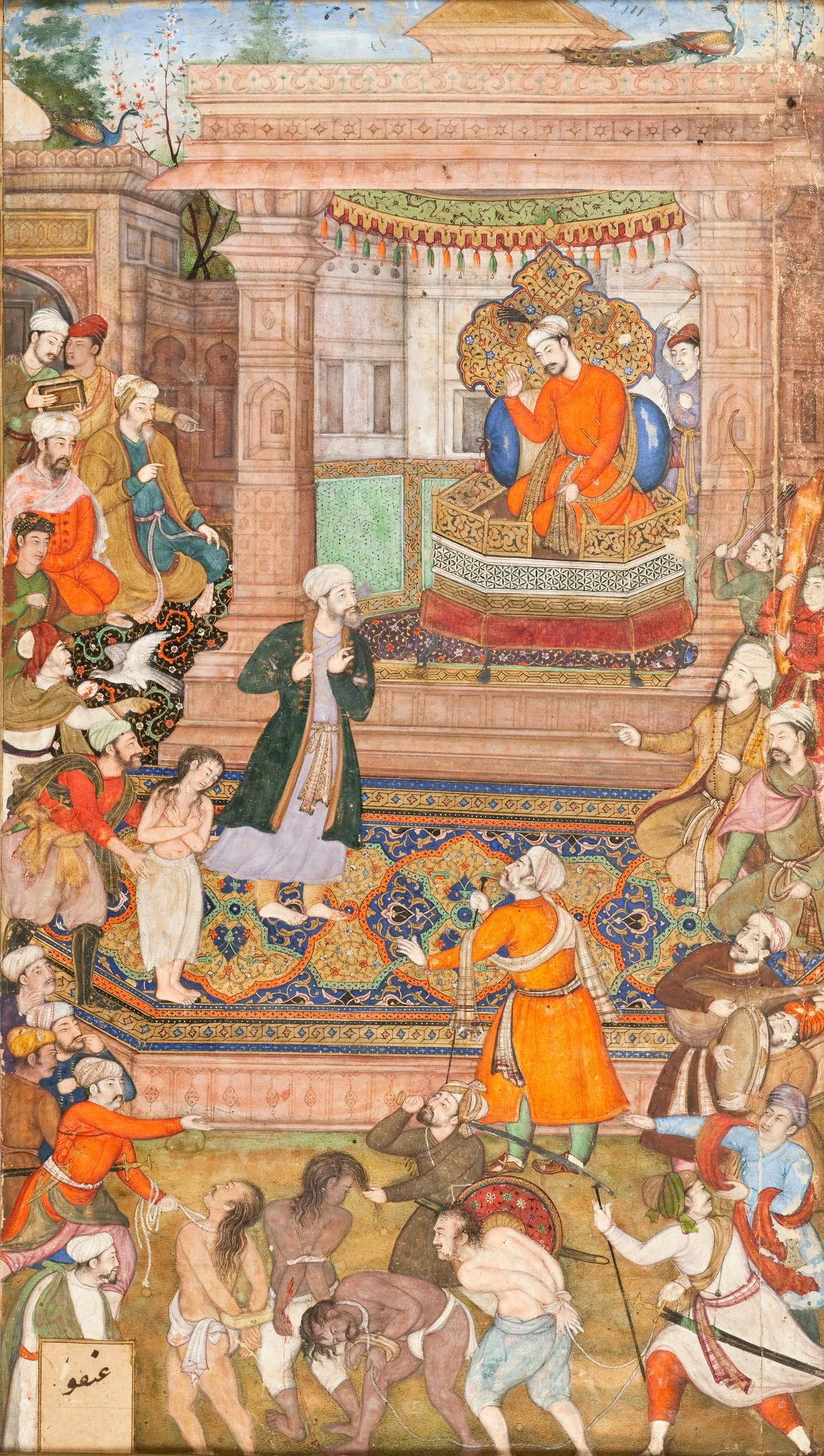
- The Vizier Pleads for the Life of the Robber’s Son (recto), Calligraphy (verso), Folio from a Manuscript of Sa'di's Gulistan (Rose Garden)
- Date Made
- colophon dated 1596
- Medium
- Opaque watercolor, gold, and ink on paper
- Dimensions
- Image: 10 3/8 x 5 3/4 in. (26.35 x 14.61 cm); Sheet: 11 1/4 x 6 1/16 in. (28.58 x 15.4 cm)
- Accession Number
- M.79.9.12
- Curatorial Notes
The Gulistan (Rose Garden) is a compilation of moralistic tales. Considered one of the gems of Persian literature, it was written in 1258 in Shiraz by the celebrated Persian poet Sa'di (1210-1291). Illustrated copies of the text were frequently produced for the Persian and Mughal courts. This folio is from a now-dispersed manuscript of the Gulistan dated in its colophon to 1596. Eight additional folios are now in the Cincinnati Art Museum (1950.284–.288, 1950.290, 1951.299–.300).
This folio is ascribed in a marginal inscription to the great Mughal painter Basawan (active circa 1565-1598). It depicts an episode from Chapter 1, Tale 4 of the text, in which a young son of a member of a gang of captured robbers was brought to court for sentencing. The kindly vizier pleaded with the monarch to spare the boy’s life on the promise that he would raise and educate him to be an honest man. The cynical ruler reluctantly agreed, and the vizier made every effort to bring up the boy properly. But two years later the boy connived with local robbers to kill the vizier and abscond with his benefactor’s wealth. The moral of the story, in the words of the king, is, “How can a man fabricate a good sword of bad iron?” Here, the pleading vizier and the seemingly repentant youth stand on an exquisite carpet before the enthroned king in a pavilion. Four bound robbers under guard are in the foreground. Various courtiers participating in the deliberations are grouped along the sides of the painting.
- Selected Bibliography
- Pal, Pratapaditya. Indian Painting, vol.1. Los Angeles: Los Angeles County Museum of Art, 1993.
- Rosenfield, John. The Arts of India and Nepal: The Nasli and Alice Heeramaneck Collection. Boston: Museum of Fine Arts, Boston, 1966.
- Heeramaneck, Alice N. Masterpieces of Indian Painting : From the Former Collections of Nasli M. Heeramaneck. New York: A.N. Heeramaneck, 1984.
Pal, Pratapaditya, Thomas W. Lentz, Sheila R. Canby, Edwin Binney, 3rd, Walter B. Denny, and Stephen Markel. "Arts from Islamic Cultures: Los Angeles County Museum of Art." Arts of Asia 17, no. 6 (November/December 1987): 73-130.