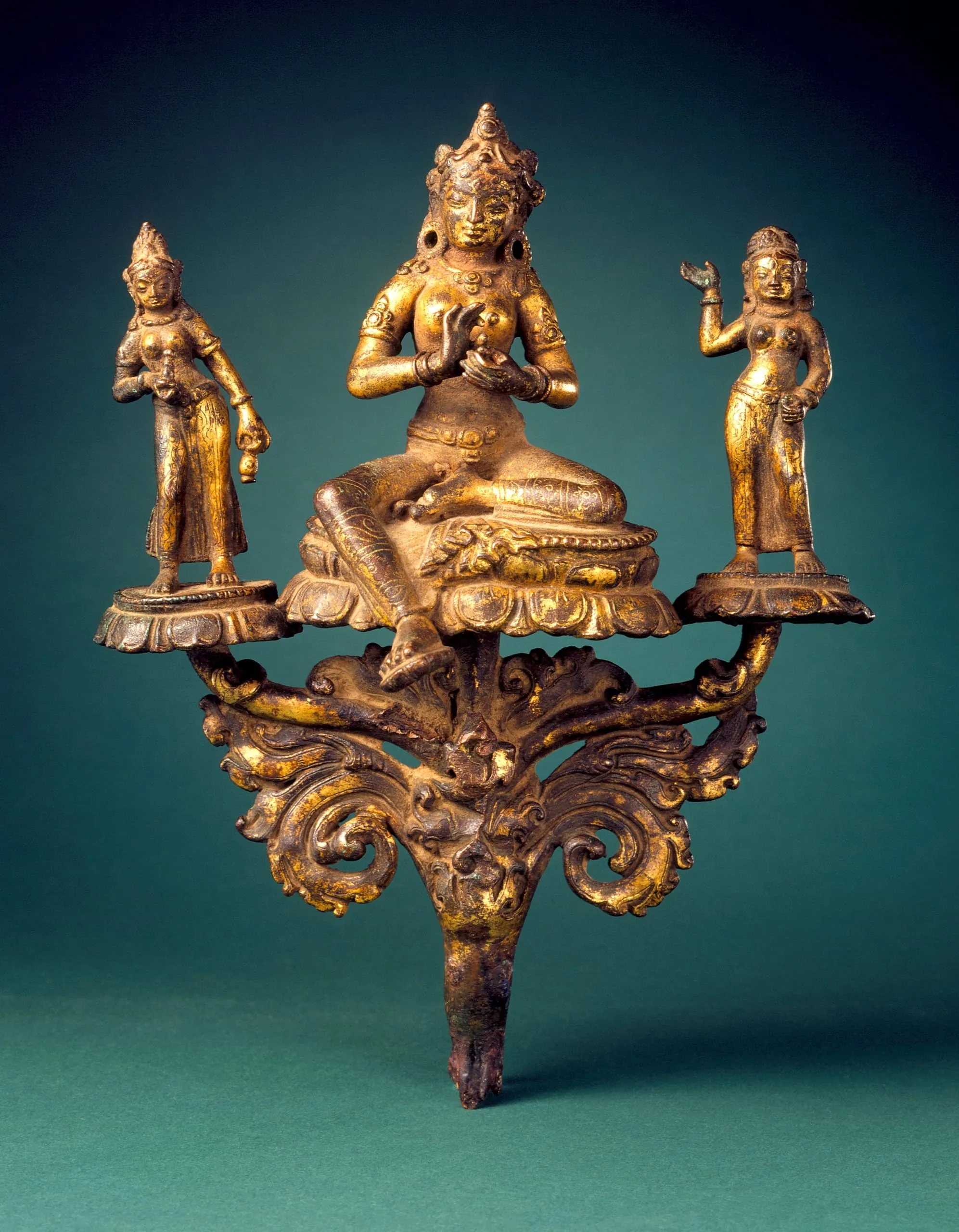
Mahashri Tara (Great Splendor Tara) is a compassionate manifestation of the Buddhist goddess Shyama (Green) Tara, who is highly venerated in Nepal (see M.91.232.7). She is revered as a female Buddha who swiftly protects seekers and grants spiritual liberation. There are many forms of Tara, all of whom help practitioners overcome hindrances and difficulties on the path to Enlightenment. Each Tara has a different symbolic character and associated color. Green Tara is a gracious form regarded as the savioress from all suffering and the symbol of Enlightenment in female form. She is often propitiated for longevity.
Mahashri Tara is the central deity in this divine triad emerging from a lush blossoming lotus stalk that supports the lotus bases under the enthroned goddesses. She is crowned, copiously ornamented, and wears a patterned dhoti. Her hands are held in the teaching gesture of Turning the Wheel of the Law (dharmachakra mudra or dharmachakra-pravartana mudra). She is seated on a lotus base in a relaxed posture (lalita asana) with her right leg pendant and supported by the pericarp of a lotus flower (karnika). Mahashri Tara is flanked on her proper right by the solar goddess Ashokakanta (She who is beloved of the Ashoka tree). She holds the thunderbolt (vajra) in her right hand and carries a ritual vase (kalasha) in her left hand. On Mahashri Tara’s proper left is the wrathful Ekajata (She who has a single bun/chignon), who is also known as Ugra (Blue) Tara. Ekajata raises her right hand in an open-palm gesture of salutation that pays homage to the teachings of the Buddha (tathagata vandana mudra). She holds an indeterminate object with her left hand resting on her hip.
A comparable Tibetan triad with Amitayus and Taras on a burgeoning lotus stalk, attributed to circa 15th century, is in the Metropolitan Museum of Art, New York (1979.507.1).