LACMA

ShopMembershipMyLACMATickets
LACMA
Los Angeles County Museum of Art
5905 Wilshire Blvd.
Los Angeles, CA 90036
info@lacma.org
(323) 857-6000
Sign up to receive emails
Subscribe
© Museum Associates 2025

Museum Hours

Monday

11 am–6 pm

Tuesday

11 am–6 pm

Wednesday

Closed

Thursday

11 am–6 pm

Friday

11 am–8 pm

Saturday

10 am–7 pm

Sunday

10 am–7 pm


  • About LACMA
  • Jobs
  • Building LACMA
  • Host An Event
  • Unframed
  • Press
  • FAQs
  • Log in to MyLACMA
  • Privacy Policy
© Museum Associates 2025
Collections

Jean-Baptiste-Siméon Chardin
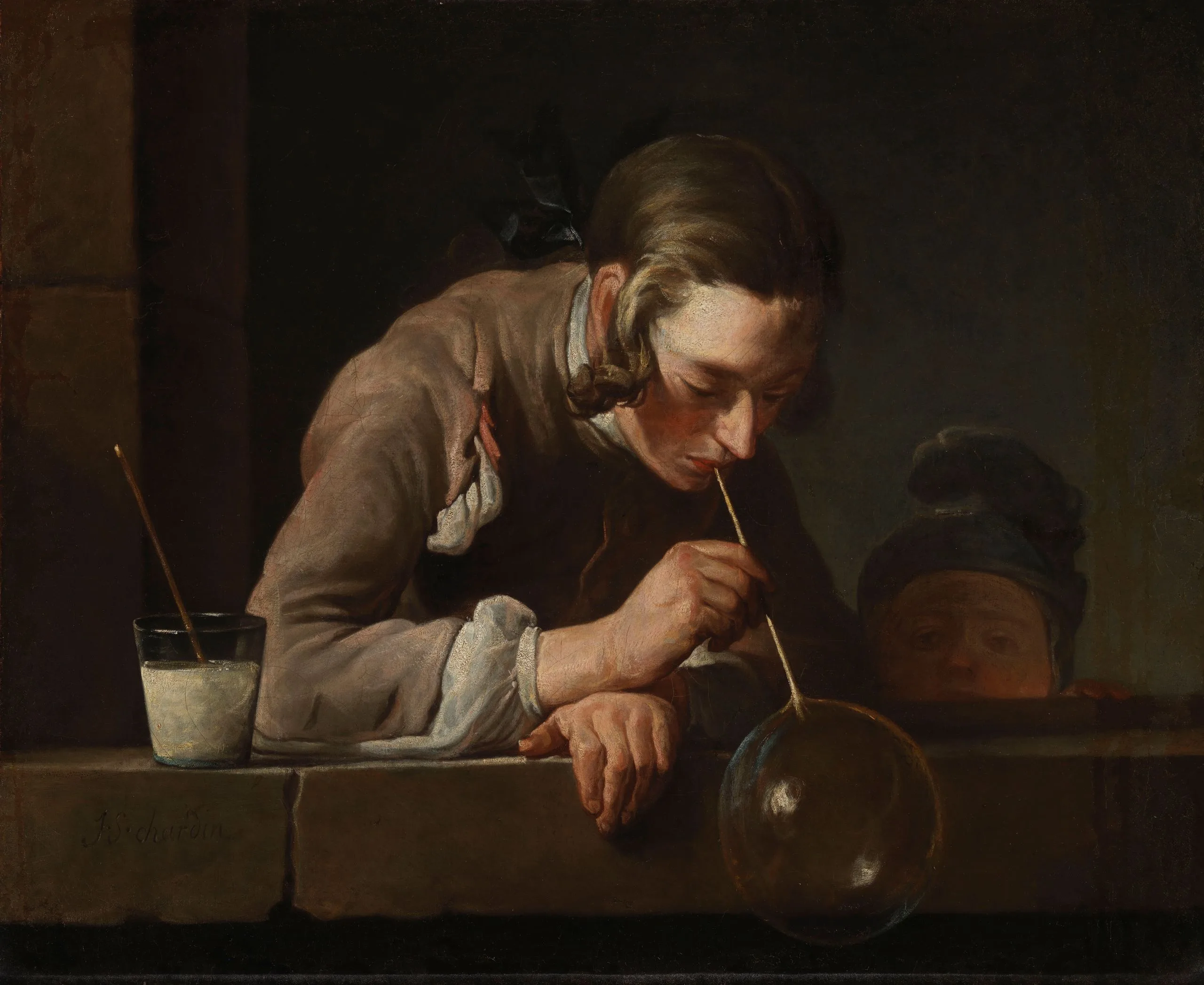
Soap Bubblesafter 1739

Not on view
Oil painting of a young man in profile leaning over a stone ledge, blowing a soap bubble through a straw, with a second figure watching from the shadows
Artist or Maker
Jean-Baptiste-Siméon Chardin
France, Paris, 1699-1779
Title
Soap Bubbles
Date Made
after 1739
Medium
Oil on canvas
Dimensions
Canvas: 23 5/8 × 28 3/4 in. (60.01 × 73.03 cm) Framed: 32 × 37 × 4 in. (81.28 × 93.98 × 10.16 cm)
Credit Line
Gift of The Ahmanson Foundation
Accession Number
M.79.251
Classification
Paintings
Collecting Area
European Painting and Sculpture
Curatorial Notes
Jean-Baptiste Siméon Chardin's work gained public attention just as a reaction to the elaborate style of rococo art was setting in. He was admitted to the French Royal Academy as a still-life painter in 1728, a rare honor, as still life was then considered far less valid than paintings of historical, mythological, or courtly subjects. Even though his work reflected the ordinary images, decorum, and morality of the bourgeois life from which he came, Chardin's talent was recognized in artistic and aristocratic circles.
Chardin began to paint genre subjects in the late 1730s, evoking through his observation of everyday life a contemplative atmosphere that in France had largely remained the domain of religious painting. In some ways his compositions heralded the values of the art of the Enlightenment, with its emphasis on rational content, naturalistic imagery, and qualities of truth and directness in subject matter.
Soap Bubbles is carefully composed in the simplest of geometries, with the window forming a rectangular space to frame the pyramidal grouping of the youth and the boy transfixed by the spherical bubble; these shapes are reinforced by the masonry, angles of the youth's arms, and the pair of heads. Chardin renders surfaces carefully but without distracting detail. A sense of timeless contemplation transforms the ephemeral pastime of the pair into a compelling allegory about the transitory nature of life. This is far from being a scene of carefree, youthful abandon.
Provenance

(Possibly Paris, Dulac Sale, 6 Apr. 1801). Possibly Thomas de Masclary (1755–1836), Montpellier, by descent to his daughter; Adèle d’Alichoux (1794–1818), by descent to her daughter; Julie d’Alichoux de Senegra (d. 1840), by inheritance to her widower; Alexandre Léonce Tapié de Celeyran (1807–1847), to his second wife; Louise d’Imbert du Bosc (1815–1905), by descent to; Adèle Zoe Tapié de Celeyran (1841–1930), married in 1863 to Alphonse Charles de Toulouse Lautrec. [Manzi, Joyant & Cie, Paris]. (Sale, Paris, Ader, Picard, and Tajan, Hôtel Drouot, 28 Feb. 1973, lot 90 [as copy]). [Claus Virch, Paris, sold 1979 to]; LACMA.

Selected Bibliography
  • Lehmbeck, Leah, editor. Gifts of European Art from The Ahmanson Foundation. Vol. 2, French Painting and Sculpture. Los Angeles: Los Angeles County Museum of Art, 2019.
  • Blondet, José Luis. Six Scripts for Not I: Throwing Voices (1500 BCE-2020 CE). Los Angeles: Los Angeles County Museum of Art, 2020.