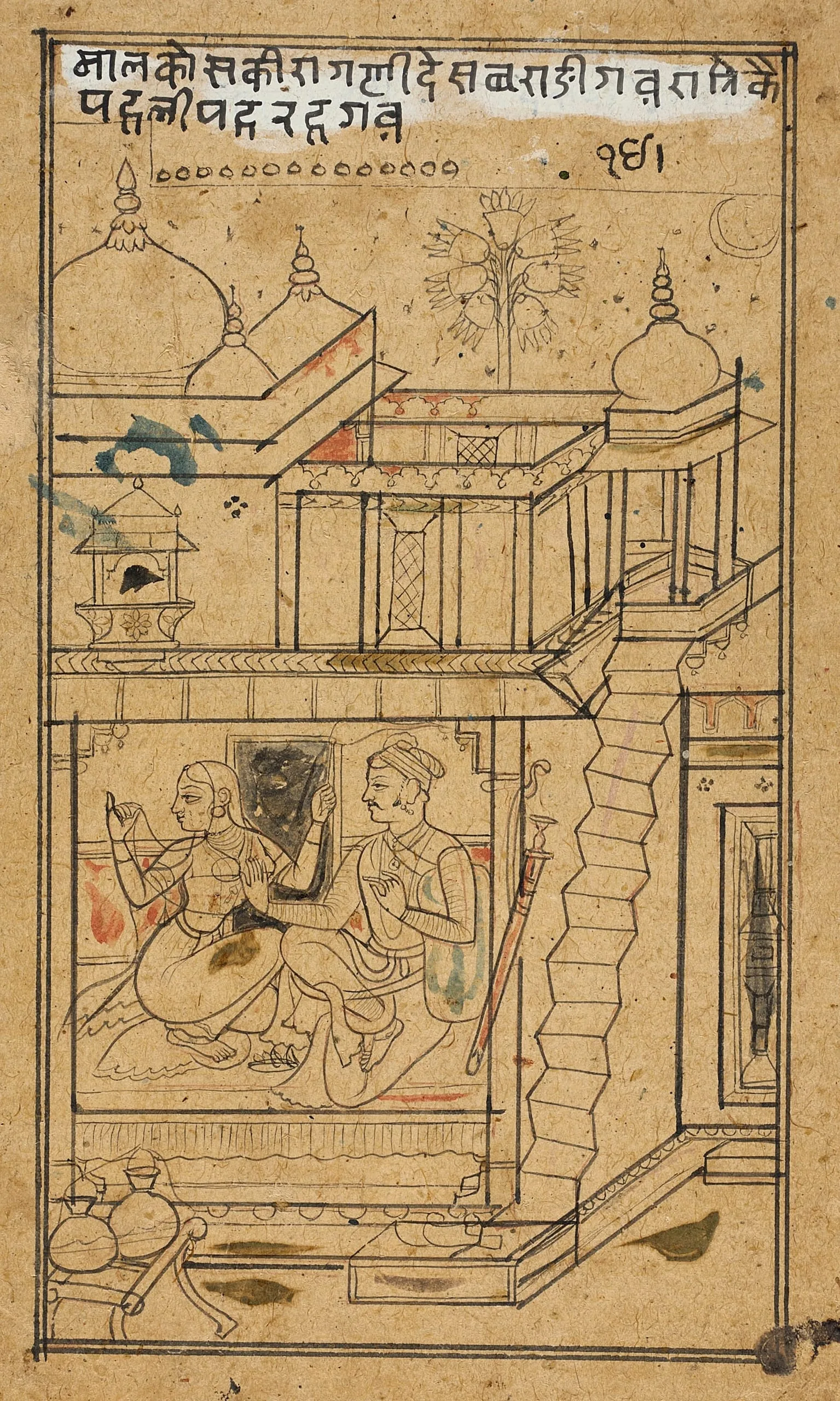
The Hindi inscription in the header identifies the melody as Desavarati [Desavaradi] Ragini, the [unnumbered] wife of Malkos Raga. (Translation by Stephen Markel.) Its set mate, Patamanjari Ragini (M.77.154.8), follows the Meshakarna’s system (developed by Meshakarna, a court priest from Rewa, Madhya Pradesh, in his Ragamala of 1570), but it does not include Desavarati Ragini in the standard listings. In the widespread Rajasthani system, Desavarati Ragini is the fifth wife of Dipak Raga. It is an early morning melody associated with Summer (May–June). Desavarati (alternatively spelled as Desavaradi, Desavari or Desvarati) Ragini is visually personified as a woman filled with longing and languor. She sits in silence on a bed with her arms raised overhead and her torso twisted. Here, she sits in a bedchamber with her arms upraised in her distinctive gesture and her head turned away from her lover who has just returned home. His sandals are on the stoop, and two water vessels are nearby on a stand.
Probable set mates include the Bilavala Ragini, Gaunda Ragini, and Dipaka Raga (Brooklyn Museum 79.260.8, 80.261.3, and 80.261.35 respectively), Lalit Ragini (San Diego Museum of Art, 1990.677), and Bhairava Raga (Victoria and Albert Museum, London (IS.23-1982). A Desavari Ragini with an identical composition, attributed to Bundi, early 18th century, is in the Metropolitan Museum of Art, New York (2008.359.1).