- Title
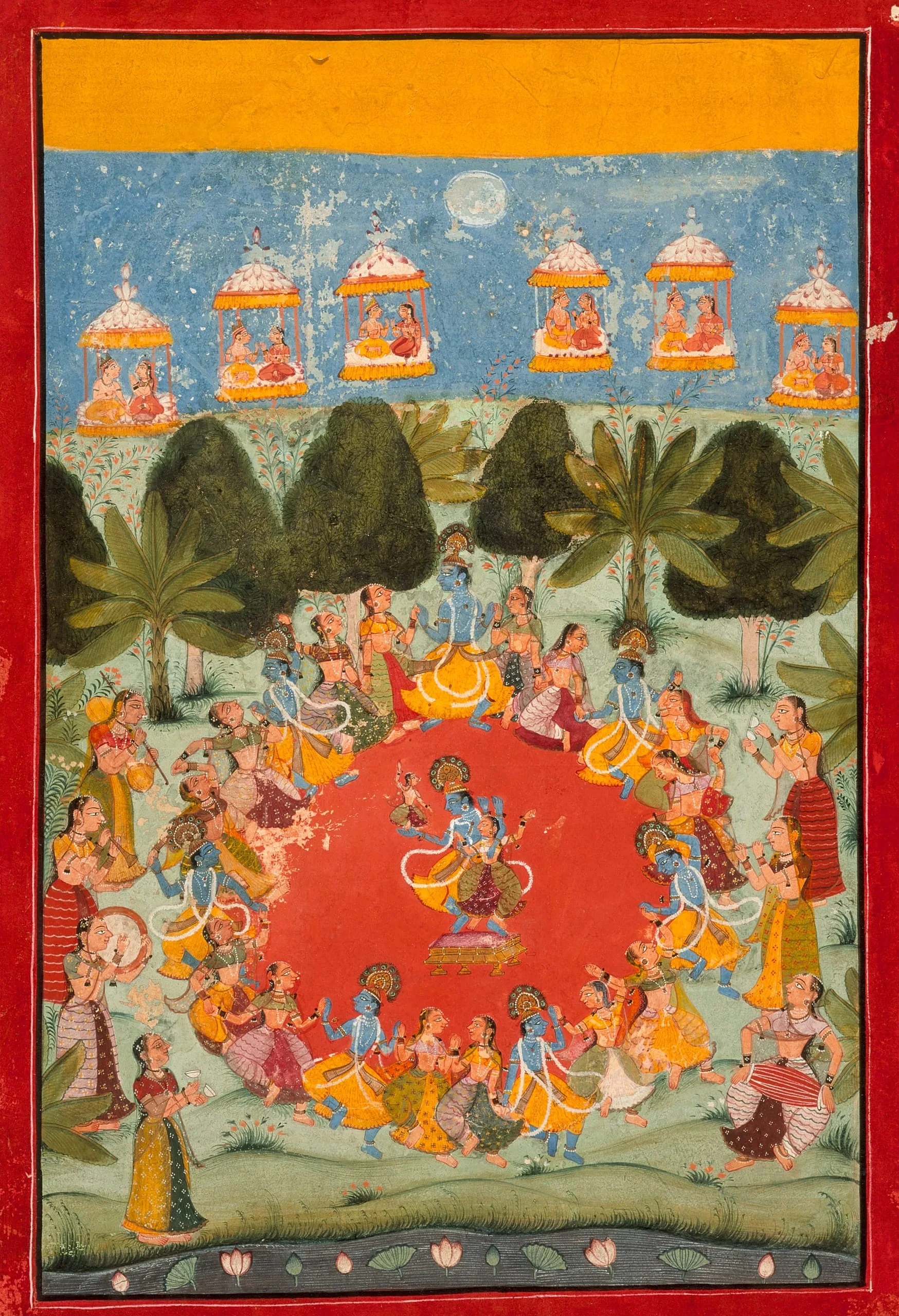
- Krishna's Dance of Delight (Rasa Lila)
- Date Made
- circa 1675-1700
- Medium
- Opaque watercolor and gold on paper
- Dimensions
- Image: 11 7/8 x 8 1/2 in. (30.16 x 21.59 cm); Sheet: 14 3/8 x 9 3/4 in. (36.51 x 24.76 cm)
- Accession Number
- M.75.66
- Curatorial Notes
According to religious belief, the Hindu god Krishna’s hypnotic fluting drew the milkmaids (gopis) of Vrindavan to the forest during the Indian month of Ashvin (September-October), where under the light of the full moon Krishna led the lovesick women in the dance of delight (rasa lila) on his final idyllic night in pastoral Braj before returning to the capital city of Mathura to overthrow the evil King Kamsa. During the divine dance Krishna manifested himself innumerably to be able to dance with each gopi individually and supernaturally caused the blissful night to last for an aeon. The rasa lila is a metaphor for the human soul's ecstatic spiritual love of Krishna.
Here, in the center of a circle that also represents the rasa mandala dance, the blue-skinned Krishna and his beloved Radha dance together on a low platform while Krishna also dances with each of the gopis in a circular chain configuration forming the penultimate circle of the mandala. In one of his four hands the central Krishna atypically holds a small dancing female. Two of his hands are in the position of playing his flute, which is absent in this painting. His fourth arm embraces Radha. The outer circle of the mandala is populated by female musicians performing for the dancers. Gods and goddesses in flying chariots (vimanas) celebrate the auspicious event.
- Selected Bibliography
- Larson, Gerald et al. In Her Image: The Great Goddess in Indian Asia and the Madonna in Christian Culture. Santa Barbara: UCSB Art Museum, University of California, 1980.
- McGill, Forrest, editor. Beyond Bollywood: 2000 Years of Dance in the Arts of South Asia, Southeast Asia, and the Himalayan Region. San Francisco, CA: Asian Art Museum, 2022.
- Meller, Susan. Labels of Empire: Textile Trademarks: Windows into India in the Time of the Raj. Novato, CA: Goff Books, 2023.