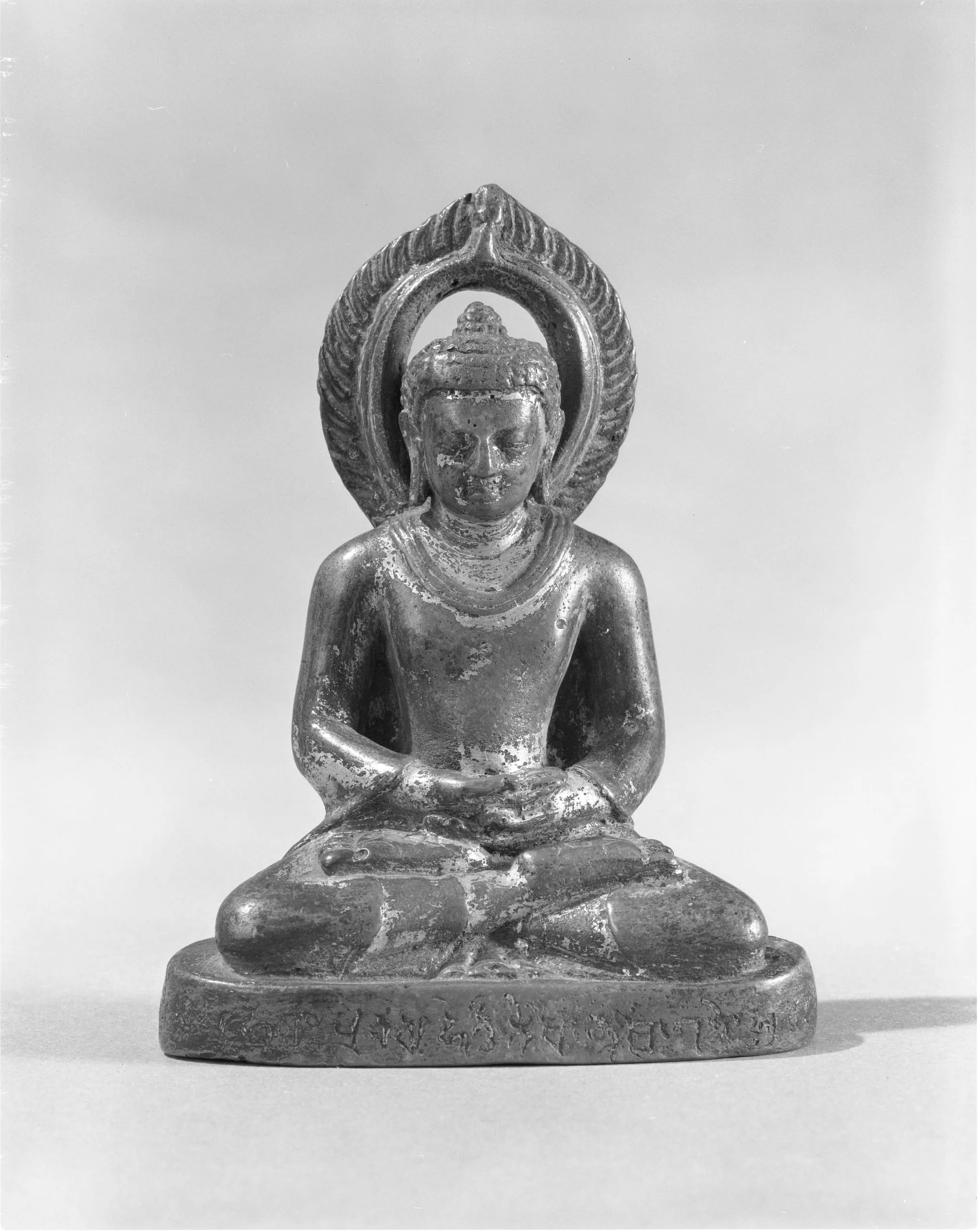
This introspective Buddha represents the historical Buddha Shakyamuni (traditionally dated to 563–483 BCE) or Amitabha, the Jina Buddha of Infinite Light. Amitabha is the transcendental Buddha of discriminating wisdom. He is also widely worshipped throughout Asia as the Buddha presiding over the Sukhavati (Pure Land of Bliss) Paradise in the West, where Buddhists can be reborn endlessly while they wait to attain enlightenment. There are Five Jina (Victor) Buddhas: Amitabha, Vairochana (Intensely Luminescent One), Akshobhya (Unshakeable One), Ratnasambhava (Jewel Born), and Amoghasiddhi (Unfailing Success). These five Buddhas, who are emanations of the Adi Buddha (Primordial Enlightened One), embody the state and qualities of Buddhahood and the essence of the Buddhist Dharma. Each Buddha has a specific mudra, insight, symbol, color, vehicle, and rules a cardinal direction or the zenith.
Both Shakyamuni and Amitabha hold their hands in their lap in the gesture of meditation (dhyana mudra) and both sit with their feet being crossed in the meditation posture (padma asana) on an inscribed plain base. They share the standard iconographic conventions of a Buddha: a cranial protuberance (ushnisha) emblematic of his omniscience, snail-curl hair and elongated earlobes symbolizing his renunciation of his princely life and the material world, and a monk’s robe (sanghati) worn over both shoulders. His forehead is now eroded, so it is unclear if there was originally a circular sacred marking (urna). The Buddha also has three rings (or folds) on his neck (trivali) that are among the beauty marks (lakshana) of a great being and symbolize the Three Trainings in Buddhism: Conduct (Shila), Concentration (Samadhi), and Wisdom (Prajña). He has a flaming nimbus (prabhamandala) symbolic of his divinity and advanced knowledge.
The devanagari inscription around the base is the Buddhist creed: The Buddha has explained the cause of all things that arise from a cause. He, the great monk, has also explained their cessation.