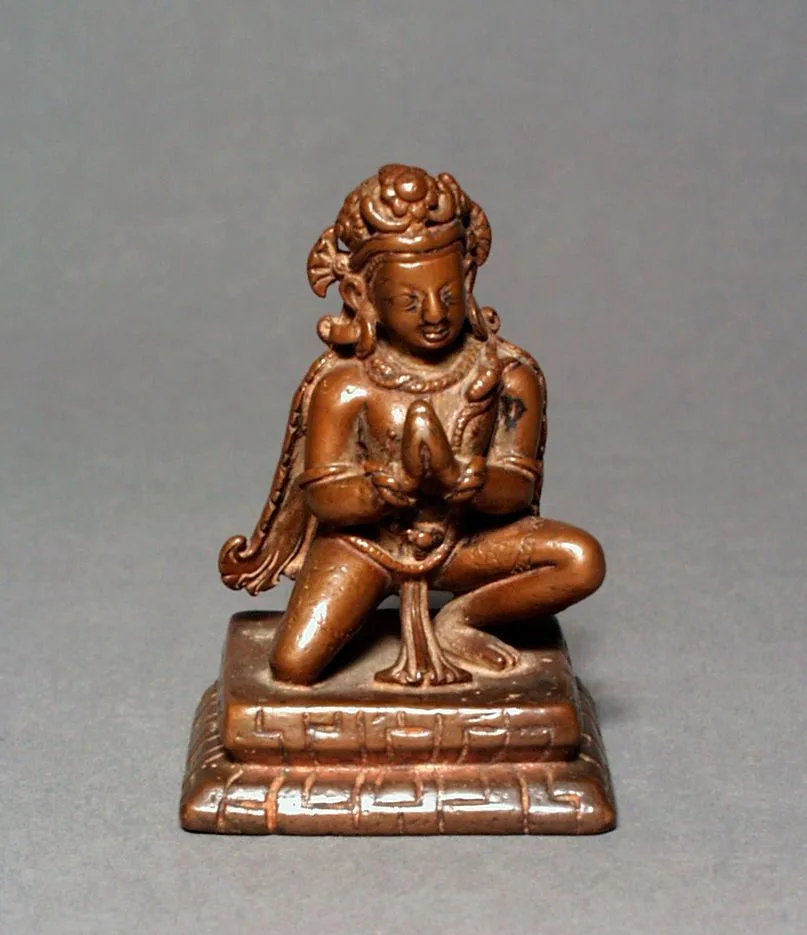
The sunbird Garuda is the half-avian, half-human mount (vahana) of Vishnu, the Hindu God of Preservation. He is particularly popular in Nepal, where he is often shown in a therianthropic guise with a human body and face with bird wings. Nepalese representations generally portray Garuda in at least four principal iconographic modes. The first mode, as represented here, emphasizes his role as a supreme devotee of Vishnu. It depicts him with his hands clasped together in the gesture of adoration (anjali mudra) and kneeling in his idiosyncratic posture of genuflection (Garuda asana). Numerous images exist in Nepal of Garuda kneeling in veneration of Vishnu or earthly rulers who identified themselves with Vishnu and his avatars to proclaim their right to rule, including at the renowned 5th-century Changu Narayan temple in Bhaktapur. This kneeling pose is also used for Garuda when he appears as the finial of pillars (stambhas), such as the Garuda Stambha at Harigaon, Kathmandu dated by inscription to 608 CE. A second iconographic mode reflects his role as Vishnu’s mount and depicts him conveying Vishnu as he travels throughout the universe preserving it (see M.73.4.10 and M.86.247.2). In a third iconographic mode, Garuda is standing with his hands in the gesture of adoration and flanking Vishnu with Shri Lakshmi (see M.87.277.2). A fourth iconographic mode has tantric influence and features Garuda with a bird’s head, multiarmed, and squatting (see AC1999.237.3).
Garuda kneels on a rocky pedestal on his right knee and left foot as if ready to fly into action. He is elaborately crowned, has long hair, and wears a flowered dhoti and serpent necklace (sarpa-hara). He has plain armlets rather than his more customary serpent armlets (sarpa-keyura). Across his left shoulder and continuing down to his waist is a serpent sacred thread (naga-yajñopavita). Garuda is the sworn enemy of serpents (nagas) due to a family feud between Kadru (the mother of serpents) and Vinata (the mother of Garuda), who were both married to the sage Kashyapa. After defeating the serpents in battle, Garuda wears serpents as ornaments to indicate his dominance over them.