- Title
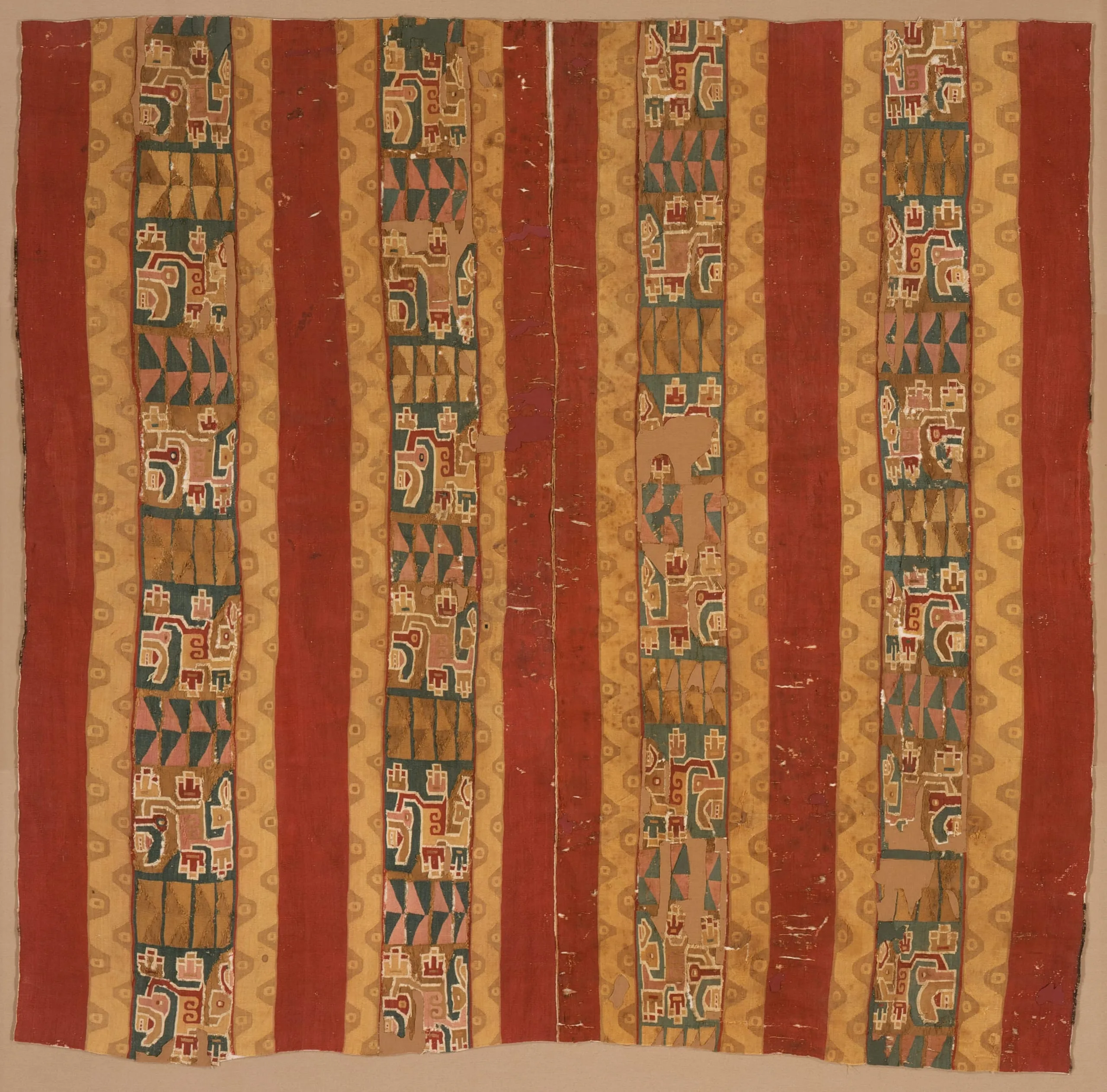
- One Half of Man's Tunic
- Date Made
- 600-900
- Medium
- Camelid fiber and cotton interlocked tapestry weave
- Dimensions
- 47 x 46 in. (119.38 x 116.84 cm)
- Accession Number
- M.75.50.11
- Curatorial Notes
Crop fertility was critically important to the inhabitants of Peru’s coastline, which outside of the river valleys was primarily a desert. The droppings of seabirds (such as cormorants and pelicans) were used for fertilizer, and reverence for birds was manifested in the proliferation of avian imagery on textiles. Birds may also have been associated with the celestial flights of shamans, who, in their capacity as intermediaries between the community and the supernatural, flew in a state of trance to the world of spirits and ancestors.
Here, each block of birds in the pattern bands has been abstracted through the technique of compression. The birds’ beaks face in opposite directions, and they share a common rectangular body identified by a double curlicue. The T-shaped forms represent bird “toes” and fanlike tail feathers, as seen in representations of the winged Standard Bearer.
Nicole LaBouff via Kaye Spilker
2009