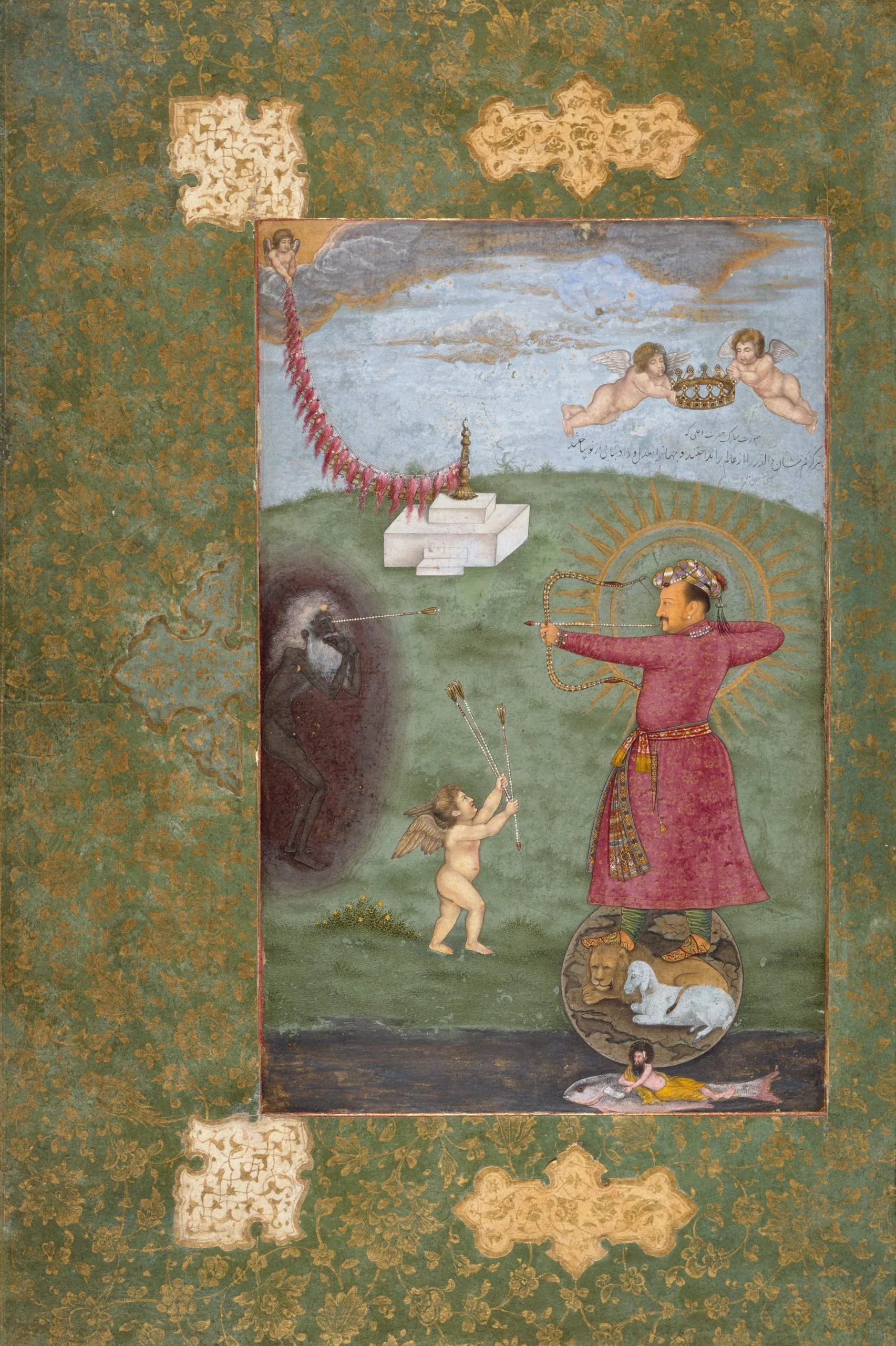
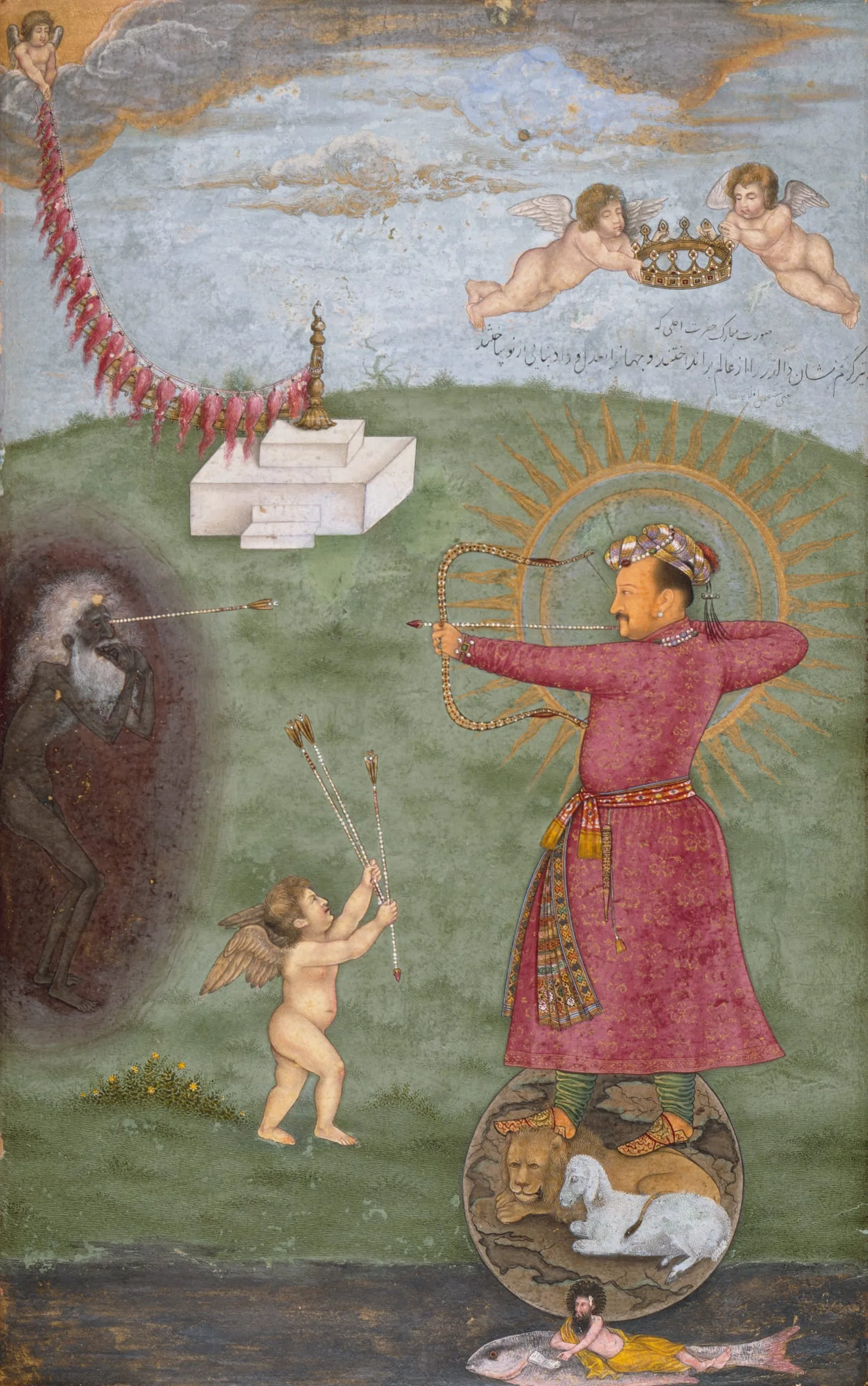
During his later years, characterized by political turbulence, regional famine, and his protracted poor health, the Mughal Emperor Jahangir (r. 1605–1627) was inspired by a self-exalting dream to commission a series of allegorical portraits that extol his righteousness and imperial supremacy (for example, see Jahangir Shoots the Head of Malik Ambar, c. 1616-1620, Chester Beatty Library, Dublin, In 07A.15). Here, an inscription explains Jahangir’s act of shooting arrows at an emaciated old man embodying indigence: “An auspicious portrait of his exalted majesty, who by the arrow of generosity eradicated the trace of Daliddar—the very personification of poverty—from the world and laid the foundation of a new world with his justice and munificence.” (Translation by Z. A. Desai.)
Jahangir stands upon a globe inset with a dominant lion, symbolizing the Mughal Empire, that lies peacefully alongside a smaller lamb, representing the Iranian Safavid Dynasty under Shah Abbas I (r. 1588-1629). The globe functions pictorially as a nimbus for a sage, who has been interpreted as Manu, the Hindu lawgiver, who reclines on the cosmic fish that Islamic and Indian cosmologies imagine as supporting the world.
The chain stretching from heaven to earth represents God’s justice manifested in Jahangir, an allusion to the “chain of justice” hanging from a window in the imperial palace. Any subject who felt that he had been denied justice in a regular court could pull the chain to appeal to the emperor.