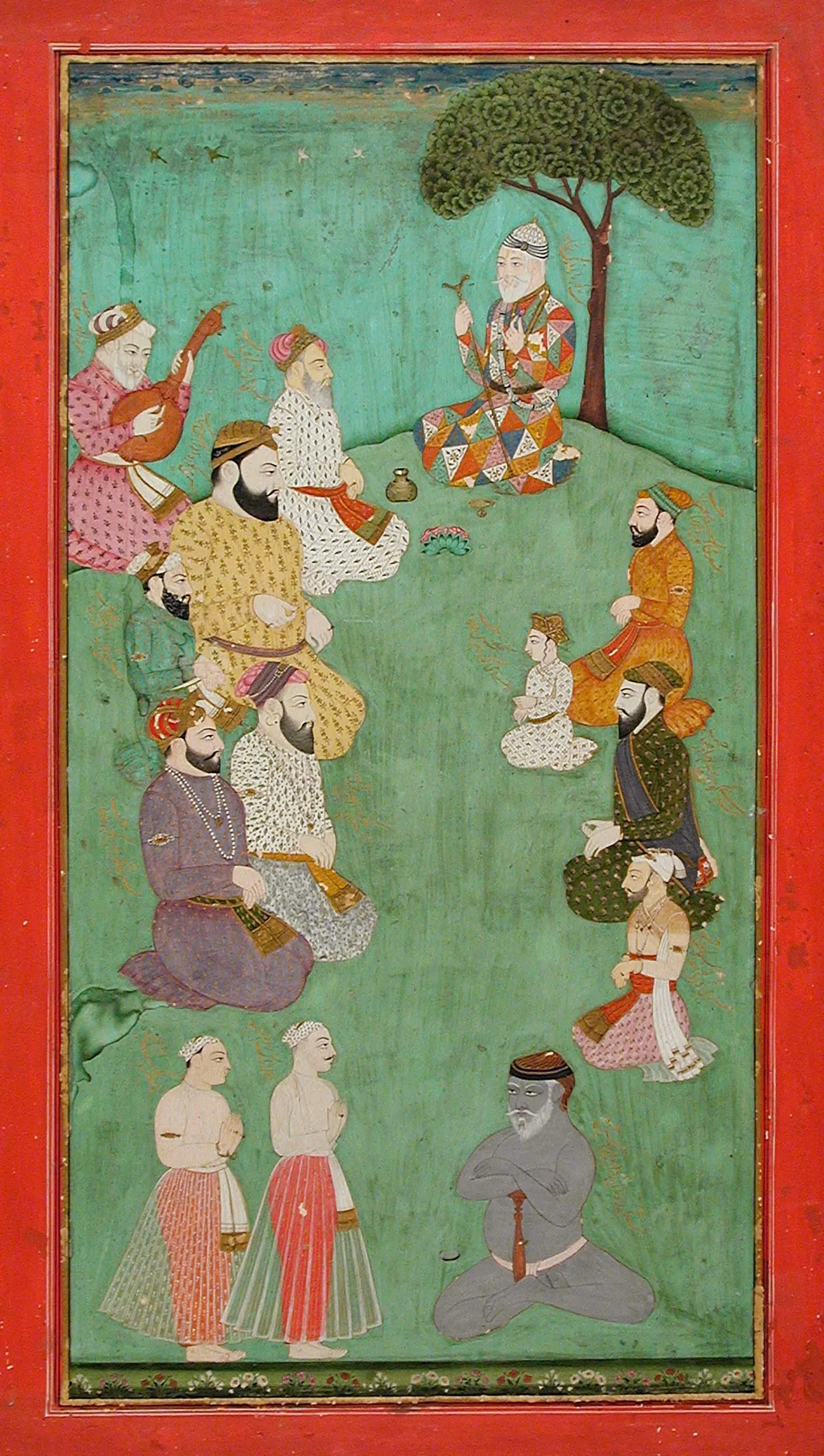
This painting depicts the ten Gurus of Sikhism, each of whom is identified by an inscription in gold. Guru Nanak (1469-1539), the founder of Sikhism and the first Sikh Guru, is seated under the regal tree. He wears a mukat (cap shaped crown) and a jacket of patchwork quilt. He holds an ascetic’s crutch and a flower (?). Mardana (1459-1534), Guru Nanak’s longtime Muslim disciple and companion, is playing a rubab (lute-like instrument). The nine other Sikh Gurus are seated in two columns. They are identified from top-to-bottom as follows: left column: Angad (1504-1552), Amar Das (1479-1574), Ram Das (1534-1581), Arjan (1563-1606), and Hargobind (1595-1644); right column: Har Rai (1630-1661), Har Krishan (1656-1664), Tegh Bahadur (1621-1675), and Gobind Singh (1666-1708). At the bottom Lala Nanak Ram and his son Rai Lakhpat Ram stand reverentially before the Udasi saint, Satguru Pritam Das Chandra (1752-1831). Numerous painted and printed group images of the ten Sikh Gurus and the Janam Sakhi (Life Stories of Guru Nanak) series were produced in the 18th and 19th centuries, particularly in the Panjab and Kashmir. The ten Gurus are represented here in conventionalized portraits, mainly without the accompanying attributes some often have in later 19th-century renditions. The painting is rendered in a descendant Mughal-style featuring a plain green background with a narrow band of sky at the top and a floral border along the bottom.