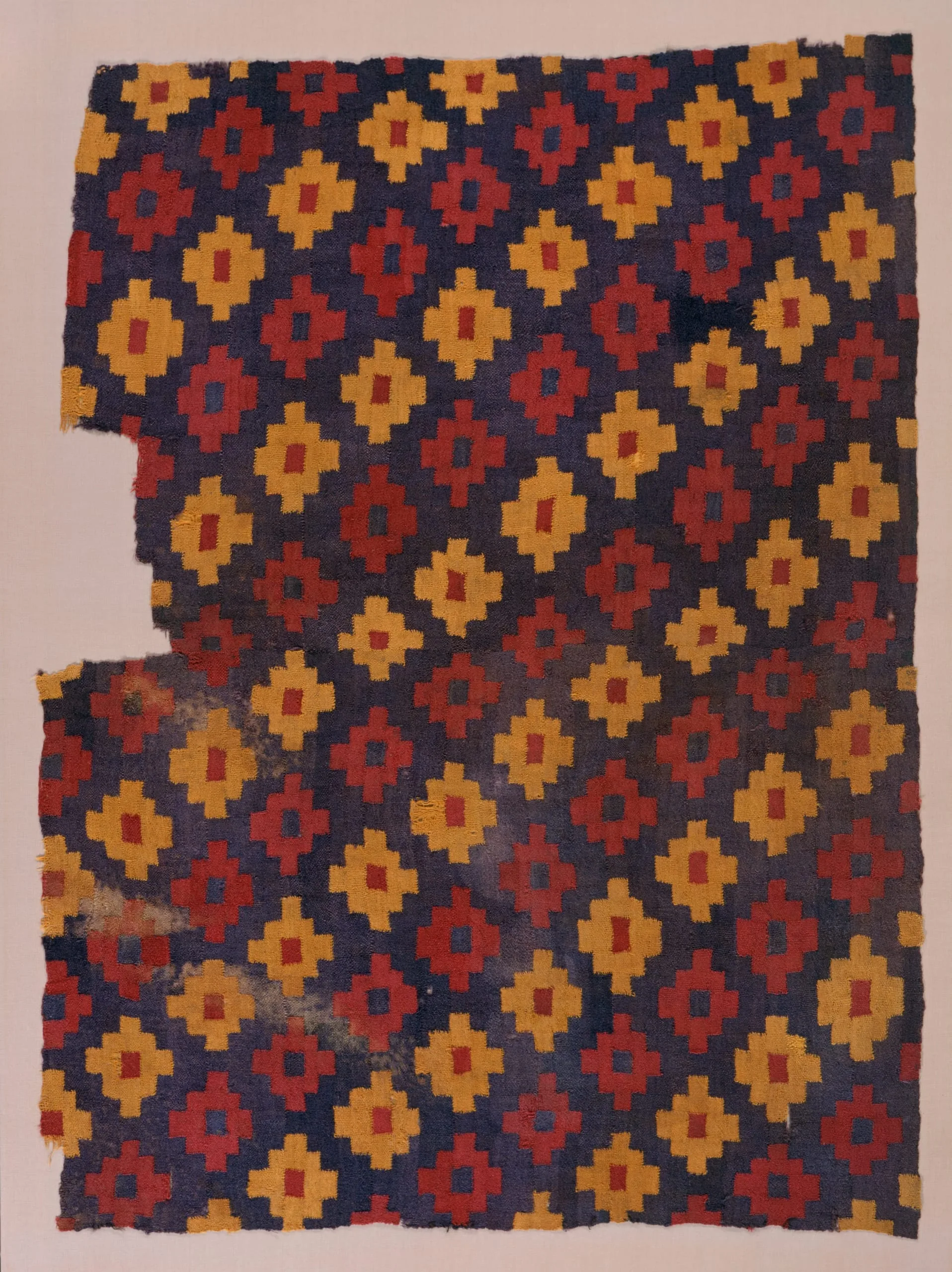
This extraordinarily colorful and finely woven textile is a fragment of an earlier, possibly much larger piece. The people who made it in the first half of the first millennium CE were inheritors of an even older tradition of highly sophisticated weaving and dyeing practices, which started with the Paracas culture in the final centuries BCE (see, e.g., 67.4). The textile is made from the wool of alpacas or llamas, which were domesticated in Peru as long as 6,000−7,000 years ago and were crucial to Andean peoples as pack animals as well as sources of wool and meat.
The motif patterning this textile is called a chakana or Andean cross, which appears on a wide range of artworks over a period of some 4,000 years, making it one of the most ubiquitous, if least understood, elements of ancient Andean iconography. Its symmetrical shape, with four sides, three steps on each, and (often) a circle at the center, suggests a relationship to the physical structure of the Andean cosmos: a horizontal plane of four cardinal directions plus a center, and three vertical levels: underworld, earth, and sky. Each of the vertical levels is conceptually related to a specific animal—respectively serpent, feline (jaguar/puma), and condor—demonstrating the animated nature in which Andean people conceived of their cosmos.
In recent times, many other meanings have been attributed to the chakana, including an association with the number pi and the Southern Cross constellation. However, most scholars consider these latest interpretations highly dubious.
2025