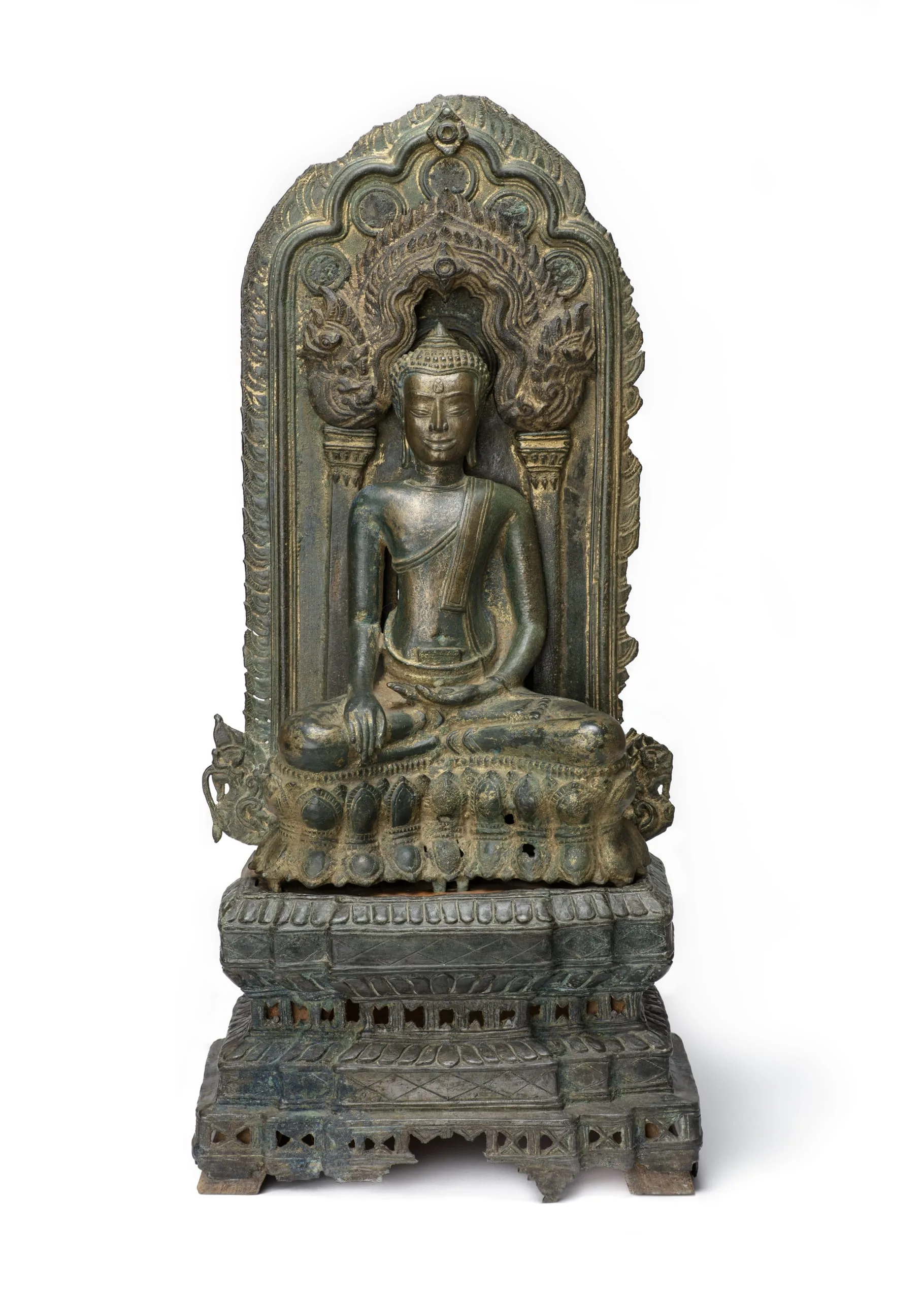
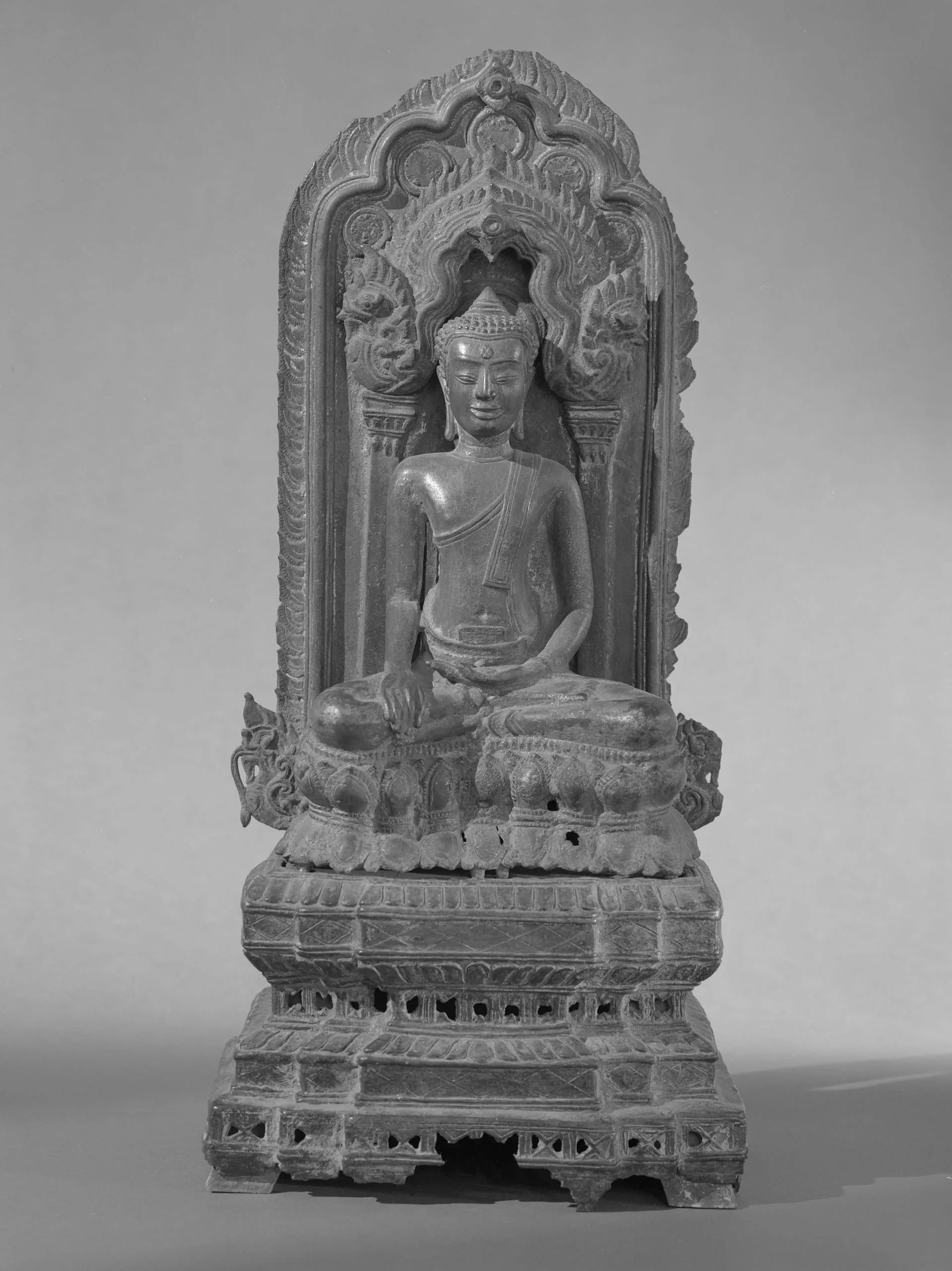
The historical Buddha Shakyamuni, traditionally dated to 563–483 BCE, is depicted in this 13th-century bronze image made in the artistic style associated with Lopburi, the Cambodian (Khmer) provincial capital during the 11th-13th centuries located in present-day central Thailand.
The Buddha sits on a lotus base atop a multitiered throne. His right hand is extended in the gesture of calling upon the earth to witness his right to achieve Enlightenment after his many lifetimes (bhumisparsha mudra). The Buddha is seated under an architectural frame with pilasters supporting an arch made of two ornate serpents. The frame is likely a reference to the Mahabodhi Temple at Bodhgaya, which was erected at the site of the Buddha’s Enlightenment. Behind the Buddha and frame is an aureole (prabhavali) with a flaming border. Typically, there is a stylized tree at the top of the aureole portraying the bodhi tree under which the Buddha achieved Enlightenment. The tree is now missing, but there are lugs on the back of the bronze where it was originally attached.
The five symmetrically placed circular medallions above the serpent arch likely represent the throat jewels of the multiheaded cobra, the serpent-king Muchalinda, which spread his hood over the Buddha for seven days to protect him during a fierce storm that threatened to interrupt the Buddha’s meditation beneath a tree after his Enlightenment at Bodhgaya. In such representations, the Buddha’s hands are held in the gesture of meditation (dhyana mudra) rather than the gesture of calling upon the earth as witness (see M.71.54, M.81.276.5, and AC1998.62.1). Thus, the visual reference to Muchalinda’s multiple heads suggest that this is a syncretic image combining the two popular Buddhist themes of the period. (Brown 1985, pp. 116-117, fig. 81)