LACMA

ShopMembershipMyLACMATickets
LACMA
Los Angeles County Museum of Art
5905 Wilshire Blvd.
Los Angeles, CA 90036
info@lacma.org
(323) 857-6000
Sign up to receive emails
Subscribe
© Museum Associates 2025

Museum Hours

Monday

11 am–6 pm

Tuesday

11 am–6 pm

Wednesday

Closed

Thursday

11 am–6 pm

Friday

11 am–8 pm

Saturday

10 am–7 pm

Sunday

10 am–7 pm


  • About LACMA
  • Jobs
  • Building LACMA
  • Host An Event
  • Unframed
  • Press
  • FAQs
  • Log in to MyLACMA
  • Privacy Policy
© Museum Associates 2025
Collections

Unknown
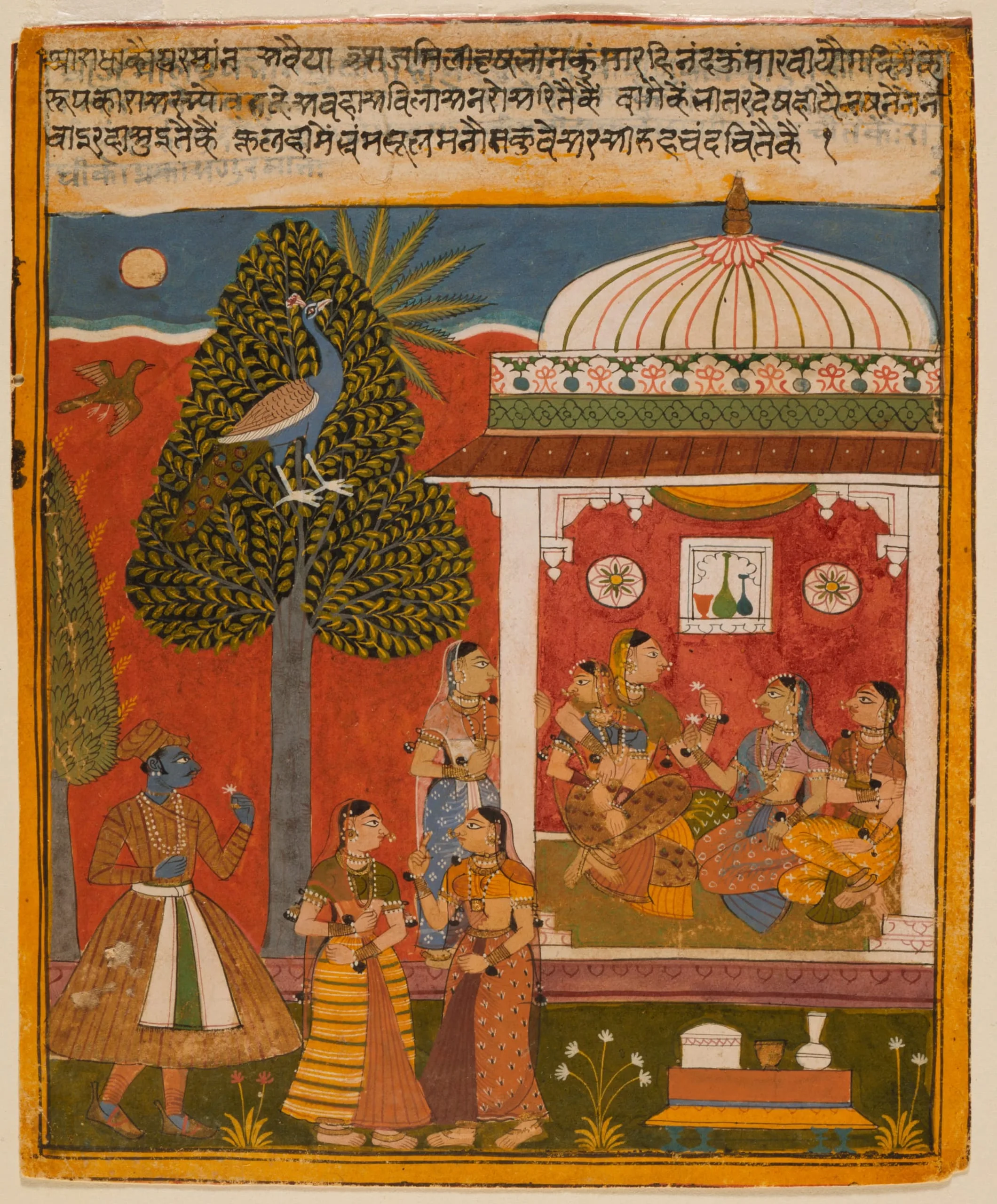
Radhika's Manifest Agitation (Prakasha Udvega), Folio from a Rasikapriya (Connoisseur's Delights)circa 1655-1660

Not on view
Indian manuscript painting, blue-skinned male figure stands before women near a peacock in a tree, with a pavilion and terrace scene to the right, Devanagari text above
Artist or Maker
Unknown
Title
Radhika's Manifest Agitation (Prakasha Udvega), Folio from a Rasikapriya (Connoisseur's Delights)
Place Made
India, Rajasthan, Mewar
Date Made
circa 1655-1660
Medium
Opaque watercolor, gold, and ink on paper
Dimensions
Image: 7 3/4 x 7 in. (19.68 x 17.78 cm); Sheet: 9 1/4 x 7 1/2 in. (23.49 x 19.05 cm)
Credit Line
From the Nasli and Alice Heeramaneck Collection, Museum Associates Purchase
Accession Number
M.74.5.12
Classification
Drawings
Collecting Area
South and Southeast Asian Art
Curatorial Notes

The Rasikapriya (Connoisseur’s Delights) was composed in 1591 in Braj-Bhasa by the poet Keshavdas (1555–1617). He was the court poet of Kunwar Indrajit Singh and Raja Bir Singh Deo of Orchha (r. 1605-1627). The text portrays Radha and Krishna as ideal lovers and enumerates the eight archetypal male and female lovers (nayakas/nayikas) and their corresponding emotions and encounters.

This folio illustrates the hidden great arrogance of the nayika (Prachanna Guruman) (Rasikapriya 9:304):
The son of Nanda [Krishna] did meet today,
Radha, his days of parting past;
Her sullenness he drove away
With laughter, and with joy at last,
As love to her he made: when lo!
Beneath his doublet she did espy
Nail-marks upon his chest, and so,
Dumbfounded did remain her eyes!
(Translation by K. P. Bahadur.)

This dispersed Rasikapriya attributed to circa 1655-1660 is from the workshop of Manohar (active circa 1650). See Andrew Topsfield, Court Painting at Udaipur (Zürich: Museum Rietberg, 2001), pp. 90, 103, n. 35. The original inscriptions in the headers have been distinctively overwritten. Additional folios are in the Kanoria Collection, Patna (GKK 161), National Museum of Scotland, Edinburgh (A.1961.393), San Diego Museum of Art (1990.606), Victoria and Albert Museum, London (IS.45-1961), and Bharat Kala Bhavan, Varanasi.

For an alternate translation by V. P. Mishra, see Harsha V. Dehejia, Rasikapriya: Ritikavya of Keshavdas in Ateleirs of Love (New Delhi: D.K. Printworld, 2013), pp. 92, 260, verse and fig. 9.4.
Selected Bibliography
  • Rosenfield, John. The Arts of India and Nepal: The Nasli and Alice Heeramaneck Collection. Boston: Museum of Fine Arts, Boston, 1966.