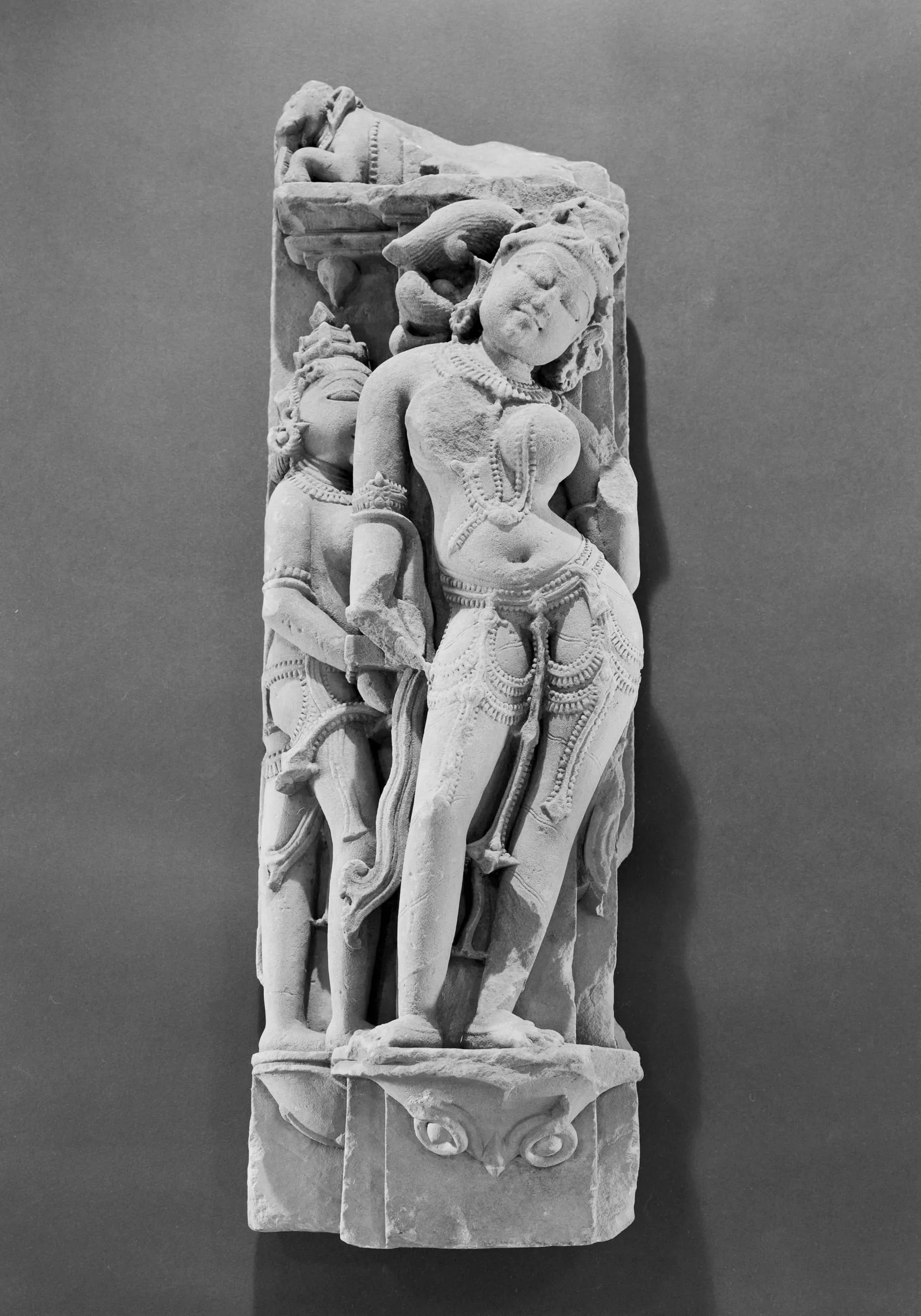
The imagery of a beautiful woman has long captivated Indian artists. Representations range from elegant tree dryads enlivening the sculpted gateways of Sanchi stupas in circa 50 BCE-50 CE (see M.85.2.1) to 18th-century paintings of an eager heroine on her way to meet her lover for an illicit tryst (kama abhisarika nayika) as described in the Rasikapriya (Connoisseur’s Delights) composed in 1591 by the Braj-Bhasa poet Keshavdas (see M.71.49.6). Voluptuous forms and supple body postures, enhanced by romantic or risqué passions, ensured the continuing artistic appeal of sensuous nymphs and impassioned damsels. They can be identified by various Sanskrit names: apsaras (celestial nymph), surasundari (heavenly beauty), or alasakanya (indolent woman).
These richly ornamented celestial nymphs were likely originally positioned on a subsidiary offset on a temple’s exterior wall or on the sanctum’s exterior wall. The principal nymph has an elegant coiffure and wears a bejeweled tiara, ear ornaments, multiple pearl and bead necklaces, and an ornate hip belt (katibandha). She stands suggestively in an exaggerated contrapposto pose known as the Triple-bend Posture (tribhanga sthanaka). Her head and shoulders lean sharply downward to her left, her hips are thrust acutely upwardly to the left, and her uneven legs are extended beneath her in the opposite direction to her right. The posture conveys dynamic movement, an inner vitality, and a sense of her own allure. Her smaller companion is similarly adorned but is turned inward to her side and partially hidden by the primary nymph. The semidivine ladies stand on lotus leaf pedestals. Above them, a bust of a kneeling elephant facing the side graces the capital top. It was likely originally surmounted by a now-lost rearing leogryph (shardula) as an apotropaic pairing analogous to those found on thronebacks (see M.2001.1).
See Kanwar Lal, Apsaras of Khajuraho (Delhi: Asia Press, 1966); and Darielle Mason, "A Sense of Time and Place: Style and Architectural Disposition of Images on the North Indian Temple," in Gods, Guardians, and Lovers: Temple Sculptures from North India A.D. 700–1200, eds. Vishakha N. Desai and Darielle Mason (New York: Asia Society Galleries in association with Ahmedabad: Mapin Publishing, 1993), pp. 116–137.