- Title
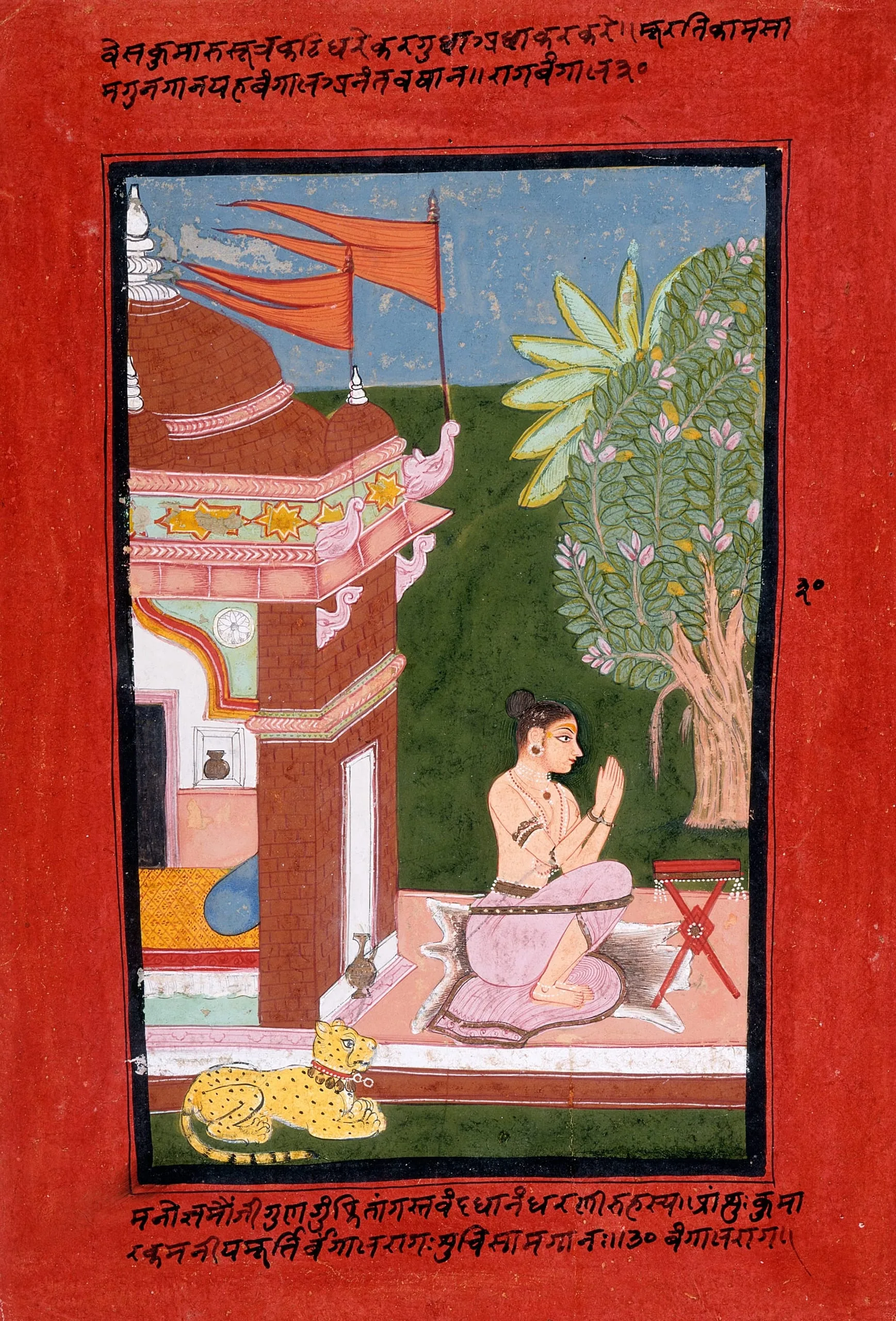
- Bangala Raga, Fifth Wife of Megha Raga, Folio from a Ragamala (Garland of Melodies)
- Date Made
- circa 1700
- Medium
- Opaque watercolor, gold, and ink on paper
- Dimensions
- Image: 8 1/8 x 5 1/8 in. (20.64 x 13.02 cm); Sheet: 11 1/8 x 7 7/8 in. (28.26 x 20.0 cm)
- Accession Number
- M.73.88.2
- Curatorial Notes
Although the Sanskrit couplets by the poet Kashyapa on the obverse and the devanagari inscription on the reverse identify the melody represented as “Bangala Raga,” it is characterized as a feminine melody (ragini) in the predominant ragamala (garland of melodies) classification system generally known as the Rajasthani system where it is regarded as the fifth wife of Megha Raga. This is corroborated by the folio being inscribed as number thirty in the series, which corresponds to Bangala Ragini’s sequence in the Rajasthani system followed in Bundi ragamalas. Moreover, Bangala Raga is not one of the six Ragas found in any of the ragamala classification systems. Nevertheless, as with the case with Nata Ragini (see M.83.105.15 and M.84.222.2), the melody is variously personified in painting and poetry as either a raga or a ragini depending on the geocultural tradition being followed. It is a restrained melody associated with the afternoon and Autumn (September–November).
With slight variations, both inscribed couplets describe the melody as a handsome youthful ascetic wearing a sacred thread made of munja grass and singing pure Sama songs (Vedic hymns). Here, the melody is envisioned as a young female ascetic sitting on a terrace in front of a pavilion with a bedchamber. She is reading a devotional text on a bookstand and is accompanied by a tame leopard wearing a collar. The blue sky indicates it is a daytime melody.
- Selected Bibliography
- Pal, Pratapaditya. The Sacred and Secular in Indian Art. Santa Barbara, CA: University of California, 1974.